| name |
Zhuliangomyces subillinitus |
| author |
Redhead. 2019. Nomenclatural novelties. Index Fungorum. 385:1-1.
≡Guzmán in Guzmán & P. D. Johnson. 1974. Bol. Soc. Mex. Micol. 8: 89, figs. 28-29, 82. |
| name status |
nomen acceptum |
| english name |
double click in markup mode to edit. |
| MycoBank nos. |
316923, 555490 |
| GenBank nos. |
Due to delays in data processing at GenBank, some accession numbers may lead to unreleased (pending) pages.
These pages will eventually be made live, so try again later.
|
| intro |
The following text may make multiple use of each data field.
The field may contain magenta text presenting data from a type study
and/or revision of other original material cited in the protolog of the present taxon.
Macroscopic descriptions in magenta are a combination of data from the protolog and
additional observations made on the exiccata during revision of the cited original
material.
The same field may also contain black text, which is data from a revision of the present
taxon (including non-type material and/or material not cited in the protolog).
Paragraphs of black text will be labeled if further subdivision of
this text is appropriate.
Olive text indicates a specimen that has not been
thoroughly examined (for example, for microscopic details) and marks other places in the text
where data is missing or uncertain.
The following material is derived from the protolog and from original research of R. E. Tulloss and J. Geml.
Macroscopic description from collector’s notes. Microscopic description by RET. |
| pileus |
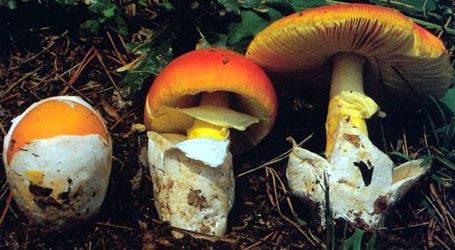
protolog: 15 - 55 mm wide, white to yellowish, with disc yellowish brown when dry, convex, slightly subumbonate, almost flat, glabrous, smooth, viscid or glutinous; context white; margin profusely striate; universal veil with color of gluten not recorded.
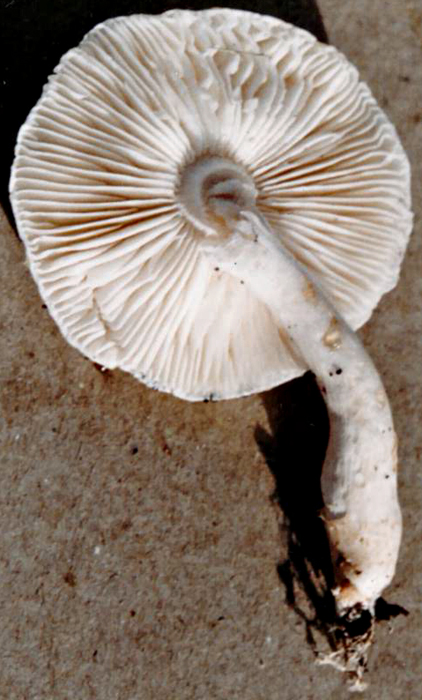
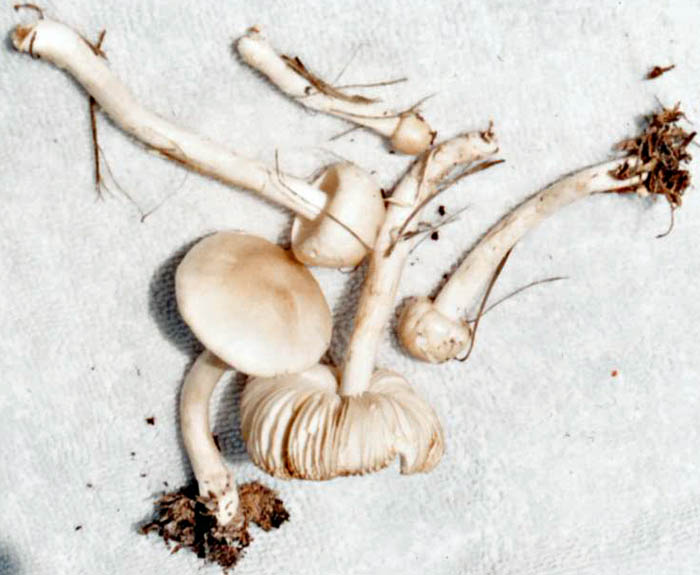
20–40 mm wide, white, with pale tan over disc, hemispheric, becoming planar and broadly umbonate; context ??; margin smooth at first, becoming striate (up to 3 mm); universal veil as colorless gluten pile. |
| lamellae |
from protolog: free, ??, white, yellowish when dry, anastomosing.
adnexed, close, white; lamellulae attenuate, of several lengths. |
| stipe |
protolog: 45 - 65 × 4 - 6 mm,
uniform, white, pale yellowish (especially
toward base) when dry, viscid; context white; universal veil with gluten probably colorless.
45–65 × 3–5 mm, color??,
cylindric, sinuate, enlarged at base, very viscid;
bulb ??;
context solid (distinct central cylinder
filled with sordid tissue in exsiccata),
white; partial veil as superior glutinous
collar, hardly evident; universal veil as
gluten layer covering stipe below last point of
contact between stipe and pileus (i.e., "glutinous
collar," see above). |
| odor/taste |
protolog: Odor agreeable. Taste not recorded.
Odor mild. Taste not recorded. |
macrochemical
tests |
none recorded. |
| pileipellis |
absent. |
| lamella trama |
bilaterial; wcs = ?? µm; central stratum comprising interwoven filamentous undifferentiated hyphae 2.0–4.0 µm wide, ??. |
| basidia |
26–32 × 6.5–7.5 µm, 4- and (occasionally) 2-sterigmate, with sterigmata up to 3.5 × 1.4 µm, arising from ??; clamps common to plentiful. |
| gluten layer |
protolog: [gluten supporting?] hyphae 2.8 - 4.9 μm wide, thin-walled; clamps present.
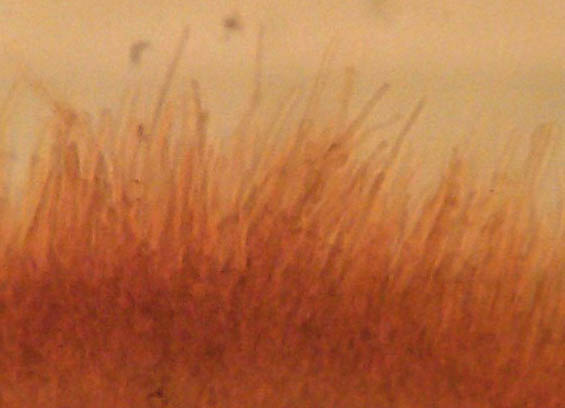
On pileus: filamentous undifferentiated hyphae within gluten pile 1.4–3.8 µm wide, occasionally branching, with occasional narrowly clavate nonterminal segments; terminal cells of such hyphae 34–80 × 2.1–3.7 µm, with length/max.-width ratio = (9.7–) 11.3–25, with basal septa 0.8–2.5 (–3.0) µm wide, often curved, without obvious common orientation, not organized in fascicles, slanting upward, cylindric to narrowly clavate (and then only expanded very close to apex), with apex rounded, sometimes pale yellow, gelatinizing with aging of basidiome; clamps common. On stipe: filamentous undifferentiated hyphae frequent, but not crowded, arising from ??, branching rather sparsely, with segments and terminal cells much shorter than on pileus, eventually drooping (taking form suggesting epiphytic lycopods) and gelatinizing. |
| stipe context |
longitudinally acrophysalidic; filamentous undifferentiated hyphae 1.8–4.5 µm wide, branching occasionally, dominating, with occasional slightly inflated intercalary elements; acrophysalides (e.g.) 38–108 × 5.5–10.2 µm, locally common, infrequent near surfaces; vascular hyphae 2.0–5.0 µm, rather common; clamps common. |
| partial veil |
absent. |
| lamella edge tissue |
fertile. |
| anatomical figures |
|
| basidiospores |
protolog: (4.9-) 5.6 - 7.0 (-8.4) — (4.2-) 4.9 - 5.6 (-6.3) μm, (est. Q = 1.14 - 1.33; est. Q = 1.25), hyaline, minutely punctate or verruculose, inamyloid, subglobose to broadly ellipsoid; apiculus "apical or lateral"; contents not reported; white in deposit.
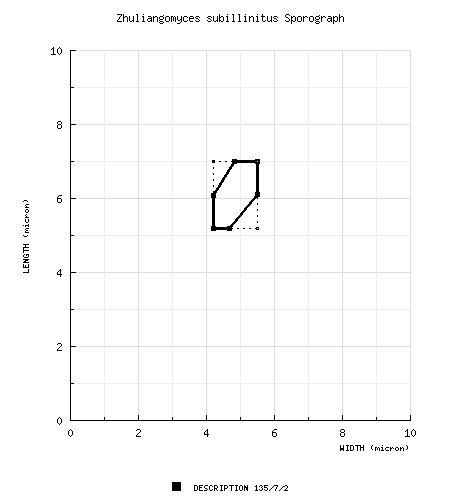
[135/7/2] (5.0–) 5.2–7.0 (–7.8) × (4.0–) 4.2–5.5 (–6.5) µm, (L = 5.7–6.4 µm; L’ = 6.1 µm; W = 4.6–5.0 µm; W’ = 4.8 µm; Q = (1.08–) 1.11–1.45 (–1.74); Q = 1.24–1.29; Q’ = 1.27), hyaline, colorless, thin-walled, inamyloid, moderately densely covered with fine spine-like warts 0.1± μm high, subglobose to broadly ellipsoid to ellipsoid, infrequently elongate, adaxially flattened; apiculus sublateral, cylindric; contents mono- to multiguttulate to granular; white in deposit. |
| ecology |
protolog: Terrestrial, growing among grass.
Scattered to subgregarious. Florida: At 17 m elev. On lawns after numerous heavy rains. |
| material examined |
protolog: MÉXICO:
CHIAPAS—Palenque, 1973 P. D.
Johnson 1973-052145 (holotype, ENCB, n.v.; isotype,
TRTC=>NY, nrITS seq'd.).
RET: MÉXICO:
CHIAPAS—Palenque, 1973
P. D. Johnson 1973-052145 (holotype, ENCB, n.v.; isotype,
TRTC=>NY, nrITS & seq'd.).
PANAMÁ: PANAMÁ—Disto. La
Chorrera - La Chorrera, 11.ix.2012 Eduardo Esquivel Rios
s.n. (RET 520-6, nrITS & nrLSU seq'd.).
U.S.A.: FLORIDA—Osceola Co. -
Kissimmee, Good Samaritan Village, Northgate Drive
[28.2658° N/ 81.4483° W, 17 m], 20.v.1991 Ellen Greer
s.n. [Tulloss 5-20-91-GA] (RET 019-6, nrITS & nrLSU
seq'd.), s.n. [Tulloss 5-20-91-GB]
(RET 019-7), 25.v.1991 E. Greer s.n. (RET 019-8),
26.vii.1995 Ellen Greer s.n. (RET 158-6, nrITS &
nrLSU seq'd.), 29.vii.1995 Ellen Greer 1-3 (RET 159-2,
nrITS & nrLSU seq'd.), 1.viii.1995 E. Greer 4-5
(RET 159-3, nrITS & nrLSU seq'd.),
2.ix.1995 E. Greer s.n. [Tulloss “a”]
(RET 159-4), s.n. [Tulloss "b"] (RET 159-5, nrITS
& nrLSU seq'd.). Sarasota Co. - St. Augustine,
Myakka Valley Ranches subdivision, 10.x.1995 Robert S.
Williams s.n. (RET 158-10, mrITS & nrLSU
seq'd.); Sarasota [27.4044° N/ 82.4861° W, 5 m],
12.ix.2020 Dryw Morehouse s.n.
(RET 887-2, nrITS seq'd.).
PUERTO RICO—Mpio. Cidra, 21.vii.2018
Kurt Miller s.n. (RET 841-9, nrITS-LSU & rpb2 seq'd.). |
| discussion |
The fact that even in the youngest material, the
terminal cells of the gluten retaining hyphae are not
gathered in fascicles, are quite flexuous or
whip-like, and are not entirely erect, suggests that
this taxon differs from
Zhuliangomyces sp-CMP0152,
Z. illinitus (Neville and
Poumarat 2004: 235) and
var. argillacea,
L.
ochraceolutea (Neville and Poumarat
2004: 242),
and L. ochraceorosea (Neville and Poumarat 2004: 249).
It should be considered that
L.
agricola may be a synonym of Z.
subillinitus. If this were satisfactorily
demonstrable, the name agricola (published in
1911) would have priority. The geographical
location of the 1909 type collection of
agricola, the color and striate margin of its
fresh cap, the size-shape of its spores support the
case for synonymy; however, the condition of the
type of the older name may pose obstacles for making
a sufficient case for synonymy. This issue
requires further work. Based on limited
available data, a sporograph comparison
follows:
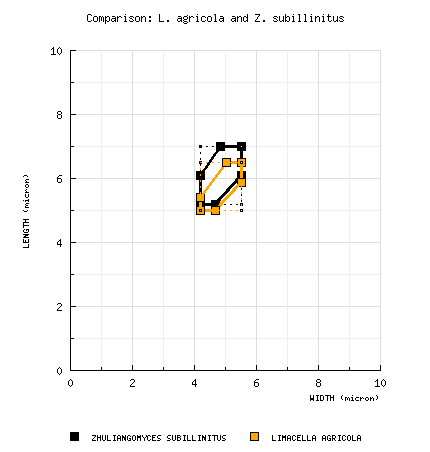
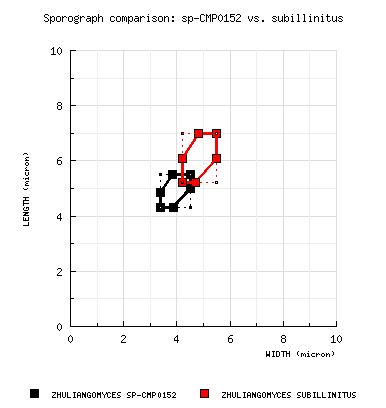
A sporograph comparison between the present
species and the macroscopically similar
Z.
sp-CMP0152 is presented in the following
figure:
The largest spores observed in the present species
are probably produced by the 2-sterigmate
basidia.
The U.S. collections were formerly presented on
this site under a temporary code that is now
abandoned—"L. sp-Williams-10-x-1995." |
| citations |
—R. E. Tulloss & J. Geml |
| editors |
RET |
|




 Spore data sets and their composite