| name |
Zhuliangomyces sp-CMP0152 |
| author |
Tulloss & Geml |
| name status |
cryptonomen temporarium |
| GenBank nos. |
Due to delays in data processing at GenBank, some accession numbers may lead to unreleased (pending) pages.
These pages will eventually be made live, so try again later.
|
| intro |
Olive text indicates a specimen that has not been
thoroughly examined (for example, for microscopic details) and marks other places in the text
where data is missing or uncertain.
The following material is based upon original research by R. E. Tulloss.
Macroscopic description derived from exsiccata and collectors’ brief notes. Microscopic description by RET. |
| pileus |
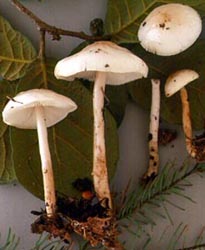
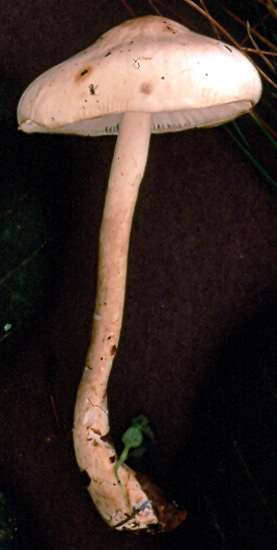
20 - 50 mm wide, somewhat sordid light tan in exsiccata, with disc pale brown to brown in exsiccata, glutinous when fresh, subconic at first, irregularly campanulate to broadly campanulate, becoming planar with age, with broad umbo; context white, ??; margin nonstriate, incurved at first, decurved even at maturity, not extending beyond lamellae, often slightly rimose; gluten layer at first orange brown (in smallest pinheads) to pale tan to [?olivaceous] brown (red-brown or rusty-brown or golden brown over disc) fading to colorless or nearly so (although often pale brown over disc). |
| lamellae |
free to narrowly adnate, close, white in mass and in side view, ventricose; lamellulae attenuate to subattenuate to rounded subattenuate to truncate with attenuate tooth at pileus context, of diverse lengths, common (between almost all pairs of lamellae). |
| stipe |
40 - 73 × 4 - 6 mm, subcylindric, narrowing upward, white, with lower half distinctly brownish in exsiccatum, covered ?evenly with light brown or "pale" gluten, with base often curved abruptly to one side (within substrate), with white pseudorhizoids binding substrate to stipe base; bulb lacking or as slight swelling at stem base; context white, solid (distinct central cylinder filled with sordid tissue in exsiccata); partial veil absent; gluten in more or less even layer below last point of stipe-pileus contact, light brown to rusty tan or pallid.
[Note: Interlacing gluten-retaining hyphae from pileus and stipe create a transient, gluten-coated, cortina-like structure in young material.—ed.] |
| odor/taste |
not recorded. |
macrochemical
tests |
none recorded. |
| pileipellis |
absent. |
| pileus context |
filamentous undifferentiated hyphae ?? µm wide, ??; acrophysalides ??; vascular hyphae sinuous, 5.2 µm wide, ??; clamps ??. |
| lamella trama |
bilateral; ?? |
| basidia |
23 – 31 × 4.9 – 6.5 µm, 4-sterigmate, with sterigmata 2.9 – 4.0 × 1.0 – 1.5 µm; clamps common, prominent. |
| gluten layer |
On pileus: filamentous undifferentiated hyphae supporting gluten pile 1.5 – 4.3 µm wide in non-terminal segments, branching, gelatinizing extensively in older material, with elements collapsing and gelatinizing last over disc, extensively gelatinized in mature basidiomes and then often with gaps exposing pileus context, with segments occasionally with pale yellow vacuolar pigment, erect at first, then collapsing in tightly compacted criss-crossing fascicles of diverse widths; terminal cells cylindric to subcylindric, often with slight ellipsoid expansion at apex, [29/5/2] (14-) 24 – 85 (–95) × (1.4-) 1.5 – 3.6 (-4.5) µm, with basal septa 0.9 – 3.0 µm wide, with mean length = 50 μm, with mean tip width = 2.6 μm, with length/tip-width ratio = (5.8-) 10.8 – 42 (-43) (mean = 20), rounded at apex, with pigments as in nonterminal hyphal segments; clamps abundant, prominent. On stipe: ??. |
| stipe context |
longitudinally acrophysalidic; filamentous undifferentiated hyphae 1.6 – 12.0 µm wide, branching, dominant in interior as well as at surface; acrophysalides 60 – 144 × 8.5 – 18.5 µm, relatively commonly with one or more subterminal cells similarly inflated (e.g., 9.2 – 12.0 µm wide); vascular hyphae 2.0 – 7.7 µm wide, unevenly distributed, sordid yellowish, in infrequent clusters, subsinuous, occasionally branching, co-entangling, with insoluble content as in Amanita; clamps common. |
| partial veil |
absent. |
| lamella edge tissue |
fertile. |
| basidiospores |
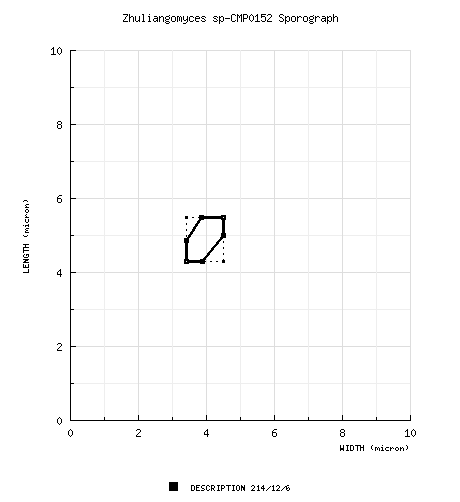
[214/12/6] (4.0–) 4.3 – 5.5 (–6.5) × (3.0–) 3.4 – 4.5 (–5.9) µm, (L = 4.6 – 5.0 µm; L’ = 4.8 µm; W = 3.6 – 4.0 µm; W’ = 3.8 µm; Q = (1.05–) 1.11 – 1.43 (–1.59); Q = 1.22 – 1.32 (-1.38); Q’ = 1.27), hyaline, colorless, thin-walled, inamyloid, dominantly to entirely echinulate (at 1250× with or without Nomarski differential interference contrast), adaxially flattened, infrequently subglobose, otherwise broadly ellipsoid to ellipsoid; apiculus sublateral, cylindric; contents dominantly monoguttulate in some sections, dominantly granular in others; color in deposit unknown. |
| ecology |
Solitary to subgregarious. Tlaxcala, Mexico:
At 2800 m elev. In leaf litter and extensively
decayed wood, among shrubs in mixed forest including
Abies religiosa, Pinus, and Quercus.
Arizona, U.S.A.: At 2090± -
2390± m elev. In litter of forest
dominated by Pseudotsuga menziesii and
Quercus leucoides. |
| material examined |
MÉXICO: TLAXCALA—Mpio.
Tlaxco - Cerro El Peñon, km 4-5 Camino El Rosario,
El Rodeo [19.6886° N/ 98.2339° W, 2720 m], nrITS seq'd.),
17.vii.1992 Reyes Guevara & Pérez
Ramirez 1595 (FCME 5180), 5.ix.1992 Espinosa Arreola
& Pérez-Ramirez 1655 (FCME 5181 as “L. illinita
var. argillacea”), 31.viii.1994 A. Estrada
Torres, L. Varela Fregoso, R. E. Tulloss, etc. s.n.
[Tulloss 8-31-94-E] (RET 135-7, nrITS & nrLSU
seq'd.; TLXM), 20.viii.1998 Anna
Gerenday s.n. [Tulloss 8-20-98-C] (RET 293-2, nrITS
& nrLSU seq'd.; TLXM); unkn. loc., 15.viii.1992 Puebla
Amado & Hernandez Muñoz 458 (FCME 5354).
U.S.A.: ARIZONA—Cochise Co.
- Coronado Nat. For., Chiricahua Mtns., Pinery Cyn.
Campg., 4 km SE of Pine Cyn Rd., CMP site 10
[31.9330° N/ 109.2711° W, 2091-2134 m],
15.viii.1989 R. M. Chapman s.n. [CMP0152] (RET 418-5,
nrITS eq'd.), 30.viii.1993 F. H. Nishida s.n. [CMP
3806-2] (RET 419-6);
Coronado Nat. For., Chirichau Mtns., Onion Saddle at
jct. w/ rd. Rustler Pk., CMP site 28 [31.9332° N/
109.2264° W, 2326 m], 24.viii.1993 F. H. Nishida 5124
[CMP3714] (in herb. F. H. Nishida; RET 419-4, nrITS
& nrLSU seq'd.), 28.viii.1993 A. Ortiz s.n.
[CMP3121] (RET 419-9, nrITS & nrLSU seq'd.),
30.viii.1993 S. B. Fleming s.n. [CMP3148] (RET 419-3,
nrITS & nrLSU seq'd.);
Coronado Nat. For., Chiricahua Mtns., jeep tr. to
Shaw Pk., 8 km NE of Onion Saddle, CMP site 56
[2382 m], 24.viii.1993
F. H. Nishida s.n. [CMP3653] (RET 419-8, nrITS &
nrLSU seq'd.);
Coronado Nat. For., Chiricahua Mtns., CMP site
#??,
prob. viii.1997 Joaquín
Cifuentes-Blanco 3084 [CMP0443] (RET 419-7, nrITS
seq'd.), 19.viii.1997 J. Cifuentes 3916 [CMP5184]
(RET 419-1, nrITS seq'd.);
Coronado Nat. For., Chiricahua Mtns., CMP site
#??, 19.viii.1997 S. L.
Benson s.n. [CMP4802] (RET 418-10, nrITS &
nrLSU seq'd.).
Coconino Co. - San Francisco Peaks area, 22.viii.2012
Erik Nelson s.n. [mushoomobserver #108540]
(RET 513-6, nrITS & nrLSU seq'd.) |
| discussion |
more t.b.d....
New collections with better annotation would be
very helpful.
Macroscopically similar material from Florida and
Texas appears differentiable from the Chiricahua
Mtns. material at least on the basis of spore size
and shape. For purposes of comparison, a
sporograph (red figure) from the macroscopically
similar Z.
subillinitus is presented here:
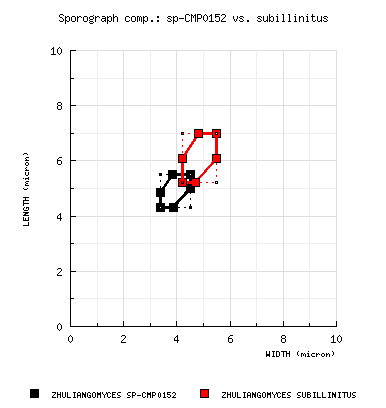
The following figure provides sporograph comparison
for the present taxon and
L. illinita sensu H. V.
Smith:
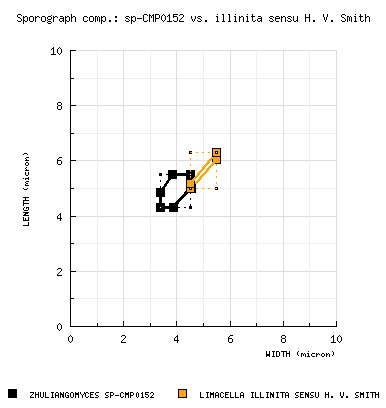
For sporograph comparison with Zhuliangomyces sp-CMP3806-1
see the taxon page for that species. |
| citations |
—R. E. Tulloss |
| editors |
RET |
|



 Spore data sets and their composite