

| name | Amanita yenii |
| name status | nomen acceptum |
| author | Zhu L. Yang & C. M. Chen |
| english name | "Yen's Lepidella" |
| images |
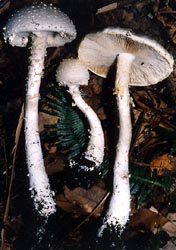 1. Amanita yenii - China - C. M. Chen photo 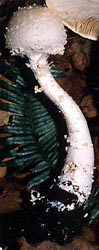 2. Amanita yenii - China - C. M. Chen photo 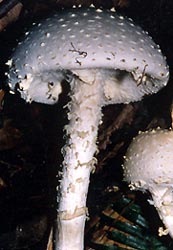 3. Amanita yenii - China - C. M. Chen photo |
| cap |
The cap of Amanita yenii is 50 - 100 (-120) mm wide, convex to applanate, white to whitish or dirty white, but cream-colored or pale yellowish over the center when young. The volval remnants on the cap are conical to subconical, 1 - 3 (-4) mm high and 1 - 3 (14) mm wide, white to dirty white, occasionally brownish, especially towards their tips, and randomly arranged; the cap's margin is smooth and appendiculate. |
| gills |
The gills are white when young, becoming cream-colored to yellowish when mature. |
| stem |
The stem is 60 - 120 × 5 - 15 mm, subcylindrical or tapering upwards, with the apex slightly expanded, white, with the upper half often covered with recurving squamules. The stem's basal bulb is clavate to subclavate or ventricose, 10 - 30 mm wide, non-marginate, with the upper part nearly completely glabrous or covered with whitish to white, occasionally brownish, verrucose to subconical volval remnants, irregularly arranged or in incomplete concentric rings. The stipe's annulus is thin and nearly membranous. The flesh is white and unchanging. |
| spores |
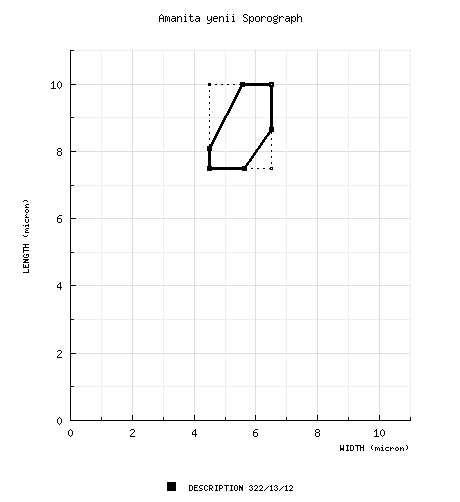
The basidiospores of Amanita yenii are (6.5-) 7.5 - 10.0 (-12.5) × (4.0-) 4.5 - 6.5 (-7.5) µm and are ellipsoid to elongate, amyloid, colorless, hyaline, thin-walled, and smooth. There are no clamps at bases of basidia. |
| discussion |
Amanita yenii grows in forests. To date it has been found in both southern China and Taiwan. Amanita polypyramis (Berk. & M. A. Curtis) Sacc., A. pulverulenta Beeli, and A. boudieri Barla of Bas' stirps Polypyramis are similar to A. yenii. Amanita polypyramis, originally described from North America, usually has a more robust basidiome, often with strong smell, smaller warts of volval remnants on the cap, paler colored gills, a more or less submarginate bulb on the base of the stem and significantly larger basidiospores. Amanita boudieri, originally described from Europe, has a more fugacious annulus, and much longer basidiospores. Furthermore, its volval remnants on the cap are mostly rather adnate, subtomentose-subfelted patches or small warts, and its stipe is glabrous to subglabrous, without reflexed squamules on its upper part.—Zhu L. Yang Amanita pulverulenta, originally described from the Republic of Congo, has a somewhat more robust fruiting body, has a more robust, membranous annulus, lacks recurved squamules on the stem, has yellow or tan tints in the center of the cap at maturity, and has larger spores.—Zhu L. Yang |
| brief editors | RET |

 Spore data sets and their composite