| name |
Amanita pulverulenta |
| author |
Beeli. 1927. Bull. Soc. Roy. Bot. Belgique 59: 101, pl. 1 (fig. 1). |
| name status |
nomen acceptum |
| english name |
"African Pulverulent Lepidella" |
| synonyms |
≡ Aspidella pulverulenta (Beeli) E.-J. Gilbert. 1940. Iconogr. Mycol. (Milan) 27, suppl. (1): 79, tab. 56 (figs. 1).
The editors of this site owe a great debt to Dr. Cornelis Bas
whose famous cigar box files of Amanita nomenclatural information
gathered over three or more decades were made available to RET for computerization
and make up the lion's share of the nomenclatural information presented on this site.
|
| MycoBank nos. |
161999, 284330 |
| GenBank nos. |
Due to delays in data processing at GenBank, some accession numbers may lead to unreleased (pending) pages.
These pages will eventually be made live, so try again later.
|
| holotypes |
BR (implicit) |
| revisions |
E.-J. Gilbert. 1941. Iconogr. Mycol. (Milan) 27, suppl.: 401, 402, tab. 69.
Bas. 1969. Persoonia 5: 442, figs. 177-183. [Amanita boudieri and Amanita pulverulenta were presented as synonyms of Amanita baccata, but doubt was expressed concerning the status of the latter. Note: Current segregation (here) based on revision of central African material by Tulloss, see below.] |
| selected illustrations |
Beeli. 1935. Fl. Champ. Congo 1: pl. 3 (fig. 3). |
| intro |
The following text may make multiple use of each data field.
The field may contain magenta text presenting data from a type study
and/or revision of other original material cited in the protolog of the present taxon.
Macroscopic descriptions in magenta are a combination of data from the protolog and
additional observations made on the exiccata during revision of the cited original
material.
The same field may also contain black text, which is data from a revision of the present
taxon (including non-type material and/or material not cited in the protolog).
Paragraphs of black text will be labeled if further subdivision of
this text is appropriate.
Olive text indicates a specimen that has not been
thoroughly examined (for example, for microscopic details) and marks other places in the text
where data is missing or uncertain.
The following material is based on the protolog of the present species, (Bas 1969), and original research of R. E. Tulloss. |
| pileus |
from protolog: 100 - 110 mm wide, white, plano-convex; context thick; margin nonstriate (per figure); universal veil as covering of fine pulverulent white scales.
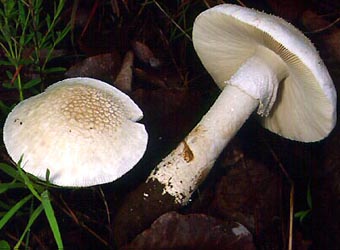
RET: white with pale brownish disc, convex; context not recorded; margin nonstriate, appendiculate; universal veil as small pyramidal warts, off-white. |
| lamellae |
from protolog: free, density not described, white or palely yellowish, broad; lamellulae not described. |
| stipe |
from protolog: 130 × 15 mm, white, becoming slightly red-brown, thick, cylindric or narrowing upward; bulb "tubercular," somewhat radicating; context barely hollow in center; partial veil superior, membranous, thin, white; universal veil thin, white, friable, not very distinct. [Note: The term "tubercular" may refer to a lumpy appearance of the upper bulb in Beeli's line-drawing adaptation of Goossens' watercolor of the present species.]
RET: white; bulb narrow, radicating; context not recorded; partial veil white, membranous,superior, persistent; universal veil as many rows of small warts on lower stipe and upper bulb, off-white. |
| odor/taste |
not described. |
macrochemical
tests |
none recorded. |
| pileipellis |
Bas (1969): filamentous hyphae 3 - 8 μm wide, interwoven, gelatinizing near surface. |
| pileus context |
not described. |
| lamella trama |
Bas (1969): bilateral; probably without terminal inflated cells. |
| subhymenium |
Bas (1969): inflated-ramose to subcoralloid. |
| basidia |
Bas (1969): 45 - 50 × 9.5 - 11 μm, 4-sterigmate; clamps not present. |
| universal veil |
Bas (1969): On pileus: colorless to yellowish in alkaline solution, with elements in more or less erect position near pileipellis, but irregularly disposed near upper surface; filamentous hyphae 3 - 8 μm, branching; inflated cells dominating, ellipsoid to ovoid, also with other shapes, up to 55 × 45 μm, terminal singly or in chains. |
| stipe context |
Bas (1969): longitudinally acrophysalidic. |
| partial veil |
not described. |
| lamella edge tissue |
Bas (1969): as few pyriform cells up to 35 × 25 μm in young specimen. |
| basidiospores |
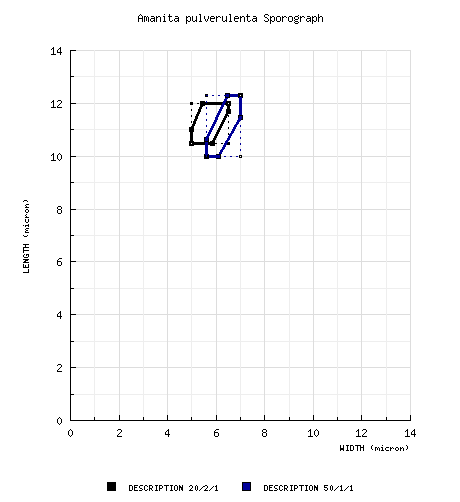
Bas (1969): [20/2/1] (10-) 10.5 -
12 (-13.5) × (4.5-) 5 - 6.5 µm, (Q = 1.8 - 2.2 (-2.7); Q' = 2.1), amyloid, elongate to cylindric.
RET: [50/1/1] (9.0-) 10.0 - 12.3 (-12.7) × (5.5-) 5.6 - 7.0 (-7.4) µm, (L = 10.9 µm; L’ = 10.9 µm; W = 6.2 µm; W’ = 6.2 µm; Q = (1.62-) 1.64 - 1.90 (-1.96); Q = 1.76; Q’ = 1.76), hyaline, colorless to pale yellowish, smooth, thin-walled, amyloid, elongate, often adaxially flattened; apiculus sublateral, cylindric; contents mono- or multiguttulate or granular; color in deposit not recorded. |
| ecology |
from protolog: Democratic Republic of Congo: Scattered. Terrestrial in dry forest. Zambia: Very common in miombo woodland. |
| material examined |
from protolog: CONGO, DEMOCRATIC REPUBLIC OF: PROV. EQUATEUR—Territoire Lisala - Lisala [2°09'00" N/ 21°31'00"E, ca. 420 m], xii.1925 M. Goossens-Fontana 532 (holotype, BR).
Bas (1969): CONGO, DEMOCRATIC REPUBLIC OF: PROV. EQUATEUR—Territoire Lisala - Lisala [2°09'00" N/ 21°31'00"E, ca. 420 m], xii.1925 M. Goossens-Fontana 532 (holotype, BR).
RET: ZAMBIA:
NORTHERN PROV.—Mpika Distr. - ca. Mpika, Mutinondo, Wilderness Area, 22 km off Great North Hwy., 31.xii.2000-7.i.2001 David Arora 01-505 (RET 348-9). |
| discussion |
Beeli (1935) altered the description of the species; among other changes, was the conversion of the membranous annulus to a pulverulent one. Because this description seems a rather fundamental one, we have not included the 1935 changes in the above description.
Bas included the present species within his concept of what is now called A. boudieri. However, this species does not have a membranous, persistent partial veil. |
| citations |
—R. E. Tulloss |
| editors |
RET |
|




 Spore data sets and their composite