
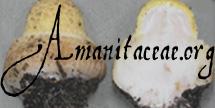
| name | Amanita boudieri var. boudieri |
| name status | nomen acceptum |
| author | Barla |
| english name | "Boudier's Lepidella" |
| intro | double click in markup mode to edit. |
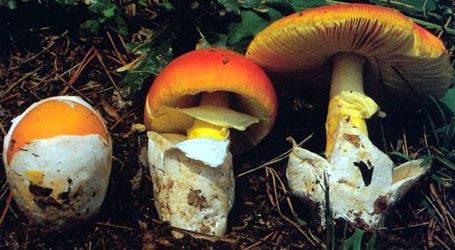
| cap | The cap of A. boudieri is about 40 - `10 mm wide, hemispherical to convex when young, becoming plano-convex with a slightly depressed center with age, white to whitish, sometimes becoming yellowish, dry, unpolished, appendiculate, with a nonsulcate margin. The cap probably subviscid to shiny between remnants of volva at the margin. The cap is at first completely covered with adnate, subtomentose-subfelted to pulverulent-subtomentose, white, volval layer, sometimes decorated with small, pustular warts; later, the covering layer more or less breaks up into rather vague, large, irregular, crust-like to small, rounded, wart-like subtomentose-subfelted patches. |
| gills | The gills are rather crowded, subadnate to free, moderately broad, and white to cream or yellowish. The short gills are rounded-truncate. |
| stem | The stem is about 50 - 150 × 5 - 20 mm, cylindrical or attenuate upward, solid, white, with one to three vague circles of usually indistinct, flocculose-felted warts. |
| spores | The spores measure 10.5 - 14 (-16.0) × (4.5-) 5.0 - 6.5 (-7.5) µm and are amyloid and elongate or elongate-obovoid to cylindical. Clamps are present at bases of basidia. |
| discussion |
This species is known from the Mediterranean region.
See discussions under A. polypyramis (Berk. & M. A. Curtis) Sacc. and A. pulverulenta Beeli. At first, Bas (1969) accepted the name A. baccata for this species; however, the type of the latter species is a plate that resembles both A. boudieri and A. gracilior Bas ex Bas & Honrubia (a taxon lacking clamps on its basidia and assignable to Bas' stirps Virgineoides). Apparently, A. boudieri and A. gracilior are often confused in the field. A study by Neville and Poumarat (1996) reveals that A. boudieri is uncommon and occurs mostly in the first half of the year, while A. gracilior is common and occurs in the second half of the year. In my herbarium, all material of A. boudieri is from the period including March through May; and all material from A. gracilior is from the months including September through November.—R. E. Tulloss |
| brief editors | RET |
| name | Amanita boudieri var. boudieri | ||||||||||||||||||||
| author | Barla. 1888. Bull. Soc. Mycol. France 3: 195. | ||||||||||||||||||||
| name status | nomen acceptum | ||||||||||||||||||||
| english name | "Boudier's Lepidella" | ||||||||||||||||||||
| synonyms |
≡Amanita baccata var. boudier (Barla) Bigeard & Guill. 1913. Fl. Champ. Supér. France 1: 16.
≡Amanita solitaria var. boudieri (Barla) E.-J. Gilbert. 1918. Gen. Amanita Pers.: 92.
≡Lepidella boudieri (Barla) E.-J. Gilbert & Kühner. 1928. Bull. Trimestriel Soc. Mycol. France 44: 151.
≡Aspidella boudieri (Barla) E.-J. Gilbert. 1940. Iconogr. Mycol. (Milan) 27, suppl. (1): 79, tab. 56 (figs. 2-6).
??=Agaricus moulinsii Brond. 1851. Actes Soc. Linn. Bordeaux 17: 302, pl. 7 & 9 (figs. 3-7). [n.v.] [Difficulties: Need to sort out which plate the figs. are in. Neville and Poumarat (2004) consider the synonymy listed here with question marks. Dr. Bas' notes show his first inclination was synonymy with strobiliformis; Gilbert thought solitaria; Rouzeau (1974) thought boudieri; Roumeguère (1880) gemmata.]
[Note: A few authors (e.g., Castro (1998. Mycotaxon 67: 229) refer Amanita lusitanica Torrend here, as a synonym. But this is in error according to a recent review of the type of A. lusitanica by F. Wartchow (pers. comm. to RET).] The editors of this site owe a great debt to Dr. Cornelis Bas whose famous cigar box files of Amanita nomenclatural information gathered over three or more decades were made available to RET for computerization and make up the lion's share of the nomenclatural information presented on this site. | ||||||||||||||||||||
| etymology | genitive of a Latinized name; hence, "of Boudier" or "Boudier's" | ||||||||||||||||||||
| MycoBank nos. | 208785 | ||||||||||||||||||||
| GenBank nos. |
Due to delays in data processing at GenBank, some accession numbers may lead to unreleased (pending) pages.
These pages will eventually be made live, so try again later. Search:
Showing 0 to 0 of 0 entries | ||||||||||||||||||||
| lectotypes | A. boudieri—PC | ||||||||||||||||||||
| lectotypifications | A. boudieri—Bas. 1969. Persoonia 5: 441. | ||||||||||||||||||||
| revisions |
Bas. 1969. Persoonia 5: 442, figs. 177-183. [Amanita boudieri and Amanita pulverulenta (q.v.) presented as synonyms of Amanita baccata, but doubt expressed concerning the status of the latter.] Bas and Honrubia. 1982. Persoonia 11: 511. ["Amanita baccata" declared nom. dub due to proposal of Amanita gracilior Bas & Honrubia. The type of Amanita baccata (a plate) cannot resolve A. gracilior from A. boudieri.] Neville and Poumarat. 1996. Doc. Mycol 26(101): 6, fig. 9(A-F). | ||||||||||||||||||||
| selected illustrations |
Barla. 1888. Fl. Mycol. Illus. Champ. Alpes-Marit. (1): 19, pl. 6 (figs. 10-12). Neville and Poumarat. 1995. ll. Semestriel Féd. Assoc. Mycol. Medit. Nouv. Sér. 7-8: 52, pl. 4. | ||||||||||||||||||||
| intro |
The following text may make multiple use of each data field. The field may contain magenta text presenting data from a type study and/or revision of other original material cited in the protolog of the present taxon. Macroscopic descriptions in magenta are a combination of data from the protolog and additional observations made on the exiccata during revision of the cited original material. The same field may also contain black text, which is data from a revision of the present taxon (including non-type material and/or material not cited in the protolog). Paragraphs of black text will be labeled if further subdivision of this text is appropriate. Olive text indicates a specimen that has not been thoroughly examined (for example, for microscopic details) and marks other places in the text where data is missing or uncertain. The following material is predominantly based on (Bas 1969) and original research of R. E. Tulloss. | ||||||||||||||||||||
| macrochemical tests |
Spot test for laccase (syringaldazine) - negative throughout the basidiome. Spot test for tyrosinase (paracresol) - after 4 min. positive in stipe base and upper bulb (region remains that with strongest reaction), in next 11 min. becoming stronlgy positive on lamellae edges produced by section and weakly positive throughout much of basidiome except as noted above. Test voucher: F. Massart 97011. | ||||||||||||||||||||
| basidiospores | Bas (1969): [130/12/-] 10.5 - 14 (-16) × (4.5-) 5 - 6.5 (-7.5) μm, (Q = (1.60-) 1.70 - 2.40 (-2.70); Q = 1.80 - 2.10), colorless, thin-walled, amyloid, elongate or elongate-obovoid to cylindric, adaxially flattened (per figure); apiculus sublateral (per figure); contents refractive granular to guttulate; white in deposit. | ||||||||||||||||||||
| ecology | Bas (1969): In dry, open, often sandy woods in southern Europe and northern Africa. | ||||||||||||||||||||
| material examined |
Bas (1969): FRANCE: ALPES MARITIMES—Nice, RET: FRANCE: GIRONDE—St-Médard-en-Jalles, 3.v.1998 Francis Massart 98007 (in herb. F. Massart; RET 279-2). LANDES—Chesse-Laharie, 11.v.1997 Francis Massart 97011 (in herb. F. Massart; RET 261-7). ITALY: COSENZA—Santa Sofia d'Epiro, Chiubbica, 26.xi.2006 C. Lavorato 061126-12 (in herb. C. Lavorato; RET 406-6=427-6). | ||||||||||||||||||||
| discussion |
t.b.d. Some of the data from the treatment of "A. baccata" (=A. boudieri) in (Bas 1969 442-446) is not included herein because Bas considered A. pulverulenta a synonym of the present species at the time of publication of this thesis; hence, one cannot be sure (without researching his notes) on which character states are reported based on the examination of the specimen currently no longer recognized as belonging in A. boudieri. | ||||||||||||||||||||
| citations | —R. E. Tulloss | ||||||||||||||||||||
| editors | RET | ||||||||||||||||||||
Information to support the viewer in reading the content of "technical" tabs can be found here.
| name | Amanita boudieri var. boudieri |
| bottom links | [ Keys & Checklists ] |
| name | Amanita boudieri var. boudieri |
| bottom links | [ Keys & Checklists ] |
 Spore data sets and their composite
Each spore data set is intended to comprise a set of measurements from a single specimen made by a single observer; and explanations prepared for this site talk about specimen-observer pairs associated with each data set. Combining more data into a single data set is non-optimal because it obscures observer differences (which may be valuable for instructional purposes, for example) and may obscure instances in which a single collection inadvertently contains a mixture of taxa.
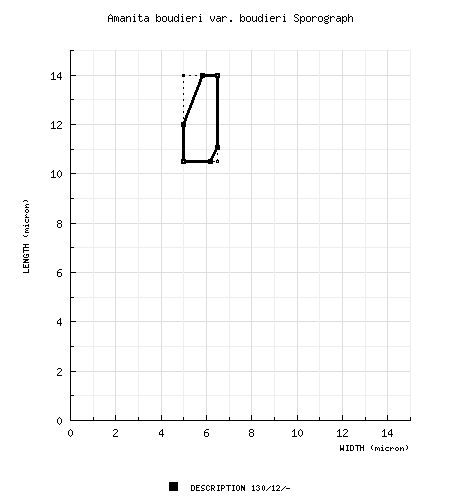

Text and User-Generated Sporographs are published under the Creative Commons License.

In the case of a taxon page, image credits are on the 'image' tab.