
| name | Amanita eliae var. eliae |
| name status | nomen acceptum |
| author | Quél. |
| english name | "Elias' Amanita" |
| images |
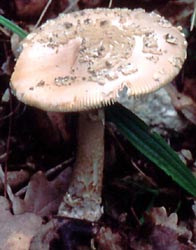 1. Amanita eliae, southwestern France. 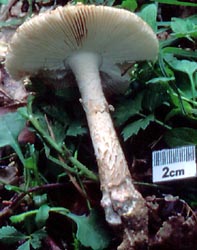 2. Amanita eliae, southwestern France. 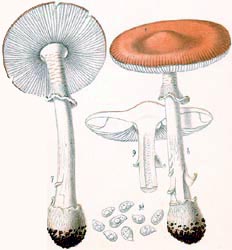 3. Amanita eliae, plate from (Barla 1888), Alpes-Martimes, France. 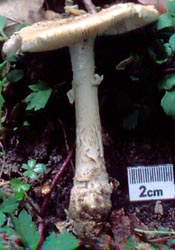 4. Amanita eliae, southwestern France. |
| intro | The following is based on the description by Neville & Poumarat (2004). |
| cap | The cap of Amanita eliae is 40 - 80 mm wide, eggshell-white at first, then rose-tawny, sometimes tinted paler to whitish, with a long-striate margin. The volva is absent or present as small white warts which correspond to small, deep depressions in the cap, more or less over the cap surface, easily removable. The flesh is white. |
| gills | The gills are free and whitish. |
| stem | The stem is 75 - 150 × 10 - 15 mm, subcylindric, narrowing slightly upwards, flaring at the base, with concentric rings in the upper portion, white with small squamules turning brownish with age, with a narrow bulb in age. The ring is membranous, white, thin, fragile, and more or less lost in mature examples. The volva is whitish, friable, fragile, white to whitish, and left in fragments or as a small limb. The flesh is white. |
| spores |
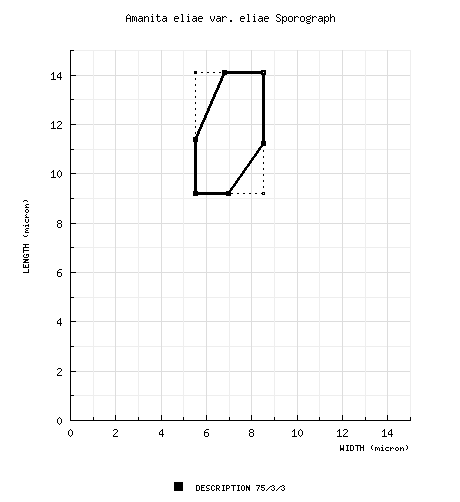
According to Neville & Poumarat (2004), the spores measure (10-) 10.5 - 13 (-15) × (6-) 6.5 - 9 µm and are broadly ellipsoid to ellipsoid to elongate and inamyloid. Spores measured from spore prints were thought to be more often elongate than spores measured from the gills. Clamps are absent from the bases of basidia. RET measured spores from gills of three collections from southwestern France (courtesy F. Massart, Gradignan, Gironde) and reported data as follows: (9.0-) 9.2 - 14.1 (-16.0) × (5.4-) 5.5 - 8.5 (-10.0) µm and ellipsoid to elongate to cylindric (infrequently broadly ellipsoid). Spores can be very variable in length and shape within a small region of a gill from a single specimen. |
| discussion |
This species was originally described from France where it occurs most often in broad-leaved forests, for example, with oaks (Quercus spp.), beech (Fagus sylvatica), chestnut (Castanea sativa), birch (Betula pubescens), hornbeam (Carpinus betulus), and hazel (Corylus avellana), sometimes with pine present (Pinus sylvestrus). Specimens that are entirely whitish from the button stage onward throughout the life of the fruiting body are assigned by some authors to A. eliae [var. griseovelata] f. candida Neville & Poumarat. Specimens with graying volva and stem decoration are assigned to A. eliae var. griseovelata Bertault ex Neville & Poumarat. For comparison, see A. subrecutita (Murrill) Murrill, A. lippiae Wartchow & Tulloss, A. viscidolutea Menolli, Capelari & Baseia, and A. sp-N58.—R. E. Tulloss and L. Possiel |
| brief editors | RET |

 Spore data sets and their composite