| name |
Amanita
longicuneus |
| author |
Tulloss, Kudzma, S. D. Russell & K. W. Hughes |
| name status |
nomen provisorum |
| english name |
"Long Wedge Ringless Amanita" |
| etymology |
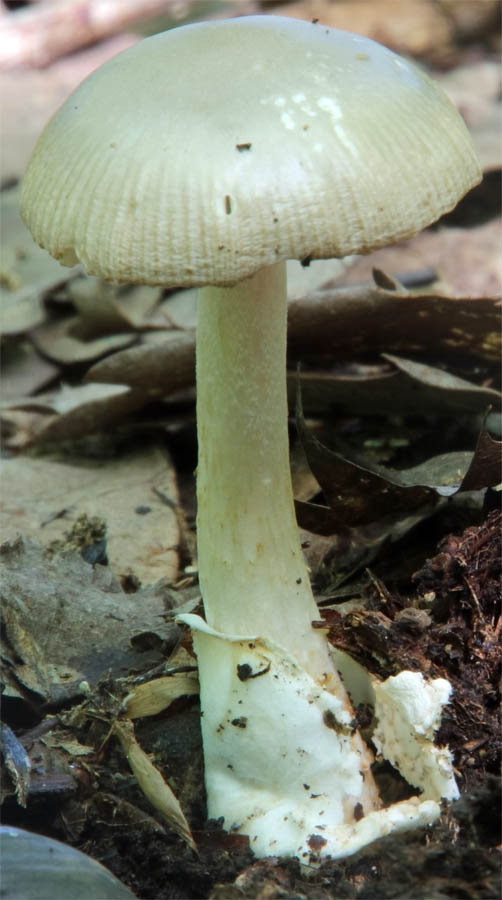
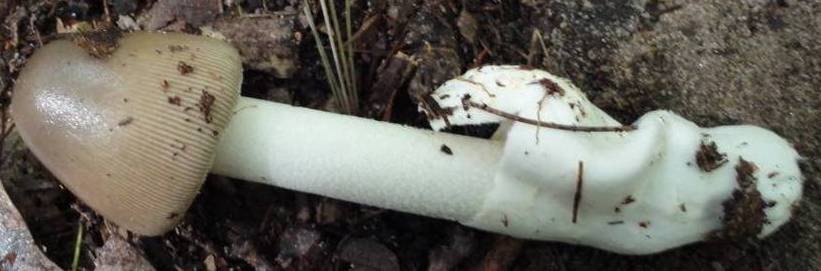
longus "long" + cuneus "wedge"; hence, "long wedge", because of the unusually tall limbus internus of the universal veil |
| GenBank nos. |
Due to delays in data processing at GenBank, some accession numbers may lead to unreleased (pending) pages.
These pages will eventually be made live, so try again later.
|
| intro |
The following text may make multiple use of each
entry field.
The field may contain magenta
text presenting data from a type study
and/or revision of other original material cited in
the protolog of the present taxon.
Macroscopic descriptions in magenta are a
combination of data from the protolog and
additional observations made on the exiccata during
revision of the cited original
material.
The same field may also contain black text, which is
data from a revision of the present
taxon (including non-type material and/or material
not cited in the protolog).
Paragraphs of black text will be labeled if further
subdivision of
this text is appropriate.
Olive text indicates a specimen
that has not been
thoroughly examined (for example, for microscopic
details) and marks other places in the text
where data is missing or uncertain.
The following material is based molecular research
of Dr. Linas Kudzma and other original research of
R. E. Tulloss. |
| pileus |
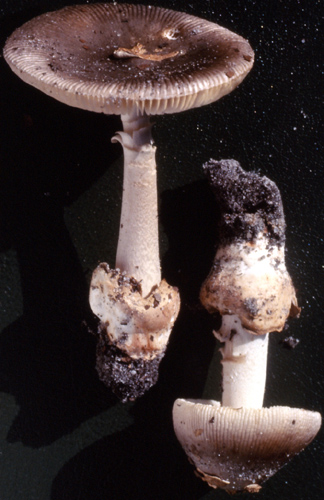
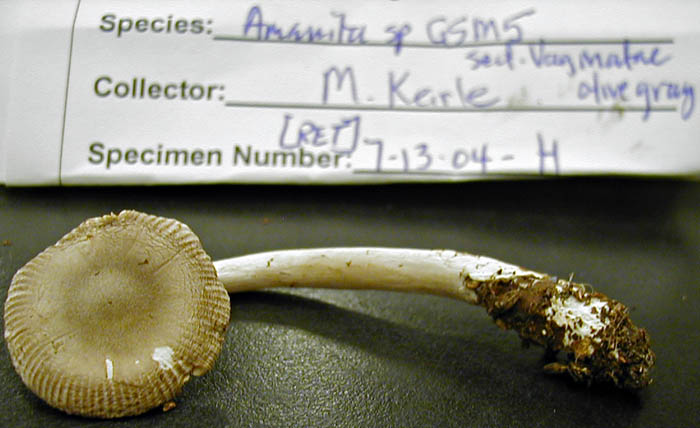
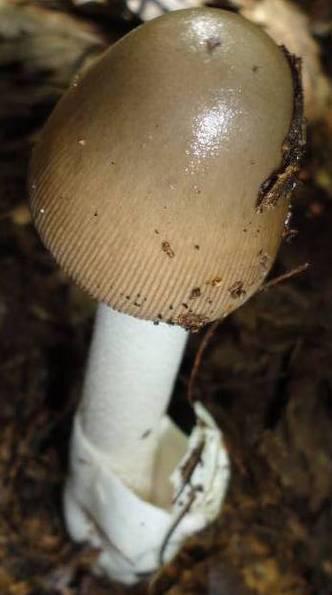
44 - 68 mm wide, deep gray-brown or
??, old wounds pallid ochraceous to brown, convex,
then plano-convex, subumbonate to umbonate, with
somewhat depressed disk in age, tacky, subshiny to
shiny; context white to very pale sordid white,
sordid to concolorous with pileus under pileipellis,
sometimes taking on faint pink flush on newly cut
surface, older cut surfaces rusty to sordid to pale
brown, sometimes with watersoaked line above lamellae,
3 - 5 mm thick at stipe, thinning evenly for two
thirds to three quarters of radius, then membranous to
margin; margin striate to
tuberculate-striate (0.4 - 0.6R), nonappendiculate;
universal veil absent or sometimes as large
patch, tough, whitish with rusty spots or eventually
becoming completely orange-brown, detersile, at
times with raised edges. |
| lamellae |
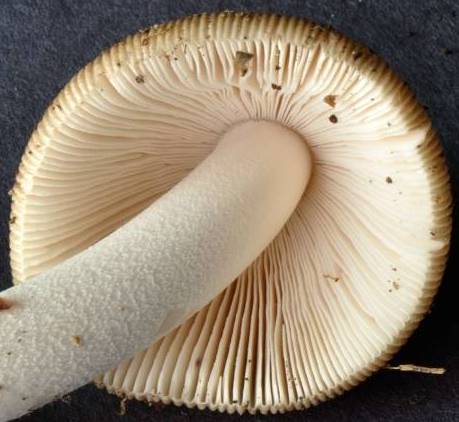
free to narrowly adnate, sometimes with short (occasionally very short) decurrent line on stipe apex, close to subcrowded to crowded, white to whitish to pale cream to cream in mass, white to watersoaked white in side view, 2 - 7 mm broad, occasionally forking and/or anastomosing; lamellulae truncate to subtruncate to rounded truncate, rarely attenuate, of diverse lengths, plentiful, unevenly distributed. |
| stipe |
61 - 125 × 5 - 10 mm, white to off-white or dingy white, becoming pale brown to orange-brown to brown from handling, narrowing upward, flaring at apex (sometimes minimally), smooth to pruinose above, minutely scurfy or with minute upward-pointing fibrillose scales below, with fibrils taking on brownish or sordid tinge, surface sometimes breaking up into recurved scales; context white to off-white to very pale yellowish white to very pale orange-white, pale brown to brown when cut or bruised, sometimes with ochraceous spots, sometimes faintly pinkish on newly cut surfaces, hollow to stuffed, always with some cottony white material in central cylinder (2 - 4.5 mm wide), sometimes brick colored in areas of larva damage near base of stipe, otherwise larva tunnels concolorous to ochraceous to fulvous; exannulate; universal veil as saccate, abruptly flaring volva, membranous, smooth, whitish, 11.5 - 41 × 14.5± mm, appressed to stipe for about one half to two thirds (rarely one quarter) of limb’s length, with limb < 1 mm thick at mid-height, with unusually long and rather thin limbus internus (at times nearly as long as free limb) arising at point of volval attachment to stipe and eventually becoming appressed to inner surface of volva or to stipe. |
| odor/taste |
Odorless and tastless. |
macrochemical
tests |
Spot test for tyrosinase (L-tyrosine)
- quickly positive in stipe, lamellae, and universal
veil (other tissues not tested).
Test voucher:
Tulloss 9-30-84-B. |
| lamella trama |
bilateral; wcs = ? µm; ?; subhymenial base ?; filamentous, undifferentiated hyphae ? µm wide, ?; terminal, inflated cells ?; vascular hyphae 6.0 - 8.0 µm wide, ??. |
| basidia |
38 - 55 × 12.6 - 15.8 µm, 4-sterigmate, with sterigmata up to ? × ? µm; clamps not observed. |
| basidiospores |
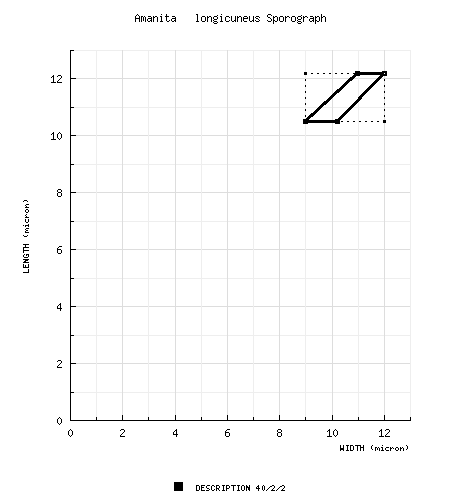
[40/2/2] (10.2-) 10.5 - 12.2 (-12.5) ×
(8.2-) 9.0 - 12.0 (-14.0) µm,
(L = 11.2 - 11.4 µm; L’ = 11.3 µm;
W = 10.5 - 10.6 µm; W’ = 10.6 µm;
Q = (1.02-) 1.03 - 1.11 (-1.14);
Q = 1.05 - 1.08; Q’ = 1.07),
hyaline, colorless, thin-walled, inamyloid, globose to
subglobose, rarely broadly ellipsoid, usually
adaxially flattened; contents granular to mono-
or multiguttulate, with additional small granules;
apiculus sublateral to lateral, cylindric to
broadly truncate-conic; white in deposit. |
| ecology |
Solitary to subgregarious.
At 63 - 1190 m elev.
Connecticut: In loam of Quercus-Fagus-Tsuga
canadensis
forest or in mixed deciduous woods.
Louisana: In sandy soil, under Fagus
grandifolia in mostly deciduous forest with
some Cupressaceae sp.
New Jersey: In Quercus-Pinus barrens sometimes
including Nyssa sylvatica or in loam of
Quercus-Fagus-Carya woods or in pure
Quercus forest with little ground cover.
New York: In forest with Betula, Fagus
grandifolia, Acer, Fraxinus, and
T. canadensis or in mixed forest with Quercus
prinus, Q. rubra & Castanea
dentata dominating.
North Carolina: In mixed hardwood forest.
Pennsylvania: In
Quercus-dominated forest with Carya
and Acer or in mixed woods with several
spp. of Quercus, Acer, Populus
tremuloides, and Pinus or with Betula,
Acer, and T. canadensis.
Tennessee: ??. |
| material examined |
CANADA:
ONTARIO—Norfolk Co. - Port Dover, Lynn Valley Road and Haldimand Road 70, 31.viii.2018 Eva Skific s.n. [mushroomobserver.org #330480] (RET 842-1)
- Turkey Point
[42.6812° N/ 80.3295° W, 174 m], 4.viii.2014
Eva Skific s.n. [mushroomobserver
#172446]
(RET 638-5, nrITS-LSU seq'd.). s.d. E. Skific s.n.
[mushroomobserver
#172448]
(RET 638-9, nrITS-LSU seq'd.); unkn. loc., s/d/
E. Skific s.n. (RET 639-9, nrITS-LSU seq'd.).
—Unkn. Co. - Walsh [42.7616° N/ 80.394° W, 223 m],
14.vii.2014 Eva Skific s.n. [mushroomobserver
169711]
(RET 652-6, nrITS-LSU seq'd.); Walsingham, 12.viii.2012 Eva
Skific s.n. [mushroomobserver
#104933]
(RET 509-6, nrITS-LSU seq'd.).
U.S.A.:
CONNECTICUT—Litchfield
Co. - Washington, Steep Rock Preserve,
41.6215° N/ 73.3247° W, 135 m, 24.vii.1992 Lynn
Payer s.n. [Tulloss 7-24-92-F] (RET 066-7, nrITS
seq'd.). Middlesex Co. - Devil’s
Hopyard St. Pk. [41°28'32" N/ 72°20'25" W, 72 m],
24.viii.2007 Noel Rowe s.n. [RET 8-24-07-O] (RET
438-3, nrITS seq'd.).
Middlesex Co. - East Haddam, Devil's Hopyard St. Pk.
[41.4825° N/ 72.3147° W, 157 m],
4.ix.2011 Cristina Rodríguez Caycedo s.n.
[Tulloss 9-4-11-P] (RET 489-4, nrITS seq'd.).
New London Co. -
Colchester, Day Pond St. Pk. [41°33'25" N/ 72°25'06"
W, 134 m], 25.ix.1999 COMA1999 foray participant
s.n. [Tulloss 9-25-99-J] (RET 301-9); SE of Groton,
Bluff Pt. St. Pk., 1.viii.2008 R. Aaron s.n.
[Tulloss 8-1-08-A] (RET 446-7,
nrITS-LSU seq'd.).
INDIANA—Monroe Co. - Bloomington,
Griffey Lk., 3.x.2012 Stephen Russell s.n.
[mushroomobserver
#112192]
(RET 536-7).
KENTUCKY—Greenup Co. - [38.5652º
N/ 82.9166º W, 226 m], 31.viii.2019 Kevin Moore s.n.
(RET 879-3, nrITS-LSU seq'd.).
LOUISIANA—La Salle
Parish - Kisatchie
Nat. For., Hwy. 123 & Fish Crk., Little Crk.
[31.7192º N/ 92.2943º W, 37 m], 2.xii.2017
Mary & R. E. Tulloss 12-2-17-A
(RET 813-8, nrITS & nrLSU seq'd.).
MAINE: Cumberland Co. - Freeport,
Stonewood Tr., 8.viii.2014 Karen Monger s.n.
[Tulloss 8-8-14-N] (RET 626-3, nrITS-LSU
seq'd.).
MISSISSIPPI—Perry Co. - De Soto Nat.
For., Cypress Creek Landing, 29.vi.1991 David P.
Lewis 4472 (RET 619-5, nrITS seq'd.).
NEW JERSEY— Cape May
Co. - Belleplain St. For., ca. Dennisville
[39°11’22” N/ 74°51’12” W], 29.x.1983 M. A. King,
N. & A. Macdonald & R. E. Tulloss [Tulloss
10-29-83-C] (RET 208-9).
Hunterdon Co. - Lebanon Twp., Teetertown Ravine Nat.
Pres., 13.viii.2017 Igor Safonov s.n.
[mushroomobserver
#287777]
(RET 801-10, nrITS & nrLSU seq'd.).
Mercer Co. - Hopewell Twp., off Carter Rd., woods
behind AT&T/Lucent research labs [40°21’39” N/
74°43’29” W, 63 m], 13.ix.1984 C. D. Hechtman &
R. E. Tulloss [Tulloss 9-13-84-B] (RET 206-3),
14.ix.1984 C. D. Hechtman & R. E. Tulloss
[Tulloss 9-14-84-A] (RET 237-7), [Tulloss 9-14-84-B]
(RET 237-8).
Monmouth Co. - Roosevelt, Valley Rd. bicycle path
[40.2136° N/ 74.4719° W, 70-105 m], 5.ix.2004 R.E.
Tulloss & Glenn Boyd 9-5-04-A (RET 379-9, nrITS &
nrLSU seq'd.), 13.viii.2014
Naomi Goldman & R. Resciniti s.n. (RET 629-6,
nrITS seq'd.).
Shark River Co. Pk. [40°12’18” N/ 74°05’44” W, 16 m],
30.ix.1984 members of
“40th birthday foray” s.n. [Tulloss 9-30-84-H] (RET
235-2), [Tulloss 9-30-84-J]
(RET 235-1), Perry Randise s.n. [Tulloss
9-30-84-G] (RET 235-3), Peter Wood s.n. [Tulloss
9-30-84-K] (RET 234-10), D. C. & R. E. Tulloss
9-30-84-A (RET 235-4), -B (RET 234-3), 28.viii.1985
R. E. Tulloss 8-28-85-A (RET 099-9), -E (RET 100-3),
13.ix.1998
NJMA foray participant s.n. [Tulloss 9-13-98-B]
(RET ??), 13.ix.1998
R. E. Tulloss 9-13-98-C (RET
??);
Morris Co. - Mendham, Meadowood Twp. Pk. [40.7923º N/
74.6449º W, 242 m], 15.vii.2017 unkn. coll. s.n.
(RET 801-9, nrITS & nrLSU seq'd.).
NEW YORK—Cattaraugus Co. - Allegany St. Pk.,
Cold Spring, Mt. Tuscarora [42.0329° N/
78.876° W, 640 m], 24.vi.2015 Garrett
Taylor s.n. [mushroomobserver.org
#208373]
(RET 699-3, nrITS & nrLSU seq'd.).
Franklin Co. - Paul Smiths, 26.vii.2016 Garrett
Taylor s..n. [mushroomobserver
#245468]
(RET 733-5, nrITS-LSU seq'd.).
Oneida Co. - unkn. loc., 6.ix.2011 Eric Smith s.n.
(RET 482-9, nrITS-LSU seq'd.),
28.vi.2013 Eric Smith s.n. (RET 588-4; nrITS seq'd.),
12.vii.2015 Eric Smith s.n.
[mushroomobserver
#209845]
(RET 718-3, nrIT-LSU seq'd.), 18,vii.2015 E. Smith
s.n. (RET 719-7, nrITS-LSU seq'd), 4.ix.2017 E.
Smith s.n. [mushroomobserver
#293453]
(RET 812-6, nrITS-LSU seq'd.).
Richmond Co. (Staten Isl.) -
High Rock Pk. [40.5856° N/ 74.1257° W, 62m],
11.ix.2018 Sigrid Jakob s.n.
[Tulloss 9-12-18-B] (RET 841-6,
nrITS-LSU seq'd.).
Sullivan Co. - Catskills Pk.,
Mongaup Pond, 8.viii.2015 David Wasilewski s.n.
(RET 706-9, nrITS seq'd.).
Ulster Co. -
NEMF2010, Walk 7, 24-25.ix.2010 Claude s.n. (RET
586-7, nrITS fragments seq'd.).
NORTH CAROLINA—Macon Co. - Nantahala
Nat. For., Standing Indian Campground, viii.2010 Jay
Justice NC-AM-23 (RET 593-4).
McDowell Co. -
ca. Little Switzerland, Anderson Crk., 9-30-17-B
Stacia Warwick s.n. [Tullos 9-30-17-B] (RET 796-5,
nrITS seq'd.); Little Switzerland, ca. Wildacres
Retreat, Blue Ridge Pkwy., 20.ix.2006 NAMA foray
participant s.n. [Tulloss 9-30-06-D] (RET 409-1,
nrITS-LSU seq'd.).
Wake Co. - Raleigh, Umstead St. Pk. [35.8725° N/
78.761° W, 121 m], 16.ix.2015 Geoff Balme s.n.
[mushroomobserver
#216321]
(RET 720-8, nrITS-LSU), [mushroomobserver
#216259]
(RET 720-9, nrITS-LSU seq'd.), 8-9.x.2015 G. Balme
s.n. [mushroomobserver.org
#218245]
(RET 720-10, nrITS-LSU seq'd.).
PENNSYLVANIA—Bradford Co. - Allegheny Nat.
For. [41.9984º N/ 78.935º W, 500 m], 30.vi.2015
Garrett Taylor 1,2,3 [mushroomobsever
#208375]
(RET 695-6, nrITS-LSU seq'd.).
Luzerne Co. - Harvey's Lake
[41.3616° N/ 76.03905° W, 383 m], 5.viii.2014 D.
Wasilewski s.n. [mushroomobserver
#172751]
(RET 653-4 nrITS-LSU seq'd.),
, s.n. [mushroomobserver
#177313]
(RET 653-7, nrITS-LSU seq'd.),
s.n. [mushroomobserver
#172749]
(RET 655-9, nrITS-LSU seq'd.);
Nescopeck Park [41.08175° N/ 75.89205° W, 320],
6.ix.2014 D. Wasilewski s.n.[mushroomobserver
#177280]
(RET 653-10, nrITS-LSU seq'd.);
Ricketts Glen State Forest [41.3036° N/ 76.2740° W,
400-600 m], 10.ix.2010 D. Wasilewski s.n.
[mushroomobserver
76131]
(RET 556-1), 12.vii.2015 D. Wasilewski s.n.
[mushroomobserver
#169769
(RET 642-5, nrITS & nrLSU seq'd.); unkn. loc.,
18.viii.2011 D. Wasilewski s.n. [mushroomobserver
#74223
(RET 499-7, nrITS seq'd.).
Schuylkill Co. - Tuscarora St. Pk. [40.7971° N/ 76.0147° W, 436 m],
22.vi.2020 D. Wasilewski s.n. [mushroomobserver
#413836 (RET 888-5, nrITS & nrLSU seq'd.).
Sullivan Co. - Lake
John [41.431° N/ 76.272° W, 700 m], 19.vii.2014 D.
Wasilewski s.n. [mushroomobserver
#170956]
(RET 642-10, nrITS & nrLSU seq'd.).
Westmoreland Co. - Laurel Highlands [],
17.viii.2010 D. Wasilewski s.n. [mushroomobserver
#51229]
(RET 556-4, nrITS seq'd.).
RHODE ISLAND—Providence
Co. - Smithfield [41.9220° N/ 71.5496° W,
78m], 17.ix.2018 Spike Mikulski s.n.
[NAMP MF61660] [mushroomobserver
#333379]
(RET 862-10).
TENNESSEE—Sevier
Co. - Great Smoky Mountains Nat. Pk., ca. Gatlinburg,
Alum Cave trailhead
[35°37'48” N/ 83°27'04” W, 1190 m], 13.vii.2004 M.
Keirle s.n. [Tulloss 7-13-04-H] (RET 374-9, nrITS &
nrLSU seq'd.). |
| discussion |
t.b.d.
Genetic studies indicate that it is probable that RET
has included collections of more than one genetically
identifiable taxon under the present name. We
are in the process of sorting this out. We hope
to sequence the earliest collections placed in this
grouping—those from 1984 and 1985.
This taxon was called "Amanita sp. 28" in
earlier correspondence, checklists, and keys of
Tulloss. On this site, the species has also been
known under the names Amanita sp-GSM05 and
A. sp-longicuneus01. |
| citations |
—R. E. Tulloss and C. Rodríguez Caycedo |
| editors |
RET |
|




 Spore data sets and their composite