| name |
Amanita sp-V01 |
| author |
Tulloss |
| name status |
cryptonomen temporarium |
| GenBank nos. |
Due to delays in data processing at GenBank, some accession numbers may lead to unreleased (pending) pages.
These pages will eventually be made live, so try again later.
|
| intro |
Olive text indicates a specimen that has not been
thoroughly examined (for example, for microscopic details) and marks other places in the text
where data is missing or uncertain.
The following material is based upon original research by R. E. Tulloss. |
| pileus |
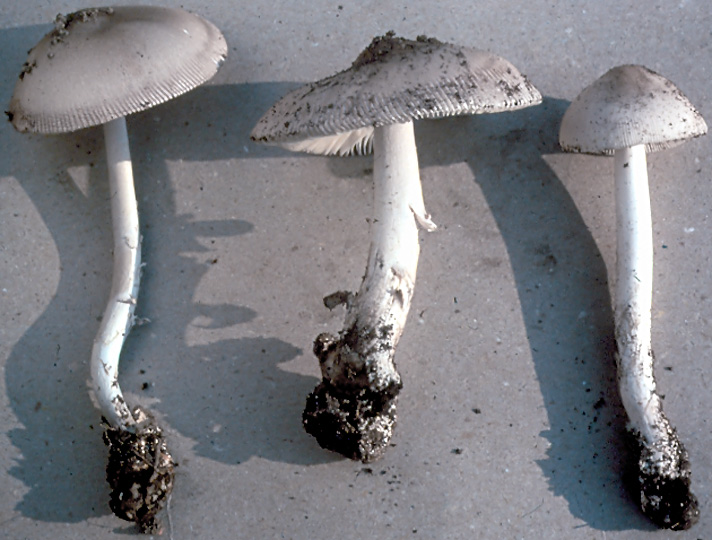
64 - 94 mm wide, very pale grayish brown to brownish gray (5C3) to tan (5B2) over margin with a brownish gray (5D3) disc, at first hemispheric, then plano-convex, umbonate, tacky, shiny; context whitish, sordid under pileipellis, unchanging when cut or bruised, 4.5 - 7.5 mm thick at stipe, thinning evenly until about 10 mm from margin, then membranous; margin striate (0.25R), nonappendiculate; universal veil absent. |
| lamellae |
narrowly adnate with decurrent tooth, with short decurrent line on stipe (lens), crowded, cream to sordid cream in mass, off-white in side view, 6 - 8.5 mm broad, margins bearing minute white flocculence, occasional forking present (more often absent); lamellulae truncate. |
| stipe |
?? - 138 × 8 - 11 mm, white to pale gray, browning from handling (especially on surface fibrils), narrowing upward or cylindrical, occasionally slightly flaring at apex, minutely fibrillose, occasionally the surface splitting into recurved scales, longitudinally striate; context off-white, not changing color when cut or bruised, partially stuffed to hollow, with 2.5 - 2.5 mm wide central cylinder, larva tunnels concolorous; exannulate; universal veil as saccate volva, membranous, but breaking somewhat easily, white, smooth, leathery, highest point on limb 29 - 33 mm from base of stipe, only attached to stipe at base and so easily detached from stipe, without evident limbus internus. |
| odor/taste |
Odor faintly fishy. Taste not recorded. |
macrochemical
tests |
Spot test for tyrosinase (L-tyrosine): positive on surface, and in context of, stipe; other tissues not tested. |
| basidiospores |
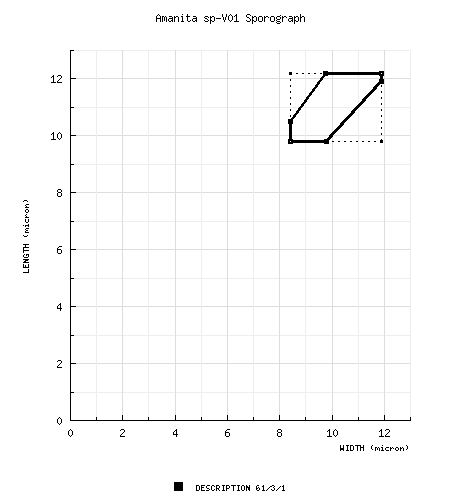
[61/3/1] (8.4-) 9.8 - 12.2 (-17.5) × (7.0-) 8.4 - 11.9 (-12.9) µm, (L = 10.8 - 11.5 µm; L’ = 11.1 µm; W = 9.6 - 10.1 µm; W’ = 9.8 µm; Q = 1.0 - 1.25 (-1.79); Q = 1.13 - 1.14; Q’ = 1.13), colorless, hyaline, thin-walled, smooth, inamyloid, globose to subglobose to broadly ellipsoid, occasionally ellipsoid or elongate, sometimes adaxially flattened, occasionally expanded at one end; contents ?; apiculus sublateral, ?; ? in deposit. |
| ecology |
Subgregarious. In sandy soil of Atlantic coastal plain in regions with plentiful Quercus species and one or more common species of Pinus as well as other potential symbionts. Ecological details are only poorly recorded for this species to date. |
| material examined |
U.S.A.:
VIRGINIA—Lancaster Co. - Weems, grounds of
Christ Church Foundation, 1.ix.1985 M. A. King &
D. C., E. H., J. C., M. H. & R. E. Tulloss 9-1-85-J
(RET 210-8). |
| discussion |
Amanita sp-V01 was originally collected in the Atlantic coastal plain of Virginia. As noted in the list of material examined, above, the species has probably also been collected in the Atlantic coastal plain of Connecticut.
The reader should compare the present species with A. sp-N53, which has some similarities.
Material that appears very similar has been collected in eastern Texas [D. P. Lewis 9043 (RET 430-6)]. Spores of the Texas material provide the following data: [100/5/2] (8.4-) 9.5 - 12.6 (-17.5) × (7.0-) 8.4 - 11.2 (-12.9) µm, (L = 10.5 - 11.5 µm;
L' = 11.0 µm; W = 9.5 - 10.1 µm; W' = 9.8 µm; Q = (1.0-) 1.04 - 1.26 (-1.79); Q = 1.10 - 1.14;
Q' = 1.13). ..more.. |
| citations |
—R. E. Tulloss |
| editors |
RET |
|




 Spore data sets and their composite