
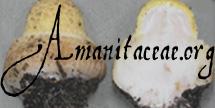

| name | Amanita sp-DED-8271 |
| name status | cryptonomen temporarium |
| author | Tulloss |
| intro | The material described on this taxon page should be compared with A. bingensis. |
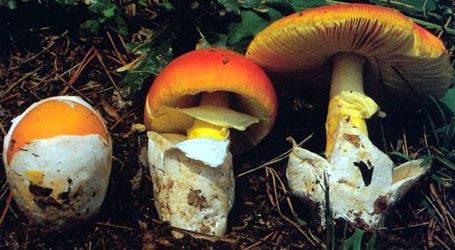
| cap | The cap of this entity is 30–55 mm wide, yellow, convex to plano-convex, and becoming planar-depressed. The cap's flesh is white and 1–2 mm thick over the stem. The margin of the cap is striate (0.5R±) and uplifted in age.7nbsp; The volval remnants on the cap are yellowish orange to orange-red, floccose scales that are 1–2 mm wide in the cap's center and become smaller toward the margin. |
| gills | The gills are very nearly free, close, white, 2–3 mm broad, and have a yellow, powdery edge. The short gills are more or less truncate to rounded truncate to excavate truncate, of diverse lengths, common, and irregularly distributed (often locally sparse on some fruiting bodies). Occasionally a short gill will merge with a regular gill. |
| stem | The hollow, ringless stem is 38–64 (including the bulb) × 3–4 (at apex) mm and pale yellowish white to yellow. It narrows upward; and, near the top it may appear powdery. The stem's bulb is 7–9 mm wide, small—similar in form to that of A. farinosa Schwein. (1822)—very small, subabrupt, and somewhat top-shaped. The stem's flesh is white. The volva is scattered on the stem—in orange granules on the lower stipe and as small red-orange floccules on the upper part of the bulb. |
| odor/taste | This mushroom lacks an odor; and its taste is not recorded. |
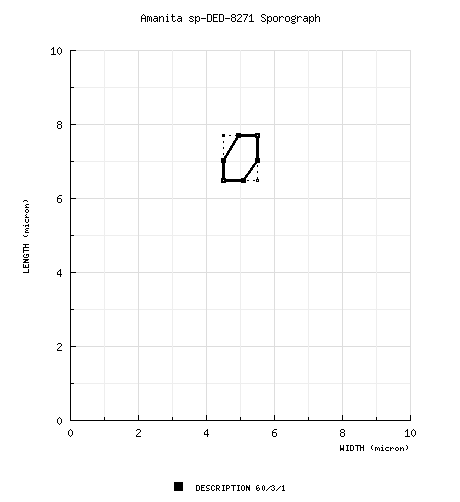
| spores | The spores measure (6.2-) 6.5 - 7.7 (-8.5) × (4.2-) 4.5 - 5.5 (-5.8) μm and are broadly ellipsoid to ellipsoid (occasionally elongate) and inamyloid. Clamps are not found at the bases of basidia. |
| discussion | This taxon has been collected once in the island nation of São Tomé e Príncipe, off the east coast of Africa. Research is continuing. t.b.d.—R. E. Tulloss and D. E. Desjardin |
| brief editors | RET |
| name | Amanita sp-DED-8271 | ||||||||||||||||||||
| author | Tulloss | ||||||||||||||||||||
| name status | cryptonomen temporarium | ||||||||||||||||||||
| GenBank nos. |
Due to delays in data processing at GenBank, some accession numbers may lead to unreleased (pending) pages.
These pages will eventually be made live, so try again later. Search:
Showing 0 to 0 of 0 entries | ||||||||||||||||||||
| intro |
Olive text indicates a specimen that has not been
thoroughly examined (for example, for microscopic details) and marks other places in the text
where data is missing or uncertain. The following material is based upon original research by R. E. Tulloss and D. E. Desjardin. | ||||||||||||||||||||
| pileus | 30–55 mm wide, yellow (3–4A4–6) convex to plano-convex, becoming planar-depressed with uplifted margin in age; context white, 1–2 mm thick over stipe, thinning to membrane at margin; margin striate (0.5R±), uplifted in age; universal veil as yellowish orange (4–5A5–6) to orange-red (8A7–8) floccose scales, with scales 1–2 mm wide over disk, with these overlying finer granules distributed from disc to margin. | ||||||||||||||||||||
| lamellae | subfree, with decurrent lines on stipe’s apical region, close, white, 2–3 mm broad, with yellow granulose edge, intervenose with such ridges sometimes bright yellow; lamellulae truncate to rounded truncate to excavate truncate, sometimes with tooth at pileus context, of diverse lengths, common, irregularly distributed (often locally sparse for given basidiome), occasionally anastomosing with lamellae. | ||||||||||||||||||||
| stipe | 38–64 (including bulb) × 3–4 (at apex) mm, pale yellowish white (3A2) to yellow (3A3–4), narrowing upward, appressed-pubescent above; bulb 7–9 mm wide, small [similar in form to that of A. farinosa Schwein. (1822)—very small, subabrupt, subturbinate]; context hollow, white; exannulate; universal veil as scattered orange granules on lower stipe, as small red-orange floccules on upper bulb. | ||||||||||||||||||||
| odor/taste | Odor none. Taste not recorded. | ||||||||||||||||||||
| macrochemical tests |
none recorded. | ||||||||||||||||||||
| pileipellis | lacking gelatinized suprapellis, ?? µm thick; filamentous, undifferentiated hyphae 2.1–3.5 µm wide, subradially arranged, ??; vascular hyphae ?? µm wide, strongly sinuous, ??. | ||||||||||||||||||||
| pileus context | filamentous, undifferentiated hyphae ?? µm, ??; acrophysalides ??; intercalary inflated cells fusiform to subclavate, common near pileus surface; vascular hyphae ?? µm wide, ??. | ||||||||||||||||||||
| lamella trama | bilateral, divergent, ??; wcs = 45 µm (good rehydration); central stratum proportionately broad, with filamentous, undifferentiated hyphae ?? µm wide, dominated by concatenated inflated cells (?? to ellipsoid); subhymenial bases rather reduced compared to larger species; angle of divergence from ??° to about ??°; filamentous, undifferentiated hyphae ?? µm wide, ??; divergent inflated cells ??, up to ?? × ?? µm, apparently ?? intercalary; vascular hyphae ?? µm wide; clamps ??. | ||||||||||||||||||||
| subhymenium | wst-near = ??; wst-far = ??; ??. | ||||||||||||||||||||
| basidia | 24–38 × 8.5–11.0 µm, 4-sterigmate; sterigmata up to 5.0 × 1.5 µm; clamps not observed. | ||||||||||||||||||||
| universal veil | On pileus: arising directly from, and maintaining plentiful hyphal connections to, pileipellis; filamentous, undifferentiated hyphae 3.0–6.1 µm wide, with pale yellow walls, occasionally including yellow guttulate or coagulated material (often attached to interior of walls), plentiful to dominating nearest pileipellis, occasionally branching, markedly constricted at septa, with segments relatively short straight (rod-like) or curved and occasionally dissociating, sometimes with hyphal tip slightly inflated (e.g., narrowly clavate); inflated cells plentiful to dominating except nearest pileipellis, 9.0–43 × 8.6–42 µm, dominantly globose to subglobose, sometimes broadly ellipsoid, least frequently ellipsoid, terminal singly or in easily dissociating chains of up to three or more, with chains subtended by partially inflated (sausage-shaped to clavate) hyphal segment, with walls distinctly yellow in cross-section and thin to 0.8 µm thick (with thickness varying approximately directly with size of cell); vascular hyphae 5.5–6.5 µm wide, folded to sinuous, ??; clamps not observed. On midstipe: inflated cells scant, smaller than on pileus, infrequently globose, more commonly clavate or irregularly clavate, thin-walled, terminal singly on ungelatinized surface hyphae, colorless or yellowish. On stipe base: similar to remnants on pileus but with inflated cells smaller and with larger cells dominantly ellipsoid to clavate or elongate (5.0–27 × 5.0–20 µm, occasionally in terminal chains of two or more), with filamentous, undifferentiated hyphae more often curved and rarely rod-like, with hyphal segments not frequently dissociating. | ||||||||||||||||||||
| stipe context | longitudinally acrophysalidic; filamentous, undifferentiated hyphae 2.5–8.0 µm, occasionally branching, plentiful in interior, dominant at and near exterior surface, colorless in interior, yellowish at exterior surface; acrophysalides 80–165 × 8.0–24 µm, with length:width ratio commonly approx. 10:1, with walls thin to slightly thickened, plentiful to dominant in interior, smallest near exterior surface, with many in interior having broad rounded bases, occasionally arising from (subterminal) cell of similar width and rounded at apex; vascular hyphae 1.0–6.5 µm wide, occasional, subsinuous to sinuous, yellowish. | ||||||||||||||||||||
| partial veil | absent. | ||||||||||||||||||||
| lamella edge tissue | filamentous, undifferentiated hyphae ?? µm wide, ??; inflated cells ??. | ||||||||||||||||||||
| basidiospores | [60/3/1] (6.2-) 6.5 - 7.7 (-8.5) × (4.2-) 4.5 - 5.5 (-5.8) μm, (L = 7.0 - 7.2 μm; L' = 7.1 μm; W = 4.8 - 5.1 μm; W' = 5.0 μm; Q = (1.24-) 1.28 - 1.56 (-1.66); Q = 1.38 - 1.44; Q' = 1.41), hyaline, colorless to very pale yellowish, smooth, thin-walled, inamyloid, broadly ellipsoid to ellipsoid, infrequently elongate, adaxially flattened; apiculus sublateral, cylindric, proportionately large; contents monoguttulate (as "oil drop") to granular; ?? in deposit. | ||||||||||||||||||||
| ecology | Solitary to scattered. In soil of secondary, moist forest. | ||||||||||||||||||||
| material examined | SÃO TOMÉ E PRÍNCIPE: PRÍNCIPE—Bom Bom Isl. - resort area [01°41.559' N/ 07°24.171' E], 20.iv.2008 D. E. Desjardin 8271 (SFSU). | ||||||||||||||||||||
| discussion | Sporograph comparison of the spores of the present material with those of Amanita bingensis can be found on the taxon page for the latter species. | ||||||||||||||||||||
| citations | —R. E. Tulloss and D. E. Desjardin | ||||||||||||||||||||
| editors | RET | ||||||||||||||||||||
Information to support the viewer in reading the content of "technical" tabs can be found here.
 Spore data sets and their composite
Each spore data set is intended to comprise a set of measurements from a single specimen made by a single observer; and explanations prepared for this site talk about specimen-observer pairs associated with each data set. Combining more data into a single data set is non-optimal because it obscures observer differences (which may be valuable for instructional purposes, for example) and may obscure instances in which a single collection inadvertently contains a mixture of taxa.

Text and User-Generated Sporographs are published under the Creative Commons License.

In the case of a taxon page, image credits are on the 'image' tab.