

| name | Amanita bingensis |
| name status | nomen acceptum |
| author | (Beeli) R. Heim |
| english name | "African Orange-Volva Amanita" |
| intro | This description is based on that of Beeli (1935), illustrations appearing in Gilbert's "Amanitaceae" (1940-41), and RET's examination of the type. |
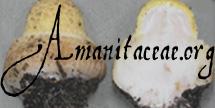
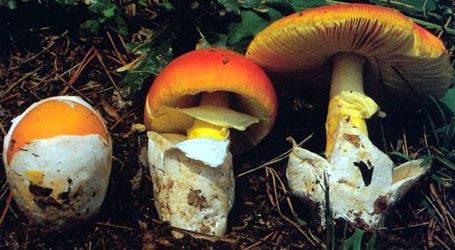
| cap | The cap of A. bingensis is 40 - 50 mm wide, fleshy and firm over the stem, but merely a membrane in the outer third of the cap radius. Its margin is striate for at least one third of the cap radius. It is pale yellow and covered with orange, pulverulent remnants of the volva. These are most densely placed over the center. Its context is white. |
| gills | The gills are subfree, rounded at the cap margin, white, and edged with yellow pulverulence. In examining the remains of the type, one short gill was found; it was subtruncate. |
| stem | The stipe is 70 - 75 × 5 - 7 mm, yellow to yellow-orange and cylindric, with a white bulbous (ellipsoid) base about 18 × 11 mm and largely white; its context is white and hollow. The stipe is exannulate and decorated in the lower portion with orange remains of the pulverulent volva organized in one to three ridges around the bulb above its broadest part. |
| odor/taste | The taste is said to be mild. The odor is not recorded. |
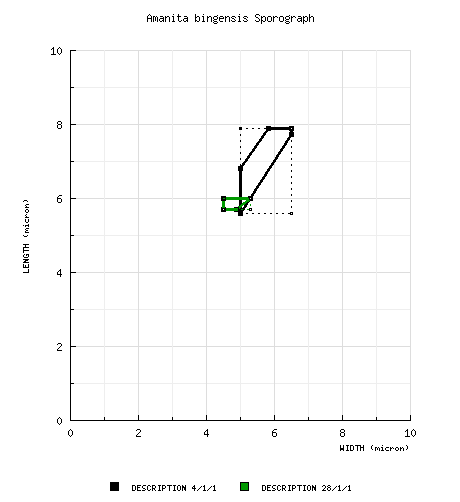
| spores | Measuring four, properly oriented, spores from the drawings of E.-J. Gilbert (1940) yields the very approximate dimensions of 6.5 - 8 × 5 - 6.5 µm (broadly ellipsoid to ellipsoid). Gilbert reported the spores to be inamyloid. In RET's examination of the type, he found remaining, undamaged spores to be (5.5-) 5.7 - 6.9 (-7.0) × (4.4-) 4.5 - 5.3 (-5.6) µm. Clamps are probably not present at bases of basidia. |
| discussion |
Amanita bingensis occurs scattered in dry tropical forest. This species, described originally from the Democratic Republic of Congo, is known only from Central Africa. A recent collection from São Tomé e Príncipe (temporarily called "A. sp-DED-7271" may be assignable to the present species. A somewhat similar, but more robust and redder entity has been collected in Zambia (A. sp-Arora-00-328) and is depicted in the picturebook/checklist for subsaharan Africa (here).—R. E. Tulloss |
| brief editors | RET |
| name | Amanita bingensis | ||||||||||||||||||||
| author | (Beeli) R. Heim. 1940. Rev. Mycol. (Paris) 5: 22, figs. 1-3. | ||||||||||||||||||||
| name status | nomen acceptum | ||||||||||||||||||||
| english name | "African Orange-Volva Amanita" | ||||||||||||||||||||
| synonyms |
≡Amanitopsis bingensis Beeli. 1931. Bull. Soc. Roy. Bot. Belgique 63: 108, pl. 9 (fig. 15). ≡Amanitaria bingensis (Beeli) E.-J. Gilbert. 1940. Iconogr. Mycol. (Milan) 27, suppl. (1): 76, tab 11 (fig. 3). The editors of this site owe a great debt to Dr. Cornelis Bas whose famous cigar box files of Amanita nomenclatural information gathered over three or more decades were made available to RET for computerization and make up the lion's share of the nomenclatural information presented on this site. | ||||||||||||||||||||
| MycoBank nos. | 284049, 284088, 156824 | ||||||||||||||||||||
| GenBank nos. |
Due to delays in data processing at GenBank, some accession numbers may lead to unreleased (pending) pages.
These pages will eventually be made live, so try again later. Search:
Showing 0 to 0 of 0 entries | ||||||||||||||||||||
| holotypes | BR | ||||||||||||||||||||
| type studies | Tulloss, herein. | ||||||||||||||||||||
| selected illustrations |
Beeli. 1935. Fl. Iconogr. Congo: 22, pl. 4 (fig. 4). E.-J. Gilbert. 1941. Iconogr. Mycol. (Milan) 27, suppl.: 253, tab. 19. | ||||||||||||||||||||
| intro |
The following text may make multiple use of each data field. The field may contain magenta text presenting data from a type study and/or revision of other original material cited in the protolog of the present taxon. Macroscopic descriptions in magenta are a combination of data from the protolog and additional observations made on the exiccata during revision of the cited original material. The same field may also contain black text, which is data from a revision of the present taxon (including non-type material and/or material not cited in the protolog). Paragraphs of black text will be labeled if further subdivision of this text is appropriate. Olive text indicates a specimen that has not been thoroughly examined (for example, for microscopic details) and marks other places in the text where data is missing or uncertain. The following material not directly from the protolog of the present taxon is based upon revision of the type by R. E. Tulloss. | ||||||||||||||||||||
| pileus | 40–50+ mm wide, pale yellow, broadly convex; context white, firm, fleshy, becoming membranous in outer third of cap radius; margin striate (0.35±); universal veil pulverulent, orange, densely distributed over disc. | ||||||||||||||||||||
| lamellae | from protolog: subfree, density not recorded, white, rounded at pileus margin, marginate with yellow pulverulence; lamellulae abruptly truncate to subtruncate, amount of variation in length unknown, frequency unknown. | ||||||||||||||||||||
| stipe | 70–75 × 5–7 mm, yellow to yellow-orange, cylindric to subcylindric, with fibrous surface; bulb ellipsoid, approximately 18 × 11 mm, largely white (especially below universal veil remnants); context hollow, white; exannulate; universal veil as orange pulverulence distributed in 1–3 ridges around bulb above bulb’s broadest part, floccose, friable, fugacious. | ||||||||||||||||||||
| odor/taste | Odor not recorded; taste mild. | ||||||||||||||||||||
| macrochemical tests |
none recorded. | ||||||||||||||||||||
| basidiospores |
Gilbert (1940): [4/1/1] 5.6 - 7.9 × 5.0 - 6.5 μm, (Q = 1.19 - 1.36; Q = 1.28). [Note: Spore measurements are taken from the four drawings of (Gilbert 1940: tab. XI (fig. 3)) that are in apparent lateral view.—ed.] From type RET: [28/1/1] (5.5-) 5.7 - 6.0 (-7.0) × (4.4-) 4.5 - 5.3 (-5.6) μm, (L = 6.3 μm; W = 4.9 μm; Q = (1.15-) 1.17 - 1.42 (-1.49); Q = 1.29), hyaline, colorless, smooth, thin-walled, inamyloid, broadly ellipsoid to ellipsoid, at least somewhat adaxially flattened; apiculus sublateral, cylindric, proportionately small; contents ??; ?? in deposit. [Note: The spores from the type of A. bingensis are not in good condition. They may be imperfectly inflated; this means that they may appear wider at present than when they were fresh, thus lowering the values of Q that were observed. Moreover, the range of length is abnormally brief; hence, we might assume that spores may have been larger in fresh material. The spore measurements from Gilbert (1940) are a further indication that the present (2009-10) state of the holotype is such that the spore data from the holotype cannot be fully trusted to accurately represent the taxon.] | ||||||||||||||||||||
| ecology | Solitary. At approx. 400-450 m elev. In dry forest. | ||||||||||||||||||||
| material examined | CONGO, DEMOCRATIC REPUBLIC OF: PROV. EQUATEUR—Territoire Lisala - Binga [2°23'41" N/ 20°25'25" E, 361 m], 18.ix.1929 M. Goossens-Fontana 890 (holotype, BR MYC031057, 17). | ||||||||||||||||||||
| discussion |
RET: The type of this species is the only specimen in BR determined as A. bingensis. It is divided into two parts. From the condition of the two halves, it appears that the specimen was divided in half longitudinally. One half appears to have been dried rather quickly. The other half may have served as a model for the aquarelle painted by Mdm. Goossens-Fontana; prior to drying, it appears to have undergone extensive decay—at the stipe apex and throughout the pileus disc and the parts of the lamellae underlying the disc. The damaged half is contained within a small, cardboard box that originally contained slide cover slips. The damaged half was judged not a reliable source of information on the species and was not utilized in RET's study of the type. The remaining half of the type is enclosed in a packet folded from waxed paper, with a slip giving limited information about the collection. This first packet is then enclosed in a larger, folded waxed paper packet with the complete herbarium label. Both halves of the collection are contained in a sturdy cardboard box. For sporograph comparison with recent material (A. sp-DED-8271) that may belong in the present species, see the following figure: The following figure provides a comparison of the present species and the east African material of A. sp-Arora-00-328: | ||||||||||||||||||||
| citations | —R. E. Tulloss | ||||||||||||||||||||
| editors | RET | ||||||||||||||||||||
Information to support the viewer in reading the content of "technical" tabs can be found here.
| name | Amanita bingensis |
| bottom links |
[ Keys & Checklists ] [ Subsaharan List ] |
| name | Amanita bingensis |
| bottom links |
[ Keys & Checklists ] [ Subsaharan List ] |
 Spore data sets and their composite
Each spore data set is intended to comprise a set of measurements from a single specimen made by a single observer; and explanations prepared for this site talk about specimen-observer pairs associated with each data set. Combining more data into a single data set is non-optimal because it obscures observer differences (which may be valuable for instructional purposes, for example) and may obscure instances in which a single collection inadvertently contains a mixture of taxa.

Text and User-Generated Sporographs are published under the Creative Commons License.

In the case of a taxon page, image credits are on the 'image' tab.