

| name | Amanita sp-CR14 |
| name status | cryptonomen temporarium |
| author | Tulloss and Halling |
| images |
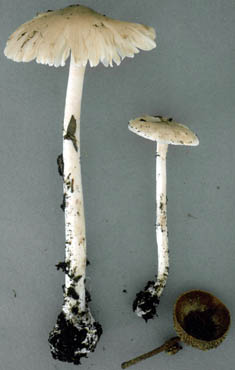 1. Amanita sp-CR14, La Chonta, Ctn. Dota, Prov. San José, Costra Rica (RET 331-8). |
| intro | The following is based on original research of R.E. Tulloss. |
| cap | The pale gray to pale brown cap has a darker rounded knob in the center and is 30-76 mm wide. The colors are darker in older specimens, and there is no staining or bruising reaction. The cap is planar to planoconvex. The cap's flesh is white, 1.5 - 4.5 mm thick, and thins evenly to the cap's edge. The edge is not grooved except in aged specimens and no volval remnants remain attached to the cap. |
| gills | The crowded gills are free from the stem, and no downward line descends onto the upper stem; they are 2.5 - 4.5 mm broad. The short gills are plentiful and of diverse lengths. |
| stem | The white, slightly longitudinally grooved stem is 76 - 119 × 3.5 - 8 mm, narrows upward, and flares at the top. The stem has no staining or bruising reaction. The bulb at the stem's base is 7 -19 x 10.5 - 19.5 mm and is flattened horizontally. The stem's white flesh is solid with a partially watersoaked central cylinder that is 1-2.5 mm wide. The white skirt-like ring is placed toward the top of the stem and is membranous; it collapses on the stem. Volval remnants are limbate as in Amanita bisporigera. |
| odor/taste | A slight odor of decay is present in younger specimens. Taste was not recorded. |
| discussion |
This little known entity has been collected at least twice
in Costa Rica. The collections were found growing by
themselves or paired at 1900 - 2400 m elevation in dark
wet loam of a forest with species of oak (Quercus
copeyensis, Q. seemannii and
Q. rapurahuensis) or in a mixed broad-leafed forest
with oak (Quercus seemannii dominant). This species has a very slender stem with a ring toward the top. Field notes distinguish this species from Amanita solaniolens (assignable to sect. Validae), which was collected on the same expedition to Costa Rica. Other field notes suggest comparisons with A. arocheae and A. eburnea. It appears to be a species of sect. Phalloideae.—R. E. Tulloss and N. Goldman |
| brief editors | RET |

