| name |
Amanita scalaris |
| author |
Tulloss |
| name status |
nomen provisorum |
| english name |
"Terraced Lepidella" |
| etymology |
scalaris, pertaining to, or resembling a flight
of stairs; because of the tiered form of universal veil
remnants on the upper bulb of this species. |
| GenBank nos. |
Due to delays in data processing at GenBank, some accession numbers may lead to unreleased (pending) pages.
These pages will eventually be made live, so try again later.
|
| intro |
Olive text indicates a specimen that has not been
thoroughly examined (for example, for microscopic details) and marks other places in the text
where data is missing or uncertain.
The following material is based on original research of R. E. Tulloss. |
| pileus |
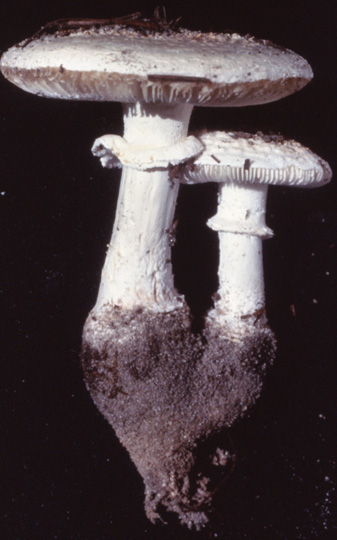
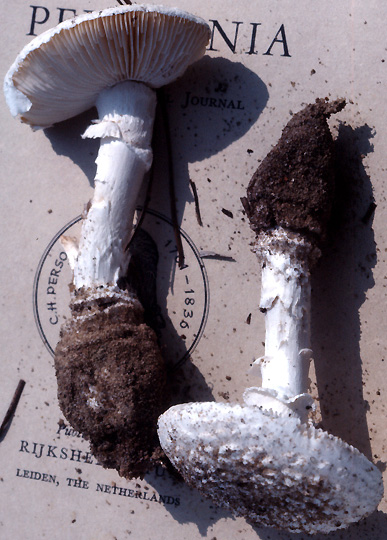
47 - 63 mm wide, white to off-white becoming pinkish brown from disc outward with age, sometimes with isolated rust-colored stain or stains, convex to planoconvex to planar, sometimes becoming slightly depressed in disc, shiny when dry, infrequently becoming areolate; context ?? mm thick above stipe, thinning evenly to margin; margin nonstriate, appendiculate, with sterile projecting limb; universal veil as concolorous warts (white at first, becoming tan or pinkish brown concurrently with surrounding surface), often densely placed, low, polygonally-based, broadly pyramidal, with sides appearing fibrous under 10× lens, becoming shapeless toward margin. |
| lamellae |
narrowly adnate with decurrent tooth, close to crowded, off-white to cream; lamellulae rounded truncate to rounded attenuate to attenuate, of diverse lengths, plentiful. |
| stipe |
85 - 110 × 7 - 17 mm, white, cylindric, sometimes with rusty stains near bulb; bulb 44 - 60 × 19 - 28 mm, usually radicating, dauciform or napiform or elongate-napiform or simply as radicating base of width not differentiated clearly from that of lower stipe, sometimes rather soft, sometimes with rusty stains; context white, solid, firm, sometimes with staining suggesting that of A. amerirubescens of sect. Validae; partial veil felted-membranous, persistent, rather narrow, superior, skirt-like, white to cream, sometimes with thickened margin, sometimes becoming lacerate; universal veil forming several (usually at least three) terrace-like or disc-like rings at bottom of stipe and on upper part of bulb, often adjacent, sometimes with upper rings separated from lower ones (and then upper rings suggesting "basal annulus"), with uppermost rings often complete, with lowest ring sometimes divided into warts. |
| odor/taste |
Odor lacking in young material, sometimes like carrion in age. Taste not recorded. |
macrochemical
tests |
Syringaldazine test for laccase - negative. Paracresol test for tyrosinase - positive throughout except for context of upper part of bulb. H2SO4 (conc.) - rapidly pink (less than 30 sec.) on pileipellis and in context of pileus and stipe, then fading away in less than 10 min.; negative on lamellae and in bulb context. Test vouchers: ??. |
| basidia |
42 - 68 × 9.5 - 11.5 μm, 4-sterigmate, ??; clamps not observed. |
| stipe context |
longitudinally acrophysalidic; filamentous undifferentiated hyphae ??; acrophysalides ??; vascular hyphae ??; clamps ??. |
| basidiospores |
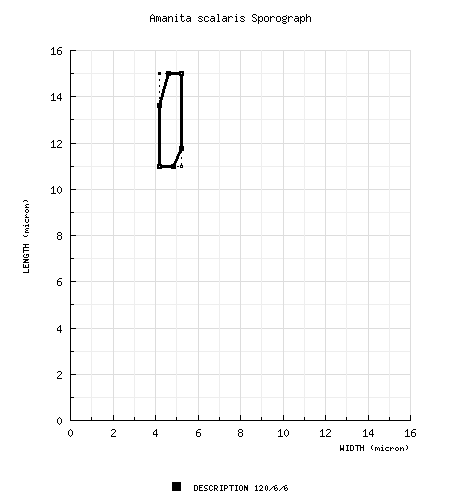
[120/6/6] (10.5-) 11.0 - 15.0 (-19.0) × (3.8-) 4.2 - 5.2 (-6.8) µm, (L = 12.1 - 14.0 µm; L’ = 13.2 µm; W = 4.5 - 5.2 µm; W’ = 4.8 µm; Q = (1.91-) 2.26 - 3.24 (-3.44); Q = 2.49 - 2.98; Q’ = 2.76), hyaline, colorless, thin-walled, smooth, amyloid, cylindric to bacilliform, sometimes constricted, sometimes slightly expanded at one end; apiculus sublateral, cylindric, sometimes proportionately broad; contents granular or monoguttulate; white in deposit. |
| ecology |
Solitary to subgregarious (occasionally as pair joined near base of bulb). New Jersey: At 15 - 30 m elev. In sand, amidst grass and lichens in pine-oak barrens including Pinus rigida, Quercus marilandica, Q. velutina, Q. alba [and/or Q. bicolor], Sassafras albidum, etc. with understory including Vaccinium and Smilax glauca. |
| material examined |
U.S.A.: NEW JERSEY—Burlington Co. - Chatsworth, Franklin Parker Preserve, "Speedwell" area, 22.vii.2012 John & Nina Burghardt & Igor Safonov s.n. (RET 503-10). Middlesex Co. - Jamesburg Twp., Jamesburg Twp. Pk., ca. Helmetta Pond [40°23’07” N/ 74°25’48” W, 17 m], 12.viii.1981 R. E. Tulloss 8-12-81-J (RET 172-10), 22.viii.1981 M. A. King & D. C., M. H. & R. E. Tulloss [Tulloss] 8-22-81-C (RET 322-4), 4.ix.1981 R. E. Tulloss 9-4-81-B (RET 171-9), -C (RET 171-10), 7.viii.1982 D. C. & R. E. Tulloss 8-7-82-B (RET 213-2), 13.viii.1982 M. A. King & R. E. Tulloss [Tulloss] 8-13-82-A (RET 341-10), -B (RET 213-10), M. A. King & D. C., M. H. & R. E. Tulloss [Tulloss] 8-13-82-D (RET 342-1), -E (RET 213-7), 7.viii.1983 M. A. King & D. C. & R. E. Tulloss [Tulloss] 8-7-83-F (RET 228-1), -G (RET 227-9), -H (RET 227-7), -I (RET 227-8), 16.viii.1984 C. Bas, D. T. Jenkins & R. E. Tulloss [Tulloss] 8-16-84-J (RET 207-7), 18.ix.1984 R. E. Tulloss 9-18-84-A (RET 237-6), -B (RET 237-3), 24.viii.1985 R. E. Tulloss 8-24-85-H (RET 098-9), -K (RET 098-7), 28.ix.1985 D. C. & R. E. Tulloss 9-28-85-B (RET 099-10), 28.ix.1986 D. C. & R. E. Tulloss 9-28-86-B (RET 022-5), 30.viii.1987 R. E. Tulloss 8-30-87-F (RET 017-7), 21.viii.1993 R. E. Tulloss 8-21-93-B (RET 097-1), M. A. King & S.E.K. & R. E. Tulloss [Tulloss] 8-21-93-D (RET 097-2). |
| discussion |
The present species can be assigned to Amanita subsect. Solitariae Bas.
This species is largely known from a single site at which it occurs with two more common species of Amanita subsect. Solitariae of somewhat similar habit: A. subcokeri and A. subsolitaria. The following figure provides comparison of sporographs for the three taxa:
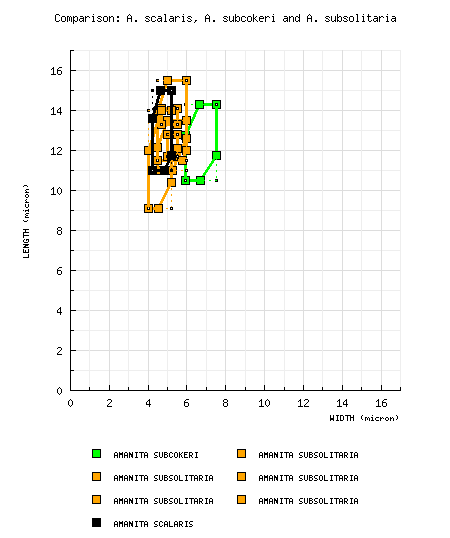
Note that the two species with annulate stipes (the present species and A. subcokeri) have disjoint sporographs.
The narrow spores of the present species might cause confusion with A. rhoadsii; however, the latter species does not have a membranous annulus at any stage of development. We are presently pursuing the issue of developing more details separating these two taxa.
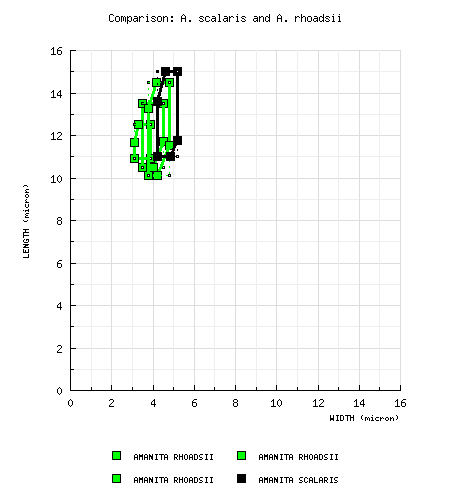
|
| citations |
Editor's note: This data field is temporarily being used to hold collections that appear to be excludable from the present taxon:
19.ix.1981 R. E. Tulloss 9-19-81-B (RET 172-4),
13.viii.1982 D. C., M. H. & R. E. Tulloss 8-13-82-C (RET 221-5),
11.ix.1982 R. E. Tulloss 9-11-82-D (RET 177-9),
7.viii.1983 M. A. King & D. C. & R. E. Tulloss [Tulloss] 8-7-83-E (RET 227-5),
18.viii.1983 R. E. Tulloss 8-18-83-F (RET 106-1),
28.vii.1985 D. C., M. H. & R. E. Tulloss 7-28-85-A (RET 202-9),
—R. E. Tulloss and C. Rodríguez Caycedo |
| editors |
RET |
|



 Spore data sets and their composite