| name |
Amanita rhoadsii |
| author |
(Murrill) Murrill. 1939. Bull. Torrey Bot. Club 66: 37. |
| name status |
nomen acceptum |
| synonyms |
≡ Venenarius rhoadsii Murrill. 1939. Bull. Torrey Bot. Club 66: 30.
The editors of this site owe a great debt to Dr. Cornelis Bas
whose famous cigar box files of Amanita nomenclatural information
gathered over three or more decades were made available to RET for computerization
and make up the lion's share of the nomenclatural information presented on this site.
|
| etymology |
genitive of Latinized name; hence, "Rhoads'" or "of Rhoads" |
| MycoBank nos. |
254370, 254373 |
| GenBank nos. |
Due to delays in data processing at GenBank, some accession numbers may lead to unreleased (pending) pages.
These pages will eventually be made live, so try again later.
|
| holotypes |
FLAS |
| type studies |
Jenkins. 1979. Mycotaxon 10: 188. |
| revisions |
Bas. 1969. Persoonia 5: 496, figs. 262-266. |
| intro |
The following text may make multiple use of each data field.
The field may contain magenta text presenting data from a type study
and/or revision of other original material cited in the protolog of the present taxon.
Macroscopic descriptions in magenta are a combination of data from the protolog and
additional observations made on the exiccata during revision of the cited original
material.
The same field may also contain black text, which is data from a revision of the present
taxon (including non-type material and/or material not cited in the protolog).
Paragraphs of black text will be labeled if further subdivision of
this text is appropriate.
Olive text indicates a specimen that has not been
thoroughly examined (for example, for microscopic details) and marks other places in the text
where data is missing or uncertain.
The following material not directly from (Bas 1969) or another cited researcher is based on original research by R. E. Tulloss. |
| pileus |
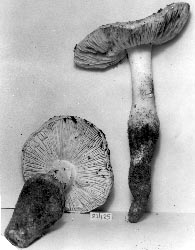
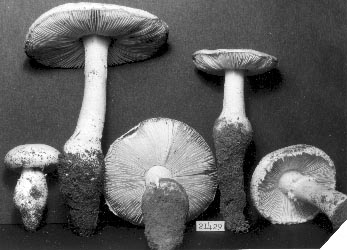
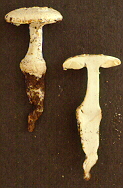
Bas (1969): 50 - 100 mm wide, white, convex to plano-convex, shiny, "probably subviscid"; context white, unchanging; margin nonsulcate, appendiculate; universal veil as large, slender, friable, conical warts when young "under favorable conditions," soon "becoming completely pulverulent-subverrucose or...breaking up into some pulverulent crusts or many small pulverulent patches or very small flocculose-pulverulent conical warts.
RET: 75 mm wide, white, convex, dull; context white, unchanging when cut or bruised, 13.5 mm thick at stipe; margin nonstriate, appendiculate, have a continuous sterile rim 2 - 3 mm wide; universal veil as thick white covering with occasional white peaks, ranging from felted to floccose or pulverulent, detersile at least in part, unchanging when cut or bruised. |
| lamellae |
Bas (1969): adnexed to adnate, moderately crowded to crowded, white to cream, "rather broad," with flocculose edge; lamellulae with shortest subtruncate, others attenuate.
RET: adnate with short decurrent line on stipe apex, subcrowded to crowded, cream in mass, pale cream in side view, unchanging when cut or bruised, up to 10.5 mm broad, edge minutely pulverulent; lamellulae rounded truncate to subattenuate to attenuate after a subtruncate step. |
| stipe |
Bas (1969): 70 - 180 × 7 - 20 mm, white, sometimes with subapical fugacious flocculose annular zone; bulb up to 35 mm wide, slender and deeply rooting or slenderly fusiform or fusiform or napiform; context white, unchanging; exannulate; universal veil apparently absent or as vague flocculose-felted ridge at top of bulb.
RET: 93 × 14.5 mm, white, with detersile dense flocculence, cylindric, unchanging when bruised, sometimes having subapical densely floccose zone; bulb 43 × 26 mm, fusiform to subnapiform, rooting, dog-legged; context white above, yellowish below, pale yellowish when bruised, solid; exannulate; universal veil in many concentric rings of small scales on lower stipe, extending at least as far down as broadest point of bulb. |
| odor/taste |
Bas (1969): Odor of "chloride of lime" or "old ham." Taste not recorded.
RET: Odor of “chlorine.” Taste not recorded. |
macrochemical
tests |
RET: Paracresol spot test for tyrosinase negative after 23 min. Syringaldazine spot test for laccase negative after 23 min. Test voucher: Tulloss 7-16-87-H |
| pileipellis |
Bas (1969): poorly developed, gelatinizing near surface only in age, consisting of interwoven hyphae 3 - 6 μm wide.
RET: apparently lacking. |
| pileus context |
RET: filamentous, undifferentiated hyphae 2.8 - 11.9 µm wide, plentiful, branching; inflated cells terminal, singly or in short chains, ellipsoid to elongate to clavate to broadly clavate to broadly ellipsoid, up to 135 × 88 µm, dominating, walls thin to slightly thickened; vascular hyphae 2.8* µm wide, uncommon; clamps prominent, common. |
| lamella trama |
Bas (1969): bilateral; clamps present. |
| subhymenium |
Bas (1969): ramose to inflated-ramose.
|
| basidia |
Bas (1969): 40 - 55 × 8 - 10 μm, 4-sterigmate; clamps present.
RET: ??; clamps prominent and plentiful. |
| universal veil |
Bas (1969): On pileus: yellowish in alkaline solution; filamentous hyphae rather scarce (in type) to rather abundant, up to 10 μm wide; inflated cells predominantly ellipsoid or elongate-ellipsoid or pyriform or clavate or subcylindric (up to 120 × 35 μm), with few globose or fusiform or irregular (up to 60 × 60 μm), in erect parallel rows; vascular hyphae scattered.
RET: On pileus: gelatinizing at surface; filamentous, undifferentiated hyphae 2.0 - 15.0 µm diam., branching, with walls thin or slightly thickened; inflated cells with periclinal orientation [?], collapsing and disordered, often containing a pale brown pigment in exsiccatum, terminal singly or (often) in short chains, pyriform to ellipsoid to broadly clavate to fusiform-elliptic to ventricose-rostrate, up to 118 × 21 µm in fresh material, up to 135 × 46 µm in exsiccatum, with walls thin or slightly thickened; vascular hyphae 1.7 - 6.6 µm wide, branching, infrequent, but locally common. From scales on lower stipe: ??. |
| stipe context |
Bas (1969): longitudinally acrophysalidic. |
| partial veil |
absent. |
| lamella edge tissue |
Bas (1969): as rather broad strip; filamentous hyphae present; inflated cells clavate to pyriform, 15 - 55 × 10 - 25 μm. |
| basidiospores |
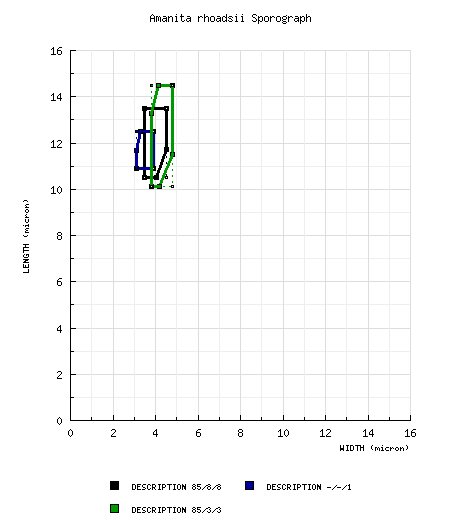
Bas (1969): [85/8/8] 10.5 - 13.5 (-15.5) × 3.5 - 4.5 μm, (Q = 2.6 - 4.2; Q = 3.0 - 3.4), colorless to yellowish, thin-walled, amyloid, cylindric to bacilliform, sometimes curved; apiculus not described; contents guttulate, refractive; color in deposit not recorded.
from type study of Jenkins (1979): [-/-/1]
10.9 - 12.5 × 3.1 - 3.9 μm, (Q = 2.70 - 3.77; Q = 3.24),
hyaline, thin-walled, amyloid, cylindric to bacilliform, often adaxially flattened; apiculus sublateral, cylindric; contents guttulate;
color in deposit not recorded.
composite of data from material revised by RET: [85/3/3] (9.8-) 10.1 - 14.5 (-18.5) × (3.5-) 3.8 - 4.8
µm, (L = 11.7 - 13.9 µm; L' = 12.1 µm; W = 4.1 - 4.3 µm; W' = 4.3 µm; Q = (2.22-) 2.40 - 3.49 (-4.14); Q = 2.66 - 3.25; Q' = 2.82), hyaline, smooth, thin-walled, amyloid, cylindric, slightly curved; apiculus sublateral, cylindric, proportionately small; contents granular to multiguttulate; color in deposit not recorded. |
| ecology |
Bas (1969): Terrestrial in deciduous (often Quercus) and coniferous woods in south-eastern USA.
Mississippi: In sandy soil of bottomland hardwood forest, no rain for a week, nearby trees include Acer rubrum, Pinus elliotii, Quercus muehlenbergii, and Ilex sp. |
| material examined |
Bas (1969): U.S.A.:
ALABAMA—Lee Co. - Auburn, 1.viii.1955 L. R. Hesler & Moore 21958 (TENN).
FLORIDA—Alachua Co. - Gainesville, 2.vii.1944 W. A. Murrill F 38904 (FLAS).
Hillsborough Co. - Tampa, 10.x.1948 G. F. Weber [Murrill] F 8568(ed.—out of sequence?)] (FLAS).
Leo Co. - Tallahassee, 30.vii.1954 L. R. Hesler & Campbell 21429 (TENN; L).
Putnam Co. - Lk. Rosa, 8.ix.1938 L. & A. S. Rhoads s.n. [W. A. Murrill} F 18125 (holotype, FLAS); ca. Melrose, 30.viii.1939 A. S. Rhoads s.n. [W. A. Murrill] F19911 (FLAS).
Wakulla Co. - St. Marks, 29.vii.1954 L. R. Hesler & Campbell 21429 (TENN; L).
SOUTH CAROLINA—Horry Co. - SW of Myrtle Beach, 28.vii.1948 W. C. Coker 14442 (NCU).
from type study of Jenkins (1979):
U. S. A.: FLORIDA— Putnam Co. - Lake Rosa,
8.ix.1938 A. S. Rhoads F. 18125 (holotype, FLAS).
U.S.A.: FLORIDA—Palm Beach Co. - W. Palm Beach, Lytel Pk., vii.2000 Hanna Tschekunow s.n. (RET 314-7).
MISSISSIPPI—Perry Co. - Black Creek Wilderness Area, 16.vii.1987 T. Baroni & D. Desjardin s.n. [Tulloss 7-16-87-H] (RET 060-3).
TEXAS—Hardin Co. - Larsen Sandyland Sanctuary, off St. Hwy. 327, 27.viii.1989 D. P. Lewis 4310 (F?; RET 146-1). |
| discussion |
Bas (1969):
"The long pointed warts on the cap mentioned by
Murrill in the protologue have disappeared from the
two dried type specimens nearly completely.
Their caps are now entirely pulverulent with only
scattered remnants of warts are in folds and
wrinkles. In most of the other collections
studied conspicuous warts are also lacking, except
in Rhoads F 19911, where quite number of them, up
to 4 mm long and 3 mm wide, have been
preserved. These warts are rather friable and
still more so is the layer of volva on which they
are situated. Apparently that is why in most
preserved specimens (and perhaps also in many
specimens in the field) the large warts have
disappeared and the caps are merely
pulverulent. Fairly often the remaining
pulverulent layer of the volva breaks up again into
large to small patches or even very small,
subconical warts, showing a somewhat shiny
pileipellis between. In young stages the
pileipellis is very difficult to locate but with
age it gelatinizes slightly at the surface when it
is exposed.
"The inflated cells in the warts on the cap are
very clearly arranged in erect, parallel
rows. More or less the same type of
arrangement is to be seen in the more pulverulent
basal layer of the volva on the cap.
"The slender, rooting base of the stem of the
largest type specimen [Bas
1969: fig.
265] is rather atypical for the species.
Usually there is a distinct, rather abrupt,
fusiform to napiform bulb with a more or less
rooting base. However, all transitional forms are
present in the specimens studied.
"Amanita rhoadsii differs
from...A.
subsolitaria,...occurring in the same area,
by its consistently narrower spores (width
3.5 - 4.5 μm against 4.5 - 6 μm), its smell
like "chloride of lime," and has larger, more often
clavate cells in the remnants of the volva on the
cap.
"The shape of the spores is similar to that in A. roanokensis, but in that species clamps are lacking and the structure of the volva is different." |
| citations |
—R. E. Tulloss |
| editors |
RET |
|



 Spore data sets and their composite