| name |
Amanita
pseudocrocea |
| author |
Tulloss nom. prov. |
| name status |
nomen provisorum |
| english name |
"Eastern American Saffron Ringless Amanita" |
| GenBank nos. |
Due to delays in data processing at GenBank, some accession numbers may lead to unreleased (pending) pages.
These pages will eventually be made live, so try again later.
|
| intro |
Olive text indicates a specimen that has not been
thoroughly examined (for example, for microscopic details) and marks other places in the text
where data is missing or uncertain.
The following material is based upon molecular
research of Dr. Linas Kudzma and other original
research by R. E. Tulloss. |
| pileus |
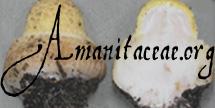
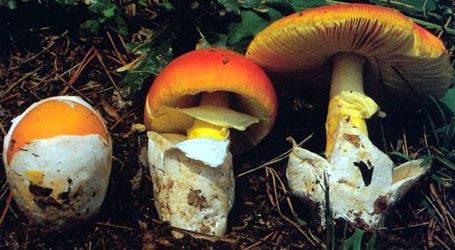
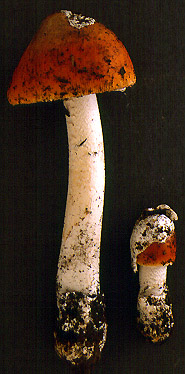
42 - 82 mm wide, pale brownish orange (more like A. velosa than like A. fulva) [7.5YR 7/6 (roughly equal to 6B3)] to orange (6A5) or peach-orange (near 5A4) with darker disc or orange-tan (5YR 6/8) and then paler at margin, sometimes becoming bleached to tannish over disc (similar to the change in A. cochiseana), subglobose to thimble-shaped at first with incurved margin, sometimes becoming broadly campanulate, later planoconvex, umbonate, tacky, dull; context white except for orange brown under pileipellis, with watersoaked line above stipe, underside (between lamellulae) becoming pale orange on drying, unchanging when cut or bruised, 2 - 6 mm thick at stipe, thinning evenly to a point about 2 - 5 mm from margin, then membranous to margin; margin striate (0.15 - 0.2R), deeply grooved, nonappendiculate; universal veil absent or as single patch covering much of disc, white or whitish, membranous, detersile, irregular, smooth, sometimes representing more than half of universal veil, with fibrillose-matted surface, sometimes showing some slight rusty brown bruising or staining. |
| lamellae |
free, without decurrent line on stipe, subdistant to
close to crowded, off-white to pale cream to cream to
yellowish cream to pale orangish cream in mass,
off-white to pale off-white to very pale cream in
side view, drying to a pale sordid yellow or pinkish
orange (5A4), with fine white flocculence on the
edges that browns in age or on drying or after injury, 3 - 6.5 mm
broad, sometimes forking, with some edges eroded
slightly; lamellulae truncate, rather
uncommon, sometimes with ten or more adjacent
lamellae having no intervening lamellulae, of
diverse lengths. |
| stipe |
38 - 146 × 7.5 - 17 mm, pallid, 5A2-3 or white below and very pale orangish white on up to upper two-thirds, sometimes slightly browning from handling, sometimes with dark brown fibrils, narrowing upward, flaring (sometimes barely) at apex, with orangish white region pulverulent or even as well-defined flocculose-pulverulent sheath at first (then striate from contact with lamellae), sometimes with distinct lower edge becoming orange-brown, sometimes with cortina-like arrangement of fibrils connecting pileus margin to sheath, later surface finely punctate near apex or with sheath cracking roughly horizontally and breaking up into scales, eventually finely longitudinally striatulate below with some small raised fibrils; context white, unchanging when cut or bruised, occasionally brown in larva tunnels, stuffed or hollow at first, eventually hollow and lined with longitudinally oriented densely packed white fibrils or stuffed just in base with white cottony material, having central cylinder 3 - 10 mm wide; exannulate; universal veil as saccate volva with up to 5 lobes, white at first, soon getting rusty or light brownish stains or spots where exposed, soft, smooth, membranous, leathery, rather tough, 17 - 37 × 10 - 23 mm, less than 1 mm thick at midheight of free limb, flaring at first, then becoming appressed to stipe, moderately easily broken into large fragments during expansion of basidiome, with point of attachment one fifth to two-thirds of limb’s length up from stipe base (depending on portion of volva left on pileus), with limbus internus rather small, apparently set rather low, probably at point of attachment with stipe to about one fifth of distance up free limb. |
| odor/taste |
Odor faintly fungoid or indistinct or pleasant. Taste not recorded.
|
macrochemical
tests |
Spot test for laccase (syringaldazine) - positive in undifferentiated tissue at stipe base and much of lower half of volva and negative throughout remainder of basidiome in both immature and mature material. Spot test for tyrosinase (paracresol) - rapidly positive throughout most of pileus and stipe context (less than 1 min.) and positive throughout basidiome in 5 - 10 min. in both immature and mature material. Test voucher: Tulloss 7-17-96-B. |
| pileipellis |
(15-) 20 - 80 µm thick, gelatinizing only at surface, lacking distinct suprapellis, pale yellow-orange near margin to brownish orange over disc and under universal veil patch or entirely yellow-orange, sometimes paler near surface, with addition of brownish tints when seen in mass; filamentous, undifferentiated hyphae 1.5 - 10.0 µm wide, branching, with those of largest diameter apparently at or near surface, with many subradially arranged, but also with many criss-crossing at diverse angles in moderately open fabric, occasionally with yellowish subrefractive walls (these most common below surface); vascular hyphae, 2.5 - 7.6 µm wide, occasionally branching, occasionally coiling or twisting, scattered to relatively common locally, not present in all mounts. |
| pileus context |
filamentous, undifferentiated hyphae ?? µm wide, ??; acrophysalides ??; vascular hyphae 6.1 - 10.5 µm wide, ??, golden. |
| lamella trama |
bilateral; wcs = ??; subhymenial base containing numerous rather large crowded inflated cells [subglobose (e.g., 31 × 27 µm) to ellipsoid (e.g., 34 × 19 µm) to clavate to ventricose]; filamentous, undifferentiated hyphae ?? µm wide, ??; divergent, terminal inflated cells ??; vascular hyphae 4.5 - 5.5 µm wide, ??, sinuous. |
| subhymenium |
wst-near = ?? µm; wst-far = ?? µm; rather shallow, subcellular; with basidia arising from ??. |
| basidia |
47 - 61 × 9.6 - 13.5 µm, 4-sterigmate, with sterigmata up to ?? × ?? µm; clamps not observed. |
| universal veil |
On pileus, upper surface: ??. On pileus, interior: ??. On pileus, bottom layer: 10 - 20 µm thick, colorless, similar to pileipellis in cross-section; filamentous, undifferentiated hyphae ?? µm wide, ??, densely packed, subgelatinized; vascular hyphae ??. On stipe base, exterior surface: 15 - 35 µm thick; filamentous, undifferentiated hyphae 1.0 - 7.5 µm wide, branching, partially gelatinized to ungelatinized, lacking dominant orientation, tangled in very open weave, occasionally in rather broad fascicles, with proportionately large gaps through which interior visible; vascular hyphae not observed. On stipe base, interior: filamentous, undifferentiated hyphae 2.4 - 12.7 (-15.0) µm wide, branching, interwoven in open lattice structure, often in fascicles, dominating, sometimes constricted at septa, with narrowly clavate intercalary and terminal segments rather common; inflated cells terminal, thin-walled, dominantly broadly clavate to clavate to narrowly clavate to subfusiform, also ellipsoid or broadly elllipsoid or subpyriform, up to 85+ × 53 µm, locally rather common, sometimes in small loose clusters; vascular hyphae 3.7 - 5.1 (-11.4) µm wide, unevenly distributed, scarce to locally moderately common, sinuous. On stipe base, inner surface: reminiscent of pileipellis in cross-section, 15 - 30 µm thick, colorless to faintly orangish or yellowish, gelatinized on surface, otherwise subgelatinized or not gelatinized; filamentous, undifferentiated hyphae 0.9 - 8.3 µm wide, branching, dominantly sublongitudinally oriented, closely packed; vascular hyphae not observed; inflated cells free in mount gelatinized, numerous, colorless, possibly(?) from friable part of limbus internus or remains of layer of inflated cells from lamella edge on limbus internus surface. |
| stipe context |
longitudinally acrophysalidic; filamentous, undifferentiated hyphae 1.9 - 6.4 µm wide, branching, dominating near surface; acrophysalides very slender, up to 343 × 30 µm, with walls 0.5 - 1.0 µm thick, dominating in interior; vascular hyphae not observed. |
| partial veil |
Floccose sheath of upper stipe: filamentous, undifferentiated hyphae ?? µm wide, ??; inflated cells ??; vascular hyphae ?? µm wide, ??. |
| lamella edge tissue |
up to five layers of inflated cells (quickly becoming gelatinized), globose to subglobose to subpyriform (e.g., 26 × 26 µm) or broadly clavate (e.g., 33 × 15 µm), thin-walled, arising from interwoven fascicle of closely packed hyphae (up to 11 or more hyphal diameters thick) running along lamella edge. |
| basidiospores |
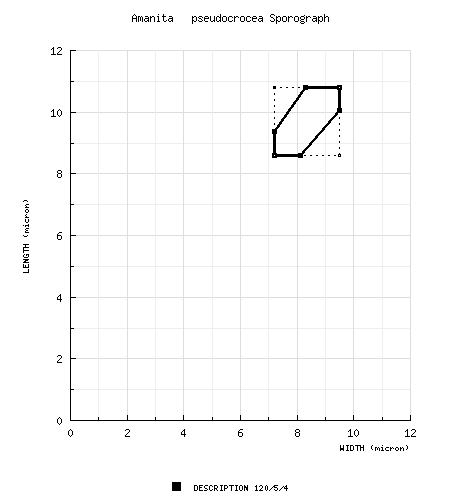
[120/5/4] (7.8-) 8.6 - 10.8 (-21) × (6.4-) 7.2 - 9.5
(-17.8) µm, (L = 9.2 - 10.1 µm; L’ =
9.7 µm; W = 7.5 - 9.2 µm; W’ = 8.4 µm;
Q = (1.05-) 1.06 - 1.30 (-1.59); Q = 1.10 -
1.20; Q’ = 1.15), hyaline, colorless, smooth,
thin-walled, inamyloid, globose to subglobose to
broadly ellipsoid, infrequently ellipsoid, often
adaxially flattened, often expanded at one end;
apiculus sublateral, truncate-conic to
cylindric, relatively large, occasionally broad and
short; contents predominantly monoguttulate;
?? in deposit. |
| ecology |
Solitary to subgregarious. Tlaxcala: At 2640± m elev. In open, dry, remnant forest of Quercus in thin, rather dry, friable loam and Quercus litter over volcanic tuff. Kentucky: In dark moist loam over limestone caves capped by sandstone, in mixed forest in which Acer sp. and Quercus alba are dominant, with Pinus strobus and Q. stellata. Missouri: In humus of upload Quercus-Carya flatwoods. Ohio: In hardwood forest. |
| material examined |
MÉXICO: JALISCO—Mpio
Atemajac de Brizuela - camino a Temajac de Brizuela,
km 4.5 del entronque Atemajac-Juanacatlán
Lagunillas, 14.viii.1995 O. Rodríquez 1204 (IBUG;
RET 276-2, nrITS seq'd.); Mpio. Ciudad Guzmán - Nevado de Colima,
camino de Ciudad Guzmán al Parq. Nac., El
Floripondio, 8.viii.1985 A. Loeza C. 158
(IBUG; RET 276-3, nrITS seq'd.); Mpio.
Tecolotlán - Sierra de Quila, km 16.3 del camino
de Tecolotlán a Quila, 16.vii.1994 M. L. Fierros
323 (IBUG; RET 276-1).
TLAXCALA—Mpio. Panotla - 1 km E of San Francisco Temezontla [19°20’41” N/ 98°16’31” W, 2640 m], 17.vii.1996 A. Montoya Esquivel & R. E. Tulloss 7-17-96-B (RET 252-2; TLXM).
U.S.A.: ARKANSAS—Pulaski Co. - unkn. loc., vii.1988 J. Justice s.n. [Tulloss 7-88-JJ1] (RET 265-3).
KENTUCKY—Laurel Co. - Levi Jackson
Wilderness Trail St. Pk. [37°04’51” N/
84°02’26” W,
356 m], 20.vii.1987 D. C. & R. E.
Tulloss 7-20-87-A (RET 087-6).
MISSOURI—Camden
Co. - ca. Camdenton, Ha Ha Tonka St. Pk., River
Cave, 24.vi.2009 Jay Justice s.n. [Tulloss
6-24-09-A] (RET 443-8).
OHIO—Preble Co. -
Somers Twp., Swan-Beatty Rd., Pleasant
Vineyard Retreat Ctr., sect. 20,
2.viii.1992 M. A. Vincent 5644
(MU F39176; RET 120-10).
[Also check
W. W. Patrick 2250 (9.ix.1970, E
side of Cleveland Lk., Onated (sp?) St.
Game Area, Lenawee Co., MI) in
MICH.] |
| discussion |
t.b.d.
Tulloss 7-27-87-A bore no mature basidia.
Tulloss formerly referred to this taxon as "Amanita sp. W10." |
| citations |
—R. E. Tulloss and L. V. Kudzma |
| editors |
RET |
|



 Spore data sets and their composite