| name |
Amanita americrocea |
| author |
Tulloss nom. prov. |
| name status |
nomen provisorum |
| english name |
"Western American Saffron Ringless Amanita" |
| etymology |
elision of "America" and "crocea"; hence, American crocea |
| GenBank nos. |
Due to delays in data processing at GenBank, some accession numbers may lead to unreleased (pending) pages.
These pages will eventually be made live, so try again later.
|
| intro |
Olive text indicates a specimen that has not been
thoroughly examined (for example, for microscopic details) and marks other places in the text
where data is missing or uncertain.
The following is based upon
original research by R. E. Tulloss. |
| pileus |
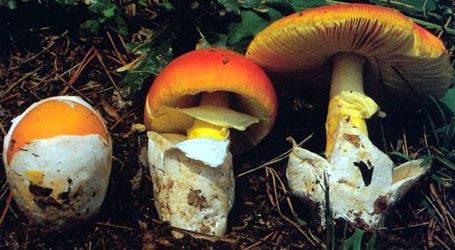
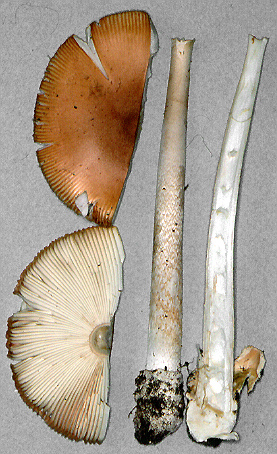
70 - 122 mm wide, yellow-orange at first, then burnt orange to orange-tan (near ISCC-NBS 71 M OY) to 7.5YR 8/6 and somewhat metallic, developing brown or olivaceous brown tint over disc, ovoid at first, then broadly campanulate with decurved margin, then broadly convex with broad umbo, dry, shiny over margin, becoming dull and hispidulose (having short fine and somewhat sparsely distributed upstanding hairs, under 10× lens) over disc within region of 35± mm diameter, becoming metallic shiny on drying slightly in situ; context white to cream except for yellow to orange under pileipellis, not changing when cut or bruised, 5 - 11 mm thick at stipe, thinning evenly to margin or very near it; margin striate [0.3R (-0.6R)], nonappendiculate; universal veil absent; pileipellis deep orange in cross section even when surface dull and faded. |
| lamellae |
free, close to crowded, cream to off-white in mass, pale cream in side view, unchanging when cut or bruised, drying pale orangish cream, 3 - 8.5 mm broad, with last few mm of edge nearest pileus margin concolorous with pileus surface; lamellulae truncate, unevenly distributed, of diverse lengths, attached to either stipe or pileus margin, plentiful in some sectors, not plentiful in others. |
| stipe |
127 - 155 × 8 - 17.5 mm, with off-white to cream ground, narrowing upward, flaring at apex at maturity, with obconic base, having surface decorated with pallid to pale orange fibrils above volval sac, becoming upward pointing fibrillose scales, with these scales very rapidly becoming orange-brown from handling; context white to off-white, sometimes orange under stipipellis, partially hollow or stuffed with tightly packed white material, with central cylinder 3 - 11 mm wide; exannulate; universal veil as saccate volva, membranous, smooth, exterior white with orange-brown stains or spots, inner surface palely concolorous with pileus and orangish at least in upper portion as dried, 25 - 59 × ? - 35 mm, 1.5 - 2.5 mm thick at midpoint of limb, with point of attachment rather low? on stipe; limbus internus ?. |
| odor/taste |
not recorded. |
macrochemical
tests |
none recorded. |
| pileipellis |
85 - 140 µm thick, yellow-orange, gelatinized only just at surface; filamentous, undifferentiated hyphae ? µm wide, ?, in subradially oriented fascicles criss-crossed by other fascicles; vascular hyphae 4.8 - 16.5 µm wide, branching, yellow to yellow-orange to deep orange, common, occasionally sinuous; no clamps observed. |
| subhymenium |
wst-near = ? µm; wst-far = ? µm; cellular, with cells up to 24 × 17.5 µm, apparently including uninflated hyphal segments, with at least 2 to 4 cells between subhymenial base and base of nearest basidium/-ole in local region, with 3 to 6 cells between subhymenial base and base of most distant basidium/-ole in local region, with basidia arising from inflated cells ??. |
| basidia |
40 - 53+ × (7.5-) 8.5 - 12.5 (-13.0) µm, 2- and 4-sterigmate, with sterigmata up to ? × ? µm; clamps not observed. |
| universal veil |
On pileus: absent. On stipe base, exterior surface: as layer 20 - 30 µm thick; filamentous, undifferentiated hyphae 2.3 - 6.1 µm wide, branching, interwoven with many proportionately large gaps through which interior visible, partially to largely gelatinized just in surface hyphae, otherwise barely or not at all gelatinized, without dominant orientation; vascular hyphae not observed. On stipe base, interior: filamentous, undifferentiated hyphae 2.3 - 10.2 µm wide, branching, interwoven (singly or in fascicles) in open lattice structure, occasionally with yellowish subrefractive walls, occasionally with narrowly clavate (e.g., 13 × 16.5 µm) to narrowly fusiform intercalary segments, with some tip segments very narrowly clavate (e.g., 61 × 12.7 µm); inflated cells terminal, thin-walled, narrowly clavate to clavate to subovoid (up to 100 × 47 µm or larger), scattered to rather common, apparently occasionally in small clusters; vascular hyphae not observed. On stipe base, inner surface: predominantly like interior, but slightly gelatinized, with scant remains of thin layer of hyphae present as isolated groups or small patches of fascicles, with such remains yellow-brown or brown-orange and often extensively gelatinized, with some hyphae in such remains having dominantly sublongitudinal oriented and others disoriented comprising interwoven fascicles. |
| partial veil |
absent. |
| lamella edge tissue |
filamentous differentiated hyphae in fascicles 7 - 8 hyphae wide running parallel to lamella edge; inflated cells in scattered clusters 2-5 cell deep (in facial view of lamella), partially gelatinized, collapsed. |
| basidiospores |
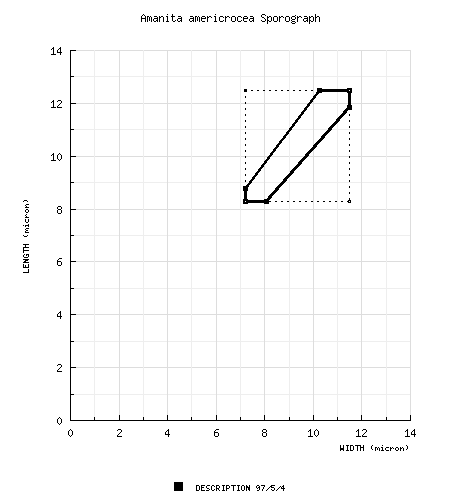
[97/5/4] (7.4-) 8.3 - 12.5 (-20) × (6.8-) 7.2 - 11.5
(-14.5) μm, (L = 8.8 - 9.8 (-11.4) μm;
L' = 9.9 μm; W = 7.9 - 9.1 (-10.0) μm;
W' = 8.9 μm; Q = (1.02-) 1.03 - 1.22 (-1.36);
Q = 1.07 - 1.15; Q' = 1.11), hyaline,
colorless, thin-walled, smooth, inamyloid, globose to
subglobose to broadly ellipsoid, infrequently
ellipsoid, occasionally lachrymiform, often
adaxially flattened; apiculus sublateral,
truncate conic; contents mono- to
multiguttulate with or without additional small
granules; white in deposit. |
| ecology |
Solitary to subgregarious. Colorado: At up to 1990± m elev. Under conifers. Minnesota: In sandy soil near Betula with scattered Pinus strobus and Quercus sp. throughout area of alternating sand islands and wetlands with old, well-decayed trunks of Pinus and Quercus scattered through wooded parts. South Dakota: In grassy clearing of P. contorta forest with young trees. Wyoming: With Populus tremuloides. |
| material examined |
U.S.A.:
COLORADO—Douglas Co. - Pike Nat. For., Indian Crk. Campground. [39°22'31" N/ 105°05'53"W], 17.viii.1991 Jerry Lavelle s.n. (DBG 18864).
MINNESOTA—Anoka Co. - Ham Lk., ix.1997 D. Johannes s.n. [A. Gerenday 1024] (MPPD; RET 271-9). Chisago Co. - E of Stacy, Carlos Avery Wildlife Refuge, ca. Sunrise R., 9.viii.1997 Anna Gerenday 1023 (MIN; RET 266-2). Unkn Co. - unkn. loc., 26.ix.1994 member Minn. Mycol. Soc. s.n. (RET 136-3).
NORTH CAROLINA—Transylvania Co. - Dupont St. For., 2nd tr. to waterfall, 15.viii.2009 J. Justice NC-AM-19 (RET 452-2).
SOUTH DAKOTA—?.
WYOMING—Teton Co. - Teton Nat. Pk., Reid Mtn., 13.viii.1997 Joseph Ammirati s.n. [Tulloss 8-13-97-JA] (RET 265-6). |
| discussion |
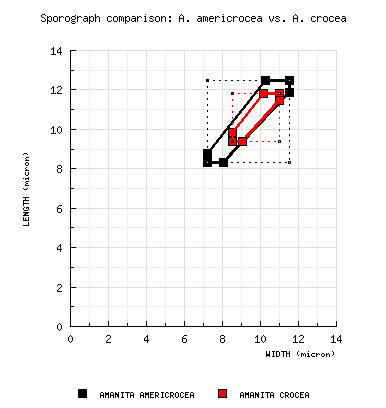
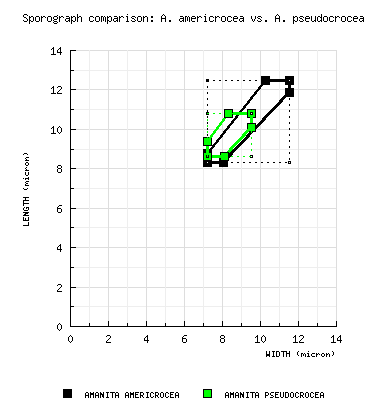
This species is distinguished from A. pseudocrocea by having slightly larger spores (see comparative sporographs below), having a somewhat thicker pileipellis, lacking a robust (pileipellis-like) inner surface layer of the universal veil at the stipe base, and having the longest marginal striations of any taxon in the "crocea group."
For purposes of comparison, spore data (red figure) for A. crocea are presented here: [521/27/18] (8.0-) 9.4 - 11.8 (-18.8) × (7.5-) 8.5 - 11.0 (-16.0) µm, (L = (9.8-) 10.0 - 11.1 (-11.3) µm; L’ = 10.6 µm; W = (8.9-) 9.1 - 10.5 µm; W’ = 9.7 µm; Q = (1.01-) 1.04 - 1.16 (-1.28); Q = 1.07 - 1.10 (-1.11); Q’ = 1.10).
For purposes of comparison, spore data (green figure) for A. pseudocrocea are presented here: [120/5/4] (7.8-) 8.6 - 10.8 (-21) × (6.4-) 7.2 - 9.5 (-17.8) µm, (L = 9.2 - 10.1 µm; L’ = 9.7 µm; W = 7.5 - 9.2 µm; W’ = 8.4 µm; Q = (1.05-) 1.06 - 1.30 (-1.59); Q = 1.10 - 1.20; Q’ = 1.15).
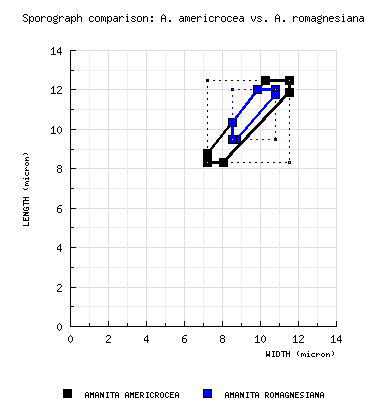
Amanita americrocea differs from all the European taxa in this group as well. Besides the marginal striations mentioned above, the present species has a thinner pileipellis than any of the European taxa. Of the European taxa, it appears most similar to A. romagnesiana Tulloss, but that species apparently lacks vascular hyphae in the pileipellis as well as having the other differences cited for European taxa in general.
For purposes of comparison, spore data (blue figure) for the neotype of A. romagnesiana are presented here: [40/1/1] (8.0-) 9.5 - 12.0 (-16.0) × (7.5-) 8.5 - 10.8 ( 14.2) µm, (L = 10.8 µm; W = 9.5 µm; Q = (1.07-) 1.09 - 1.22 (-1.31); Q = 1.14).
Blaaaa....
In mid-August, 2010, a collection that fits the provisional description of A. barrowsii A. H. Sm. nom. prov was photographed by Noah Siegel at the NAMA foray in Colorado [see mushroomobserver.org observation #50248]. This called RET's attention to the striking similarity between that provisional taxon and the present one. This similarity will be the subject of continuing research. If, indeed, it is found that the two provisional names apply to a single taxon, then RET's preference will be to use Smith's name—A. barrowsii.
DBG 18865 (not listed in the material examined) is
likely to belong to the present species based on
macroscopic characters, the minute hairs over the
pileipellis (seen in dried material), the typical
branching vascular hyphae in the pileipellis, and
the collection area ("Front Range,"
Colorado).
The greatest difficulty in resolving support for this
provisional species is that none of the specimens
listed in the "material examined" data field (above)
has yielded DNA.
Amanita americrocea has appeared in my
correspondence, keys, and foray lists as
Amanita sp. MN1 and A. sp. WY2. |
| citations |
—R. E. Tulloss |
| editors |
RET |
|



 Spore data sets and their composite