| name |
Amanita pruittii |
| author |
A. H. Sm. ex Tulloss, J. Lindgr. &
Arora. 2015. Amanitaceae 1(1): 1. |
| name status |
nomen acceptum |
| english name |
"Pruitt's Lepidella" |
| etymology |
protolog: In honor of the late Mr. Ben Pruitt (1888-1993), farmer, shopkeeper, avid naturalist, founder of historical and nature societies, environmentalist, and amateur mycologist who, at the age of 88 (when the type collection of A. pruittii was made), was actively collecting, photographing, and writing field descriptions of fungi. He is said to have been able to call wild birds to his hand.
[Note: The epithet was originally proposed by the late Dr. A. H. Smith in correspondence with Mr. Pruitt and appears with a draft description in an unpublished manuscript of Smith (MICH).] |
| MycoBank nos. |
564280 |
| GenBank nos. |
Due to delays in data processing at GenBank, some accession numbers may lead to unreleased (pending) pages.
These pages will eventually be made live, so try again later.
|
| intro |
The following text may make multiple use of each data field.
The field may contain magenta text presenting data from a type study
and/or revision of other original material cited in the protolog of the present taxon.
Macroscopic descriptions in magenta are a combination of data from the protolog and
additional observations made on the exiccata during revision of the cited original
material.
The same field may also contain black text, which is data from a revision of the present
taxon (including non-type material and/or material not cited in the protolog).
Paragraphs of black text will be labeled if further subdivision of
this text is appropriate.
Olive text indicates a specimen that has not been
thoroughly examined (for example, for microscopic details) and marks other places in the text
where data is missing or uncertain.
The following material not cited as the work another researcher is based on original laboratory research and field work by R. E. Tulloss, J. E. Lindgren, Benjamin Wolfe, and David Arora. |
| pileus |
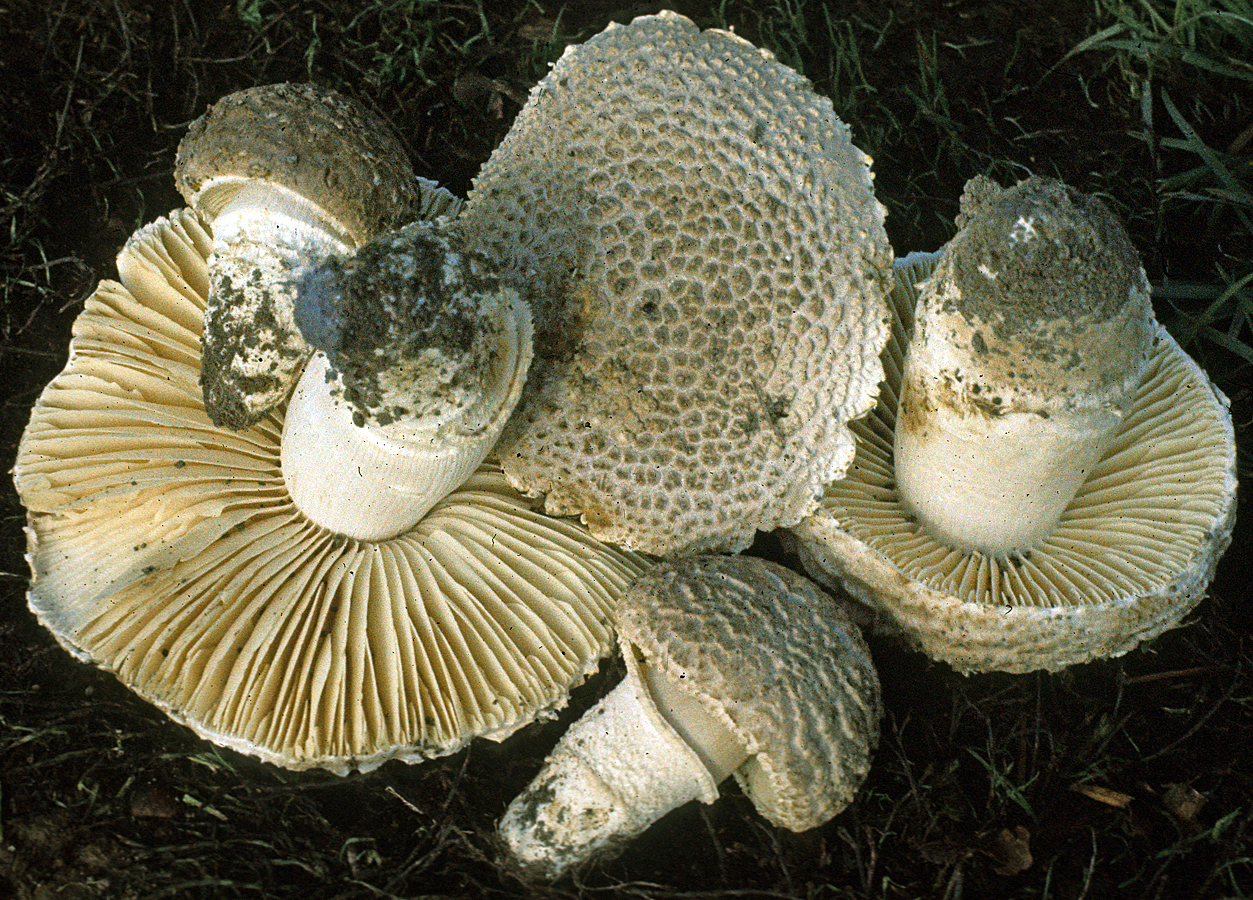
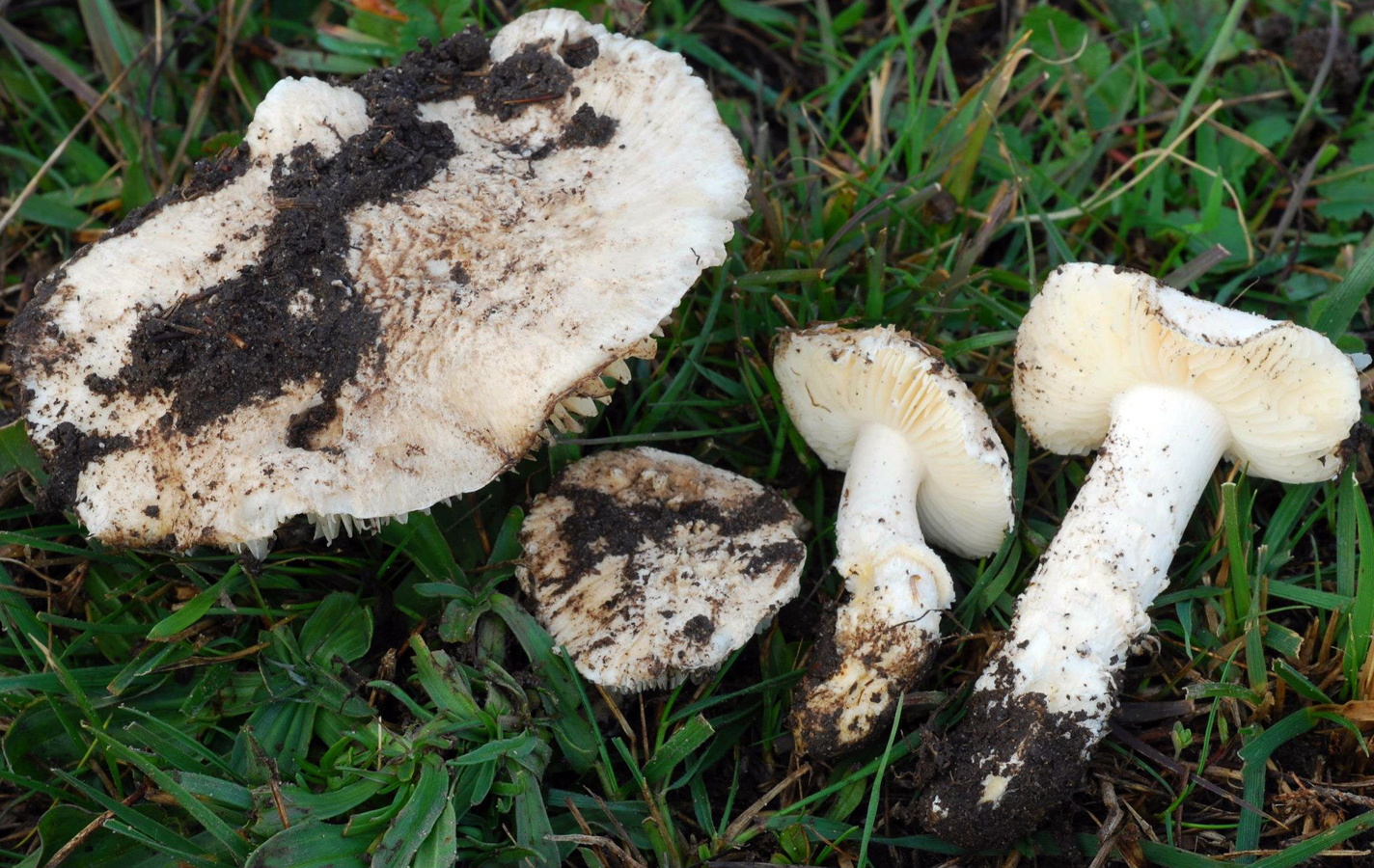
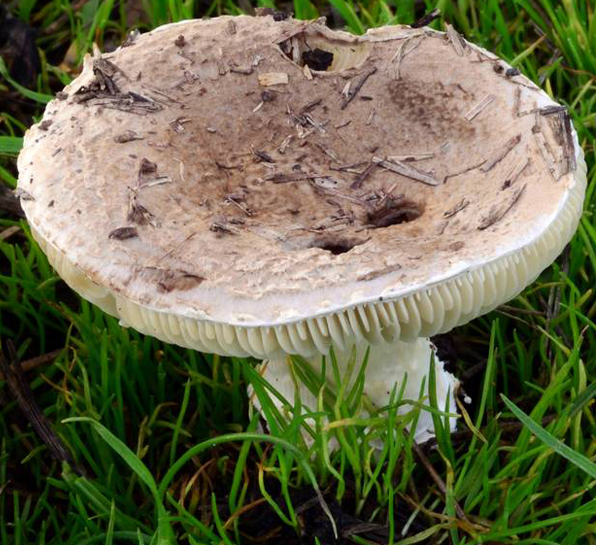
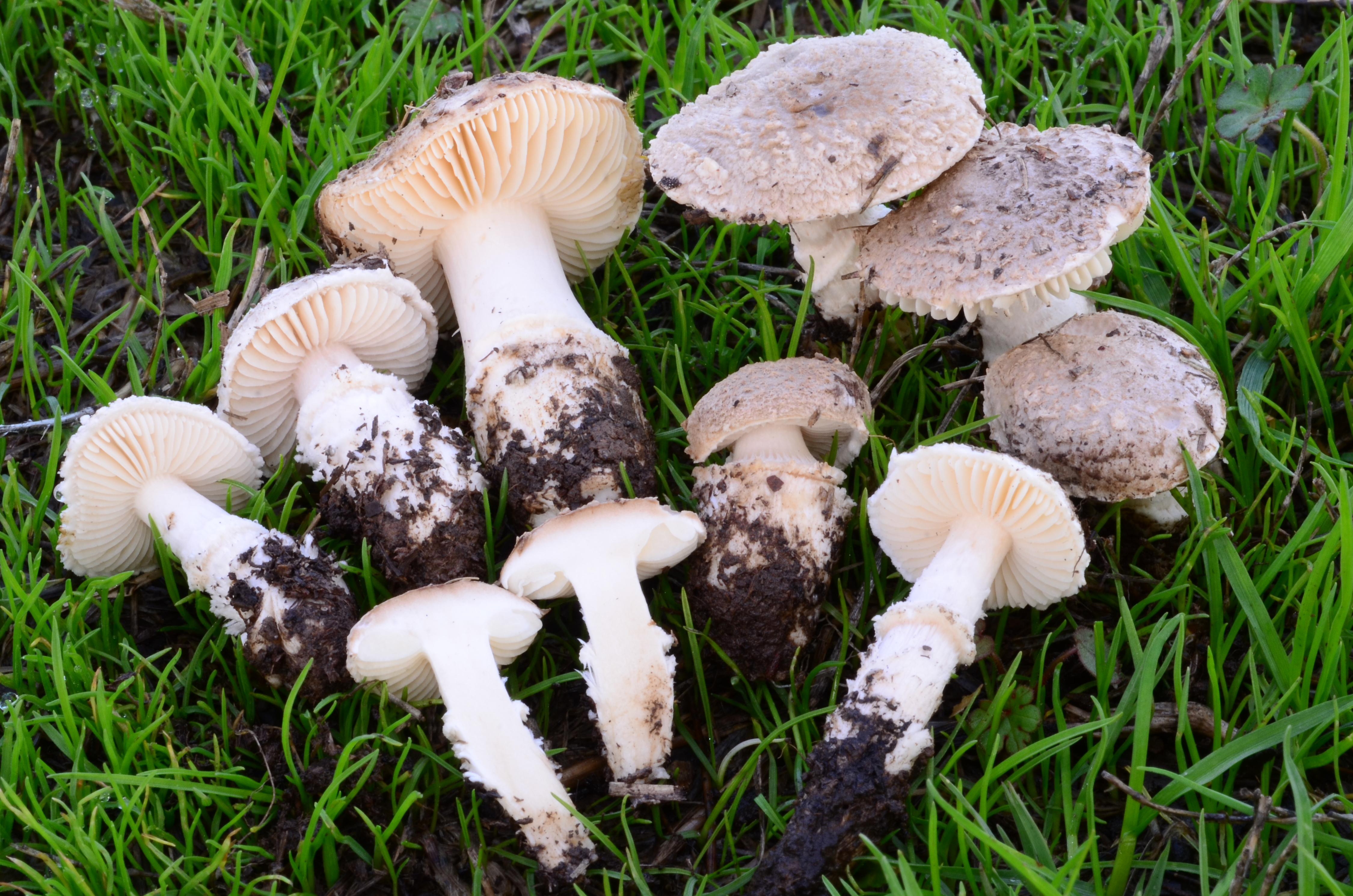
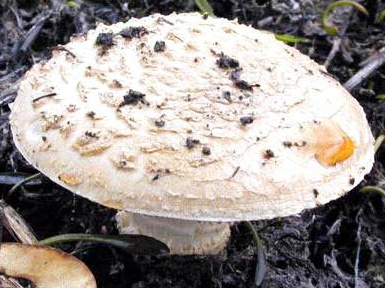
protolog: 20 - 150 mm wide, with color and appearance dominated by universal veil at first, later with context exposed between areas covered by universal veil (hence, see descriptions of universal veil and context, below), subhemispheric to hemispheric with decurved to incurved margin at first, becoming convex to plano-convex to planar or having margin uplifted in
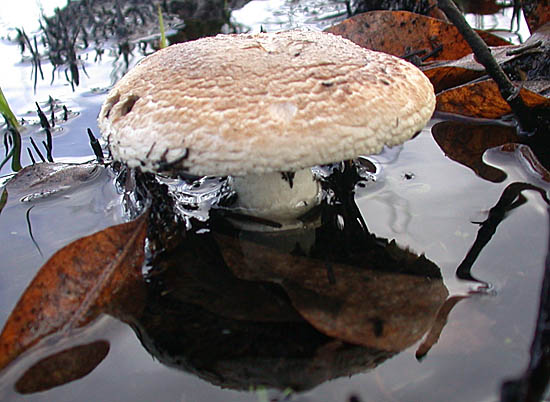
maturity, tacky to dry, with exposed context subshiny to dull or somewhat satiny in some exsiccata; context white to off-white, with proportionately thick gray-brown or orangish gray-brown region below pileus surface in older or bruised specimens, with same region sometimes pinkish to reddish in specimens growing in watersoaked soil, with lower pallid portion
discoloring slowly brownish after sectioning, 5 - 16 mm thick at stipe, thinning evenly to margin (1 mm or more thick at margin in some specimens);
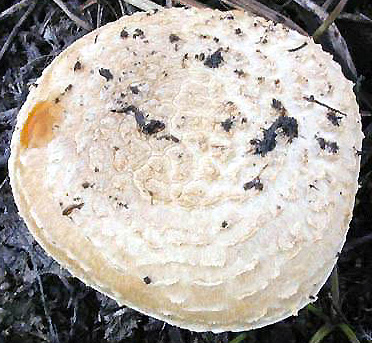
margin nonstriate, appendiculate with ephemeral bits of partial veil (pale cream, subrectangular to irregular) and with apparent sterile extension from margin 1± mm wide in one exsiccatum (Norton s.n.); universal veil; as densely distributed minutely verruculose irregular or subpolygonal small warts and squamules, flattened, sometimes confluent and then taking the form of irregular patches or broken concentric bands, near margin as fasciculate fibers, with color highly variable due to environmental conditions or physical damage[often white or whitish to brownish gray or tannish gray (about 10YR 5/3 in unstained areas of mature pilei) at first, sometimes pallid orangish to pale ochraceous at first, at times becoming reddish brown or orangish brown (orange and red tints sometimes faint at first) in whole or in part, sometimes paler in age, alternatively sometimes brown-gray to dark gray at maturity]. |
| lamellae |
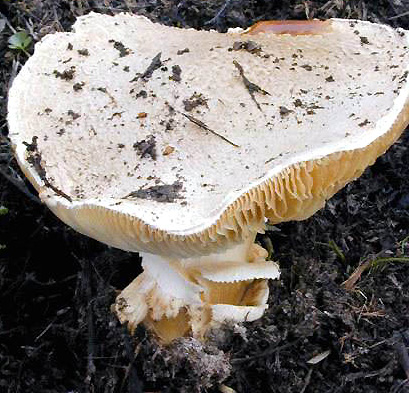
protolog: free to narrowly adnate to adnate, with long decurrent line on upper stipe (quite noticeable in larger specimens), subcrowded to crowded to subclose to close, occasionally subdistant, white to off-white to pale cream to dirty cream to pinkish cream to watery pale yellowish to pale ochraceous in side view, often watersoaked yellow-cream in age in side view, unchanging when cut or bruised, drying sordid yellowish tan (5B4) to sordid yellow-orange to orange-brown, 4 - 10.5 mm broad, rather thick in large specimens, with entire to irregular edges becoming brown in age or when dried; lamellulae attenuate, of diverse lengths, plentiful, unevenly distributed, sometimes arising at stipe as well as at pileus margin. |
| stipe |
protolog: 30- - 150 × 6 - 40± mm, with width sometimes approaching one half of length, more often one quarter to one third of length, white, sometimes with ochraceous stains, becoming brown to reddish brown from handling or in age, armillarioid, subcylindric to subfusiform to narrowing downward or broadest near midpoint, basally tapering to rounded point; bulb lacking; context white above, cream to sordid cream below, slowly becoming brownish on cut surfaces, solid, larva tunnels concolorous; partial veil subsuperior to median to submedian to subbasal, off-white, developing red-brown spots on under side with age and exposure, submembranous, rather fragile, ephemeral, rather narrow (extending 3± mm from stipe), finely striate above, subflocculose below, with thickened margin; universal veil sometimes entirely absent, sometimes indistinct, more often as subhorizontal, fibrillose squamules on lower stipe above markedly narrowing (pointed) base and/or as reddish-brown staining white fibrils longitudinally arranged above pointed base (reaching one-third to one-quarter up stipe from base)—occasionally arranged densely enough to appear sublimbate, with upper edge of limb often recurving away from stipe and thus strengthening appearance of limbate or saccate volva, sometimes giving rise to recurved, fibrous squamules throughout stipe below annular region. |
| odor/taste |
protolog: Odor not distinctive (at least at first) or earthy or like newly dug potatoes (sometimes rather strongly), or faintly of seawater (like a tide pool) when fresh, becoming “slight, disagreeable” in age, becoming “somewhat offensive” when “cooked” (method of preparation unspecified), and somewhat to very unpleasant (like an old mouse nest or mouse feces) when dried (noted in Pruitt’s original 1976 collection after fifteen years conservation); repulsive odor may intensify very noticeably when exsiccata are cut. Taste not distinctive when raw, bitter and unpalatable when cooked. Mr. B. Pruitt reported no symptoms of poisoning after ingestion of 4 bites of the cooked mushroom. [Note: Nevertheless, caution should be exercised in ingestion of the present species. Other taxa of Amanita subsection Vittidiniae have caused complete loss of kidney function (Tulloss 2014a [A. nauseosa], 2014b [A. thiersii]). Kidney damage due to ingestion of species in section Lepidella suggests the possibility of amino acid poisoning syndrome known from A. smithiana Bas (Tulloss and Lindgren 1992, Pelizzari et al. 1994, Benjamin 1995).] |
macrochemical
tests |
protolog: FeSO4 crystals - pale grayish on stipe context. HNO3 (conc.) - negative on lamellae. H2SO4 (conc.) - pale pinkish on lamellae. 3% KOH - negative on pileus surface (including universal veil and [probably] some exposed context), stipe surface and context, fibrous covering of pointed stipe base. Spot test for tyrosinase (paracresol) - rather slowly positive in spots in stipe and pileus context and on lower two-thirds of stipe surface in both young and mature material; otherwise negative. Spot test for laccase (syringaldazine) - negative in all parts of basidiome in both young and mature basidiomes. Wieland (Meixner) test for amatoxins - negative. Test vouchers: 13.xii.1992 Arora s.n. (RET 077-6), Lindgren 0025 (RET 343-2). |
| pileipellis |
protolog: poorly differentiated; 28 - 50 µm thick, comprising densely packed hyphae. |
| pileus context |
protolog: filamentous, undifferentiated hyphae 2.1 - 5.6 µm wide, branching, loosely interwoven; acrophysalides plentiful, thin-walled, clavate to broadly clavate, up to 142 × 55 µm; vascular hyphae 2.8± µm wide, uncommon, branching. |
| lamella trama |
protolog: bilateral, divergent; wcs = 55 - 75 µm; , with elements of subhymenial base [chains of narrow cells and slightly inflated hyphal segments] diverging at shallow angle and smoothly curving to angle of 45° - 80° at point of giving rise to subhymenium, with subhymenial base mainly of frequently branching, filamentous, undifferentiated hyphae, but also of intercalary inflated cells (most smaller than 30 × 16 µm); filamentous, undifferentiated hyphae 1.5 - 11.9 µm wide, dominating, branching, thin-walled or with walls slightly thickened, with some segments having yellowish and subrefractive walls; possible terminal inflated cells elongate to narrowly subfusiform to elongate-ellipsoid to clavate to broadly clavate to ellipsoid, up to 142 × 59 µm (most about two-thirds this size or less); vascular hyphae 1.4 - 10.1 µm wide, branching, uncommon to locally common (and then with occasional coiling or in dense knots); clamps present. |
| subhymenium |
protolog: wst-near = (45-) 60 - 80 µm; wst-far = (65-) 75 - 90 µm; subpseudoparenchymatous subcellular at maturity but may also include very short un- or partially inflated hyphal segments (sometimes branching extensively), with basidia arising from elements of all types; clamps present. |
| basidia |
protolog: 33 - 55 × 9.2 - 18.5 µm, thin-walled, 4- or (occasionally) 2-sterigmate, apparently in two groups based on amount of projection beyond basidioles, often collapsing rapidly after liberation of spores, with one enormous basidiole seen (118 × 31 µm); clamps common and prominent. |
| universal veil |
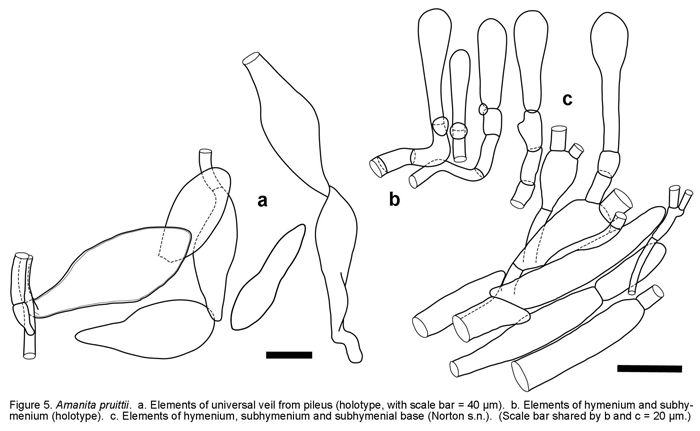
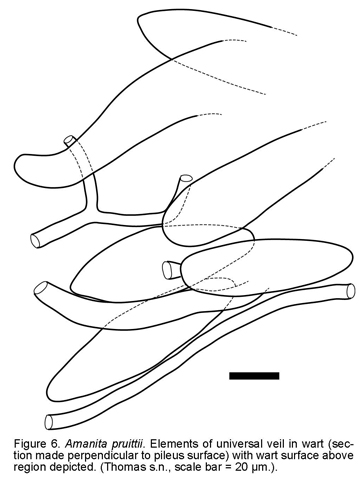
protolog: On pileus: elements with periclinal orientation near poorly formed pileipellis, sometimes with elements in upper portion of wart curving toward anticlinal orientation; with yellow-brown pigment sometimes leaching into dilute KOH mounting solution; filamentous undifferentiated hyphae 4.8 - 17.8 µm wide, branching, walls slightly thickened especially in hyphae of larger diameter, with septa slightly constricted especially in hyphae of larger diameter, uninflated hyphal end segments noted (some branching); inflated cells broadly clavate to clavate to fusiform-ellipsoid to fusiform-rostrate, from hyaline and colorless to brownish yellow, terminal singly or in short chains, dominant, to 203 × 75 µm, thin-walled or with walls 0.5 - 0.8 µm thick; vascular hyphae 1.8 - 17.1 µm wide; clamps common on septa of filamentous hyphae. On lower stipe: with inflated cells less common than on pileus; wall thickening as on pileus; all elements hyaline and colorless; filamentous, undifferentiated hyphae 2.8 - 17.5 µm wide, branching, those of larger diameter having constrictions at septa; inflated cells narrowly clavate to narrowly fusiform-elliptical, to 158 × 29 µm; vascular hyphae 3.5 - 5.5 µm wide; clamps rather common. Limbus internus deposited in form of superior to median annulus: upper surface a partially gelatinized to gelatinized tangle of hyphae; below surface, elements longitudinally oriented and having structure quite similar to universal veil on stipe; filamentous, undifferentiated hyphae 1.8 - 12.3 µm wide; inflated cells as in material of universal veil on stipe with addition of some broadly clavate cells with finely particulate contents (to 117 × 53 µm, with walls 0.5 - 0.8 µm thick, as terminal cell in chains of slightly inflated cells); vascular hyphae 2.8 - 19.8 µm wide, relatively common, branching; clamps plentiful and rather large. |
| stipe context |
protolog: longitudinally acrophysalidic; filamentous, undifferentiated hyphae 1.8 - 10.5 µm wide, with walls slightly thickened; acrophysalides very narrowly clavate or narrowly fusiform-ellipsoid, up to 308 × 41 µm, with walls thickened up to 0.8 µm; vascular hyphae scarce or absent; clamps plentiful and rather large. |
| partial veil |
protolog: filamentous undifferentiated hyphae 1.8 - 12.3 µm wide, dominating, dominantly radially oriented; inflated cells broadly clavate (e.g., 117 × 53 µm), with walls 0.5 - 0.8 µm thick, terminal, at least sometimes subtended by short chain of slightly inflated short hyphal segments; vascular hyphae 2.8 - 19.9 µm wide, relatively common, branching. |
| lamella edge tissue |
protolog: sterile; originally filling region bounded by lowest elements of opposing hymenial surfaces (hence, having inverted “V” cross-section), with remnants largely gelatinized at basidiome maturity; filamentous undifferentiated hyphae up to 2.5± µm wide, predominating and tightly interwoven and periclinal with lamella edge in uppermost (“apical”) part of tissue, otherwise as short branches that give rise to inflated cells; inflated cells only observed occasionally and in collapsed and gelatinized condition (then ca. 11.0 - 12.5 × 9.0 - 11.0 µm), dominantly detersile, original shape probably ovoid or broadly clavate or pyriform; vascular hyphae not observed; clamps unobservable due to gelatinization in material examined. |
| anatomical figures |
|
| basidiospores |
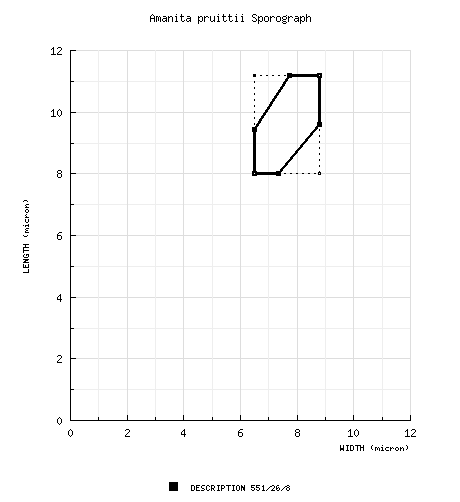
protolog: [551/26/8] (6.8-) 8.0 - 11.2 (-14.0) × (5.8-) 6.5 - 8.8 (-11.2) µm, (L = 8.7 - 10.3 µm; L’ = 9.4 µm; W = (6.9-) 7.1 - 8.0 (-8.1) µm; W’ = 7.5 µm; Q = (1.0-) 1.09 - 1.45 (-1.79); Q = (1.17-) 1.19 - 1.35 (-1.37); Q’ = 1.25), hyaline, colorless, thin-walled or with walls slightly thickened, smooth, amyloid, subglobose to broadly ellipsoid, infrequently globose or elongate or fusiform-ellipsoid, sometimes expanded at one end, rarely malformed (e.g., subsigmoid), often somewhat adaxially flattened; apiculus rather variable, sublateral to subapical, very prominent to rather small, truncate-conic to cylindric; contents monoguttulate or occasionally granular; white in deposit. |
| ecology |
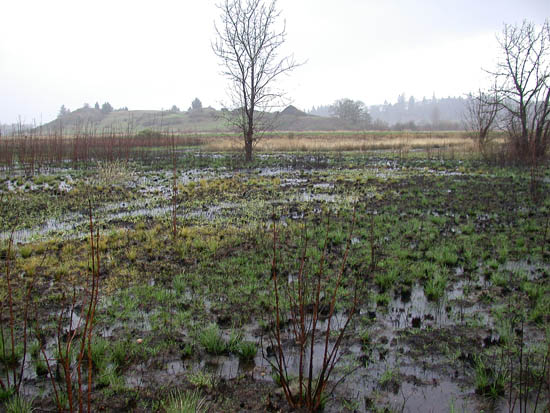
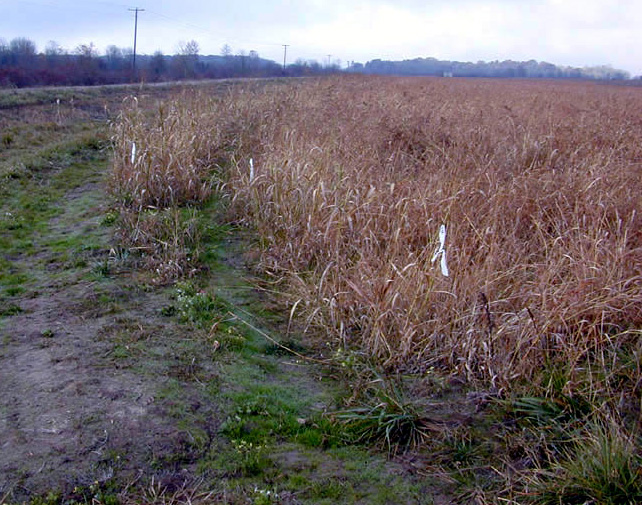
protolog: Solitary to gregarious, often in large numbers and fruiting in arcs, October to March (to June in artifically watered, landscaped areas). California: At 40± - 140± m elev. In lawns or in grazed pasture or poor exposed soil (e.g., hard clay) or in flood plain, in areas completely lacking in trees, often near or mixed with various species of Agaricus (e.g., A. campestris L. : Fr., A. cuprobrunneus (J. Shäffer & Steer) Møller, or A. xanthodermus Genevier) and sometimes mistaken for an Agaricus; in grassy area of cemetery with closest tree Cupressus. Oregon: At 115-120 m elev. In field of Sudan grass [Sorghum sudanense (Piper) Stapf] and native grass [Deschampsia cespitosa (L.) P. Beauv.)] and three species of Rosa, with nearest trees not ectomycorrhizal and at considerable distance (Fraxinus latifolia Benth.) and with no obviously associated ectomycorrhizal host and with average annual rainfall 1233 mm (pers. comm. from U.S. National Weather Service; nearest NOAA station in Eugene, Oregon) or in a meadow that is undisturbed except for at least one controlled burn (following which extensive fruiting of large basidiomata of A. pruittii occurred. |
| material examined |
protolog:
U.S.A.:
CALIFORNIA—Sacramento Co. - Galt,
Cosumnes River Preserve, 7.xii.2012 Noah Siegel s.n.
[mushroomobserver
#119465]
(paratype, RET 613-7). San Francisco Co. -
San Francisco, San Francisco St. Univ. campus,
12.vi.1978 Eric Gerry 382 (paratype, SFSU
F-010258). San Mateo Co. - Daly City, Chinese
cemetery, x.1991 Mark Norton s.n. (paratype, SFSU);
Half Moon Bay 10.xii.2012 Christian Schwarz s.n.
(RET 521-6, nrITS & nrLSU seq'd.). Santa Cruz Co. - Big Creek
Lumberyard, Last Chance Rd., 20.xi.2011 C. Schwarz
s.n. [mushroomobserver
#138586]
(paratype, RET 493-8); ca. Santa Cruz, i.1992 D.
Arora s.n. (paratype, RET 039-6); ca. Swanton,
13.xii.1992 D. Arora s.n. (paratype, NY; paratype,
L; paratype, RET 077-6).
OREGON—Lane Co. - Fern Ridge Research
Natural Area, 16 km W of Eugene,
24.xi.1976 Ben & Hal Pruitt
s.n. (holotype, MICH 191172; isotype, L 0053716);
Fern Ridge Research Natural Area, Fern Ridge
Reservoir, 16 km W of Eugene
[44°03'12.3" N/ 123°15'19.7" W, 117 m], 27.x.2000
J. E. & P. Lindgren & Paul Severns s.n.
[Lindgren 0025] (paratype, RET 343-2); Fern Ridge
Research Natural Area, Fern Ridge
Reservoir, 16 km W of Eugene
[44°03'28.8" N/ 123°15'42.2" W, 116 m], 20.xi.2012
Rhiannon Thomas s.n. (paratype, RET 522-8),
29.xi.2012 J. E. Lindgren 1201 (paratype,
RET 522-3). |
| discussion |
protolog: "Amanita pruittii is the third species of Amanita subsect. Vittadiniae to be described since 1990 from the Pacific northwest of the contiguous US states; in this case the range is known to extend south to Santa Cruz County, California. Like A. prairiicola Peck (Bas 1969)\; Tulloss [1998c], 2014c [A. prairiicola]) [=A. malheurensis A. H. Sm. ex Trueblood et al. (Miller et al. 1990)] and A. armillariiformis Trueblood & Dav. T. Jenkins (Miller et al. 1990, Tulloss [A. armillariiformis]), the mushroom described herein appears not to be associated with an ectomycorrhizal host (see above).
"Following the key of Bas (1969), A. pruittii belongs in Amanita subsect. Vittadiniae Bas. Among the species covered by Bas, A. pruittii has the most in common with A. codinae (R. Maire) Singer (Bas 1969, Tulloss and Rodríguez-Caycedo [A. codinae]), known from southern Europe and north Africa: A poorly defined pileipellis, a universal veil remaining as brown to dark brown warts on the pileus, a thickset habit, with a tendency to turn brown where wounded or handled, with spores having a rather wide range of Q, etc. However, A. codinae has a roughly cylindric stipe which does not taper toward a point at the bottom; its spores have Q values between 1.45 and 1.60; and its universal veil on the pileus tends more toward dark brown, while that of A. pruittii is very mutable and tends more to dark gray or to take on reddish tints.
"Of the taxa in stirps Vittadinii (a) described since Bas’ 1969 monograph or (b) only recently found to belong in Amanita and, hence, not covered in the monograph, the following must be considered with regard to our claim of novelty for A. pruittii:
"Amanita foetens var. grassii Raithelh. (1986) of Argentina. If indeed this is a variety of A. foetens Singer, then it should have clampless basidia, etc. and belongs in stirps Thiersii. Based on the protolog of var. grassii, the small spores of that entity (7.2 - 8.3 × 6.6 - 7.9 µm) and the viscid pileus margin also separate it from A. pruittii.
"Amanita grallipes Bas & de Meijer (1993) of southern Brazil. Among other differences from A. pruittii, the Brazilian species has a dark brown pileus with concolorous, pyramidal warts; lamellae becoming golden yellow with age; a slender, somewhat radicating stipe; and smaller spores [7.5 - 9.6 × 5.6 - 6.9 (-7.2) µm].
"Amanita pleropus (Kalchbr. & MacOwan) D. A. Reid (Reid & Eicker 1991) of South Africa. While the habit of this species has the general aspect of A. pruittii, it can be distinguished by a number of characters including a rusty brown volva with its elements having anticlinal orientation which leads to the universal veil remnants on the pileus sometimes becoming 'densely crowded, erect, hair-like spines or pyramidal warts' and larger spores (10.8 - 14.0 × 7.0 - 9.5 µm) with Q in the range of 1.5±.
"A four-locus phylogeny of Wolfe et al. (2012: fig. 2) utilized sequences from Lindgren 0025 (RET 343-2). This phylogeny places A. pruittii as the basal element in a three-leaf clade also including A. codinae and A. singeri Bas (Bas 1969, Tulloss and Rodríguez-Caycedo [A. singeri]).
"In a pairwise comparison of aligned nrITS sequences from seven A. pruittii collections made at sites distributed over the known range of the present species, the available portions of the sequence (Table 1 [see protolog]) match exactly—the nrITS of A. pruittii is 638 characters long and invariant in the material examined.
"Because of the lack of an obvious woody symbiont, several attempts were made to see if A. pruittii could be associated with other possible organisms—an ant and a common grass at one of the Oregon collecting sites. Although results did not appear in print, Dr. Tom Horton (pers. comm. to Lindgren) examined the DNA of fungi grown in ant (Formica occulta Francoeur) colonies in the FRRNA habitat of A. pruittii and of fungi forming mycorrhizal association with Deschampsia cespitosa in the same habitat. Horton found that none of the fungi sequenced in his research were assignable to Amanita.
"The Daly City specimen (Norton s.n.) exhibited the lowest values of L and W seen. This appears to be because the specimen was senescent when dried. Spores found on the stipe surface were larger and somewhat more globose than those found on the lamellae, with L = 9.3 µm, W = 8.0 µm, and Q = 1.16.
"As in all other species of the Vittadiniae revised by Tulloss, the state of conservation of the materials examined is highly variable. Species of this group have strong hygroscopic tendencies, which leads to damage of exsiccata (particularly the collapse of delicate tissues such as the subhymenium and lamella trama) by aggressively attacking molds (Tulloss 1993a). It is quite probable that some revised material has deteriorated since Tulloss’ revisions that form the basis of the above morphological description. Because of its poor condition, RET 295-6 (Oregon—Lane Co. - FRRNA, Fern Ridge Reservoir, 16 km W of Eugene [44°03'12.3" N/ 123°15'19.7" W, 117 m], 5.xi.1998 Susie Holmes s.n. [Lindgren 98260]), although very probably a collection of A. pruittii, was not utilized in preparing this description and is excluded from the original material used to define the present species.
"...."
[Note: The complete protolog and a version with corrections are available on this site (here).] |
| citations |
—R. E. Tulloss, J. E. Lindgren, D. Arora, B. E. Wolfe, C. Rodríguez Caycedo, and L. V. Kudzma |
| editors |
RET |
|



 Spore data sets and their composite