| name |
Amanita olivaceogrisea |
| author |
Kalaméés in Urbonas, Kalaméés & Lukin. 1986. Conspect. Fl. Agaric. Fung. Lithuaniae Latviae Estoniae: 45. |
| name status |
nomen acceptum |
| english name |
"Olive-Gray Ringless Amanita" |
| etymology |
olivaceus "olive" or "olivaceous" + griseus "gray"; hence, "olivaceous gray" or "olive-gray" |
| MycoBank nos. |
131597 |
| GenBank nos. |
Due to delays in data processing at GenBank, some accession numbers may lead to unreleased (pending) pages.
These pages will eventually be made live, so try again later.
|
| holotypes |
TAA |
| type studies |
Tulloss, here |
| selected illustrations |
Tulloss. 2001. Field Mycol. 2(3): 99. |
| intro |
The following text may make multiple use of each data field.
The field may contain magenta text presenting data from a type study
and/or revision of other original material cited in the protolog of the present taxon.
Macroscopic descriptions in magenta are a combination of data from the protolog and
additional observations made on the exiccata during revision of the cited original
material.
The same field may also contain black text, which is data from a revision of the present
taxon (including non-type material and/or material not cited in the protolog).
Paragraphs of black text will be labeled if further subdivision of
this text is appropriate.
Olive text indicates a specimen that has not been
thoroughly examined (for example, for microscopic details) and marks other places in the text
where data is missing or uncertain.
The following uses macroscopic information from this species' protolog and data recorded in the notes of Dr. C. Bas on his number 9208, which he generously gave to me with duplicate material of that collection and, otherwise, is based upon original research by R. E. Tulloss. The reader is referred to a brief, illustrated article presenting a condensed view of the present species as known in 2001. |
| pileus |
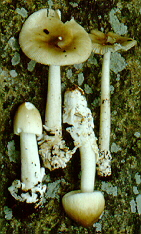
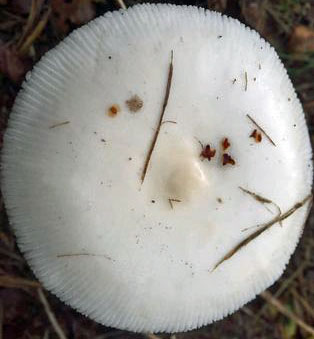
30 - 60 mm wide, olive-gray to ochraceous gray to brown-gray, convex then plane, not very viscid; context not described; margin sulcate; universal veil as large warts, white at first, becoming gray to ochraceous gray, persistent, cottony.
From Dr. Bas' notes on Bas 9208: 34 - 42 mm wide, when young olivaceous-ochraceous or slightly sordid ochraceous-olivaceous (10YR 7/4 to between 10YR 6/4 and 10YR 6/6), darker over disc than at margin, not zonate, gradually becoming more uniformly olivaceous beige to beige (10YR 7/4 or slightly darker—especially over disc), rather viscid, sometimes very slightly virgate, paraboloid at first, with obtuse apex or even slight umbo, soon flattening and then becoming saucer-shaped and with small umbo; context not described; margin finely sulcate (0.35±: at first to 0.5±); universal veil often absent, occasionally present as group of interconnected warts, very pale beige, with slight ochraceous-tinted surface. |
| lamellae |
free, crowded, white then off-white, having a crenulate flocculose edge; lamellulae not described.
From Dr. Bas' notes on Bas 9208: free, distant, crowded, white to creamy white, with slightly irregular edge (10× lens) mostly concolorous, but sometimes somewhat yellowish beige near pileus margin, ca. 10 to 11 lamellae per 10 mm arc counted at mid-radius; lamelluae truncate, scarce. |
| stipe |
50 - 90 × 5 - 10 mm, white, with minute densely set gray to olive-gray squamules, dry, with ferruginous spots or stains near base, with 1 to 3 white ring-like zones or ridges in lower third; context white, hollow; exannulate; universal veil as saccate volva, submembranous, whitish, without gray or ocher in holotype, but with gray edge to limb in other original material, often with separated large patches on lower stipe, colors as on pileus.
From Dr. Bas' notes on Bas 9208: 64 - 92 × 4.5 - 7.5 mm, narrowing upward, at first white to whitish and then decorated with white appressed longitudinally arrayed fibrils, with aging ground becoming cream-isabelline and ornamentation becoming pale grayish-brownish or ochraceous grayish-brownish; context white, hollow, with broad central cylinder; exannulate; universal veil as quickly fragmenting (originally saccate) submembranous volva, with patches often appressed or loosely distributed over lower stipe, white to slightly grayish beige, with felted to subtomentose [exterior] surface, often bearing some warty brown spots. |
| odor/taste |
Odor none. Taste indistinct.
From Dr. Bas' notes on Bas 9208: Odor and taste indistinct. |
macrochemical
tests |
none reported.
non-type: none reported. |
| pileipellis |
90 - 105 µm thick, with colorless and largely gelatinized suprapellis negligible to 10 µm thick, with subpellis 90 - 105 µm thick and pale brownish yellow in upper and lowest parts and yellow-brown to orange-yellow in mid-region; filamentous, undifferentiated hyphae 3.0 - 6.2 µm wide, ?; vascular hyphae ? µm wide, ?. |
| pileus context |
filamentous, undifferentiated hyphae 2.6 - 10.2 µm wide, branching, plentiful to dominating, in fascicles or singly, interwoven in open lattice; acrophysalides narrowly clavate to fusiform to ??, thin-walled, common, up to 78 × 27 µm or larger; vascular hyphae 2.9 - 8.4 µm wide, sometimes branching, sordid yellow, occasional, sinuous. |
| lamella trama |
non-type: subhymenial base lacking; central stratum comprising sole structure between minmal subhymenia and opposing bases of basidia; wcs = 50- - 55 μm; |
| subhymenium |
non-type: very shallow, with basidia arising from uninflated or partially inflated, sometimes branching, hyphal segments. |
| basidia |
46 - 59 × 10.9 - 15.1 µm, occasionally golden yellow in 3% KOH, dominantly 4-, occasionally 2-sterigmate, with sterigmata up to 6.5 × 3.7 µm; clamps ??.
non-type: up to 53 × 16.2 μm. |
| universal veil |
non-type: On stipe base, interior: filamentous undifferentiated hyphae 2.8 - 11.6 μm wide, hyaline colorless, common, thin-walled, frequently branching, sometimes anastomosing, occasionally in narrow fascicles, infrequently with yellowish subrefractive walls; inflated cells dominating, hyaline, colorless or slightly sordid, terminal, singly or in chains of up to three, globose to subglobose to subpyriform to ellipsoid (up to 69 × 57 μm or larger) to fusiform to clavate to subcylindric (e.g., 76 × 30 μm ) especially at base of chain of cells, with cell walls thin or (rather commonly) up to 1.0 μm thick; vascular hyphae not observed. |
| stipe context |
longitudinally acrophysalidic; filamentous, undifferentiated hyphae 1.9 - 11.0 µm wide, branching, dominating near surfaces, plentiful in interior, thin-walled; acrophysalides plentiful to dominating in interior, less common near surfaces, thin-walled, up to 205 × 34 µm; vascular hyphae 3.7 - 7.4 µm wide, uncommon, occasionally branching, sordid yellow. |
| partial veil |
absent.
non-type: absent. |
| lamella edge tissue |
not described.
non-type: not described. |
| basidiospores |
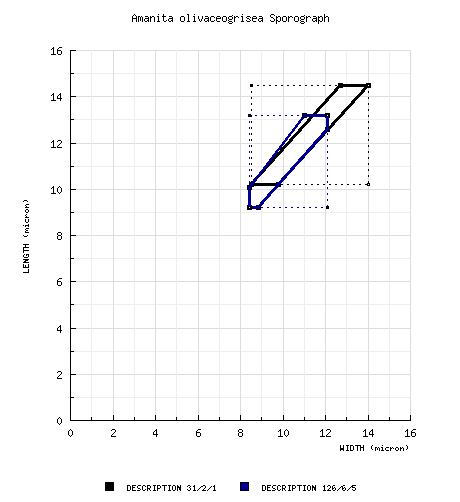
[31/2/1] (8.6-) 10.2 - 14.5 (-16.6) × (8.1-) 8.5 - 14.0 (-15.0) µm, (L = 10.8 - 12.2 µm; L’ = 11.7 µm; W = 9.8 - 11.2 µm; W’ = 10.7 µm; Q = (1.03-) 1.04 - 1.14 (-1.27); Q = 1.09 - 1.11; Q’ = 1.10), hyaline, colorless to yellowish, thin-walled, smooth, inamyloid, subglobose to broadly ellipsoid, occasionally globose, at least somewhat adaxially flattened, occasionally as "giant" spores; apiculus sublateral, cylindric, somewhat projecting; contents dominantly monoguttulate, also granular; color in deposit not recorded.
composite of all material examined: [126/6/5] (8.5-) 9.2 - 13.2 (-16.6) × (8.1-) 8.4 - 12.1 (-15.0) µm, (L = 10.1 - 12.2 µm; L’ = 10.9 µm; W = 9.1 - 11.2 µm; W’ = 9.9 µm; Q = (1.02-) 1.04 - 1.20 (-1.27); Q = 1.09 - 1.11; Q’ = 1.10). |
| ecology |
Estonia: In marshy
Pinus-Betula forest.
Latvia: In marshy mixed forest.
non-type: Estonia: In moist, blackish loam of forest
including Fraxinus, Populus,
Betula, and Picea.
England, U.K.: Solitary to subgregarious. On
soil under Corylus avellana.
Poland: At 970-1450 m elev. In acid soil of
montane Spruce-Fir forest
under Picea abies and Abies alba or in
sandy acid soil of montane conifer forest at treeline
under Picea abies. |
| material examined |
ESTONIA:
PÄRNU DISTR.—Reservatum Nigula [Nigula
Bog St. Natural Res.], Kaubaaru, 19.ix.1982 K.
Kalamees 122517 (holotype, TAA).
LATVIA: TALSI
DISTR.—Reservatum Slitense, Ushi, 23.ix.1982
K. Kalamees 122589 (uncited orig. mat’l.,
TAA).
RET: ESTONIA:
PÄRNU DISTR.—Reservatum Nigula,
Kaubaaru, 27.viii.1989 C. Bas 9208 (topotype) (in
herb. David T. Jenkins, n.v.; L, n.v.; RET
024-2).
FRANCE: AIN—Arfontaine,
ca. Oyonnax, 22.ix.1980 L. Bas s.n. [Bon 80092206]
(in herb. M. Bon => LIP, specimen "B" in mixed
collection including lectotype of A. malleata
per Tulloss
(1994)).
GERMANY: UNKN.
STATE—loc. withheld, 18.ix.2010 René K.
Schumacher s.n. (RET 522-5, nrITS seq'd.), 17.x.2010
R. K. Schumacher s.n. (RET 523-8, nrITS seq'd.),
20.x.2011
R. K. Schumacher s.n. (RET 523-2, nrITS &
nrLSU seq'd.).
NETHERLANDS: ZUID
HOLLAND—Geldermalsen, Neerijnen,
2.xi.2019 Cees Kemper s.n. (RET 884-10,
nrITS-LSU seq'd.).
POLAND: WOJEWÓDZTWO
MALOPOLSKIE—Tatra County - Hohe Tatra,
Zakopane, "Siwa Polana" [970 m], 25.vii.1998
Andreas Gminder 98/160 (in herb. A. Gminder;
RET 306-3, nrITS seq'd.), trail to Trzedniowanski Wierch [1450 m]
18.ix.1992 A. Gminder 95[92?]/446
(in herb. A. Gminder; RET 306-6, nrITS-LSU seq'd.).
RUSSIA:
NOVOSIBIRSK REG.—Riddir Distr. -
Salair, 20.viii.2017 Tatiana Bulyonkova 4089 (in herb.
Bulyonkova; RET 877-2, nrITS-LSU seq'd.).
U.K.: ENGLAND—Cumbria
- Blencathra, Aira Force, 29.viii.1999 Caroline
Hobart s.n. (RET 311-9, nrITS seq'd.). |
| discussion |
t.b.d.
As reported by Fraiture (1993), I believe that the nonconformant specimen [called "specimen B" in (Tulloss 1994)] in the holotype of Amanita malleata (Bon) Contu can be placed in A. olivaceogrisea.
In one of the specimens of the holotype, every mature spore examined had the central guttule connected to the inner surface of the spore wall by straight filaments—suggesting rather closely spaced spokes of a wheel in optical cross-section. The points of attachment of these filaments were estimated to be in the range of 0.1 - 0.3 µm across. This phenomenon is to be distinguished from the altered wall structure of crassospores as discussed by Tulloss & Halling (1997) who saw a very similar abnormal structure in many spores of a collection of A. umbrinolutea sensu Reid, from K. I have not seen this structure in any collection of Amanita other than the two mentioned here. |
| citations |
—R. E. Tulloss |
| editors |
RET |
|


 Spore data sets and their composite