
| name | Amanita oblongispora |
| name status | nomen acceptum |
| author | Contu ex Tulloss & Contu |
| english name | "Contu's Ringless Amanita" |
| images |
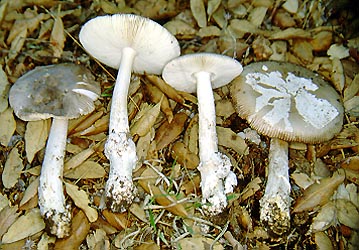  1. Amanita oblongispora, Sardinia, Italy. |
| cap |
The cap of A. oblongispora is 65 - 80 mm wide, campanulate at first, later planoconvex to planar, often with a prominent and broad umbo, glabrous, moist and lubricious at first to slightly viscid, then dry, with a striate-sulcate margin (up to 7 mm or 10 - 20% of the radius). The cap is light pearl gray, with disc brown-ocher, darkening with age. The volva is absent or as a large patch or patches, submembranous to membranous, rather thick, white to off-white. |
| gills |
The gills are free, subdistant, white, orangish tan to grayish brown to sordid tan in exsiccata, rather broad and thick. Short gills are present. |
| stem |
The stem is 80 - 150 × 6 -15 mm, cylindric to narrowing upward, subsmooth, white to whitish above, exannulate, sometimes with rather pale brown-bister fibrils in bands below. The flesh is white to slight bister towards base, stuffed to hollow, quite firm, but fragile and quick to decay. The small, cup-like volva or fragile, saccate volva is white to ochraceous, friable to submembranous, extending up to 30 mm up stem, not easily removed from substrate. |
| spores |
The spores measure (8.2-) 10.5 - 13.8 (-16.2) × (7.2-) 7.8 - 10.8 (-13.5) µm and are inamyloid and broadly ellipsoid to ellipsoid (occasionally elongate, infrequently cylindric). Clamps are rather common at bases of the basidia. |
| discussion |
This species was originally described from Italy (Sardinia) and is still known only from this region. This species seems to be rather isolated if my observation of clamped basidia is correct. Taxa with broadly ellipsoid to ellipsoid spores and weak or relatively weak volvas include taxa similar to A. malleata (Piane ex Bon) Contu on the one hand and taxa similar to A. mairei Foley on the other. At the moment, I believe the relationship of A. oblongispora is closer to the first of these groups; however, this observation still fails to place A. oblongispora definitively. Obviously, work remains to be done in these groups.—R. E. Tulloss |
| brief editors | RET |

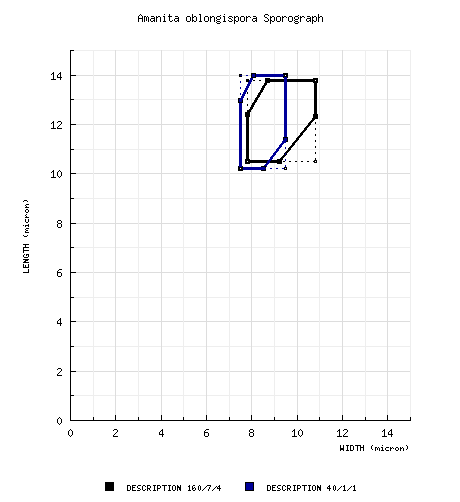
 Spore data sets and their composite