| name |
Amanita modesta |
| author |
Corner & Bas. 1962. Persoonia 2: 279, pl. 8a, fig. 35. |
| name status |
nomen acceptum |
| english name |
"Modest Death Cap" |
| etymology |
modestus "modest" |
| MycoBank nos. |
326101 |
| GenBank nos. |
Due to delays in data processing at GenBank, some accession numbers may lead to unreleased (pending) pages.
These pages will eventually be made live, so try again later.
|
| holotypes |
L (in liquid) |
| intro |
The following text may make multiple use of each data field.
The field may contain magenta text presenting data from a type study
and/or revision of other original material cited in the protolog of the present taxon.
Macroscopic descriptions in magenta are a combination of data from the protolog and
additional observations made on the exiccata during revision of the cited original
material.
The same field may also contain black text, which is data from a revision of the present
taxon (including non-type material and/or material not cited in the protolog).
Paragraphs of black text will be labeled if further subdivision of
this text is appropriate.
Olive text indicates a specimen that has not been
thoroughly examined (for example, for microscopic details) and marks other places in the text
where data is missing or uncertain.
The following material is derived entirely from the protolog of the present taxon. |
| pileus |
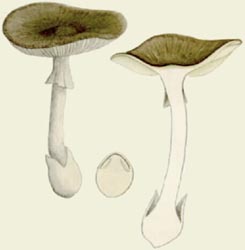
from protolog: 40- 50 mm wide, umber to grayish mouse-colored, with center sometimes inclining to purplish umber, paler toward margin, plano-convex with depressed center to concave, slightly umbonate, smooth, viscid to slightly viscid; context white, soft, 2.5 - 3 mm thick above stipe, thinning slowly [per figure] toward margin; margin smooth to shallowly short-sulcate-striate; universal veil absent. |
| lamellae |
from protolog: free, crowded, cream-white; with edges often eroded (especially those of lamellulae), rather narrow, 3 - 4 mm broad, 76 - 100 primaries; lamellulae attenuate, 0 - 3 between each otherwise adjacent pair of lamellae. |
| stipe |
from protolog: 40 - 60 × 4 - 5 mm, white, cylindric, wholly white pruinose or floccose-pruinose above and below partial veil; content solid to hollow; bulb globose, often with point on bottom or even slightly radicating, 8 - 15 mm wide; partial veil apical, white, pendent, floccose-membranous, delicate, often torn, 5 - 7 mm wide from stipe attachment to edge measured radially, striate above, somewhat floccose-scurfy below, with uneven edge; universal veil as fleshy-membranous firm limbate volva, white, smooth, 15 - 22 × 8 - 15 mm wide, usually 2-lobed. |
| odor/taste |
not recorded. |
macrochemical
tests |
none recorded. |
| pileipellis |
from protolog: suprapellis gelatinized, ca. 40 µm thick; subpellis ca. 100 µm thick; filamentous hyphae in suprapellis 2 - 5 µm wide, distant, interwoven to subradially oriented; filamentous hyphae of subpellis rather crowded "(slightly embedded?)," up to 20 µm wide, constricted at septa and irregularly inflated especially near ends of segments, with umber intracellular pigment. |
| pileus context |
not described. |
| lamella trama |
from protolog: bilateral, "loose"; central stratum with inflated cells elongate (up to 150 × 20 µm) and ellipsoid to clavate (up to 100 × 55 µm); divergent zones with inflated cells elongate-ellipsoid to ellipsoid and up to 85 × 30 µm. |
| subhymenium |
from protolog: cellular; ca. 40 µm wide, cellular; inflated cells globose to ellipsoid, 10 - 25 µm wide. |
| basidia |
from protolog: 25 - 36 × 8 - 10 µm, predominantly 4-, rarely 2- or 1- sterigmate, with sterigmata about 5 µm long; clamps not observed. |
| universal veil |
from protolog: On stipe base, exterior surface layer: filamentous hyphae 2.5 - 6 (-10) µm wide, multiseptate, irregularly and densely interwoven. On stipe base, interior: inflated cells dominating, mostly "sphaerocysts," up to 60 µm wide.
On stipe base, inner surface layer: more or less gelatinized; filamentous hyphae narrow; inflated cells scattered. |
| stipe context |
from protolog: longitudinally acrophysalidic; filamentous hyphae thin, evident on exterior surface; acrophysalides up to 300 × 30 µm; vascular hyphae and tip cells with refractive content evident on exterior surface. [Note: It is not uncommon for there to be yellowish, collapsed, or partially gelatinized hyphal segments and some small, similarly colored acrophysalides on the stipe surface in amanitas in most or all sections of the genus. It is not clear if the yellow surface elements in this description are something distinct from the usual case. Revision will be necessary.—ed.] |
| partial veil |
not described. |
| lamella edge tissue |
from protolog: inflated cells, globose, up to 30 (-50) µm wide, rather numerous. |
| basidiospores |
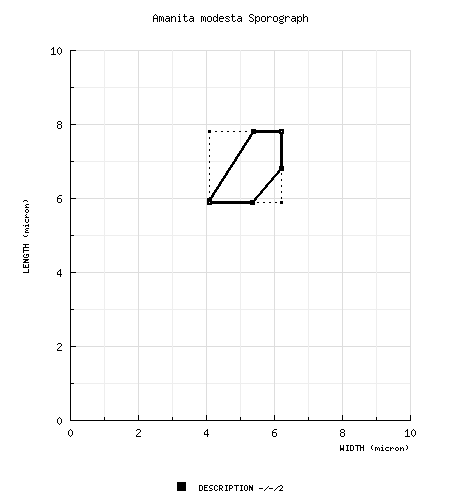
from protolog: [-/-/2] 5.9 - 7.8 × 4.1 - 6.2 μm, (Q = 1.10 - 1.45; Q = 1.20 - 1.25), hyaline, colorless, smooth, thin-walled, amyloid, subglobose to broadly ellipsoid to ellipsoid, sometimes attenuate toward apiculus; apiculus proportionately small; contents cloudy; color in deposit not recorded. |
| ecology |
from protolog: Terrestrial in tropical forest. |
| material examined |
from protolog: SINGAPORE: Reservoir Jungle, 3.xii.1940 E. J. H. Corner s.n. (holotype, L in liquid, with watercolor drawing). MALAYSIA: JOHOR—Tebrau, 24.ix.1939 E. J. H. Corner s.n. (paratype, L in liquid). |
| discussion |
from protolog: "Among the dark-colored species with ellipsoid spores of section Phalloideae only A. pseudoporphyria Hongo (1957: 141, fig. 2a-c) seems related and even bears a great resemblance to the present one. However, the Japanese species has more slender spores (Q = 1.3 - 1.6), a floccose-squamose stipe and is associated with conifers. Its spore-size was checked from a duplicate of the paratype, Hongo 1219, Ôtsu-city, 16 July 1955, preserved in the Rijksherbarium, Leiden.
"A third collection originally attributed to the present species (Amanita 13, Singapore, Bukit Timah, 4 Oct. 1944; some fragments in liquid) has to be excluded. Its spores are larger (7.6 - 9.5 × 4.7 - 5.6 µm), more elongated (Q = 1.5 - 1.85) and ellipsoid-subreniform. The insufficiency of both data and material renders this collection unidentifiable." |
| citations |
—R. E. Tulloss |
| editors |
RET |
|



 Spore data sets and their composite