| name |
Amanita elephas |
| author |
Corner & Bas. 1962. Persoonia 2: 278, pl. 6b, fig. 36. |
| name status |
nomen acceptum |
| english name |
"Pachyderm Death Cap" |
| etymology |
elephas "elephant"; because of the thick pileipellis |
| MycoBank nos. |
326094 |
| GenBank nos. |
Due to delays in data processing at GenBank, some accession numbers may lead to unreleased (pending) pages.
These pages will eventually be made live, so try again later.
|
| holotypes |
L (in liquid) |
| intro |
The following text may make multiple use of each data field.
The field may contain magenta text presenting data from a type study
and/or revision of other original material cited in the protolog of the present taxon.
Macroscopic descriptions in magenta are a combination of data from the protolog and
additional observations made on the exiccata during revision of the cited original
material.
The same field may also contain black text, which is data from a revision of the present
taxon (including non-type material and/or material not cited in the protolog).
Paragraphs of black text will be labeled if further subdivision of
this text is appropriate.
Olive text indicates a specimen that has not been
thoroughly examined (for example, for microscopic details) and marks other places in the text
where data is missing or uncertain.
The following material is derived entirely from the protolog of the present taxon. |
| pileus |
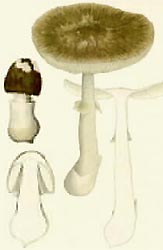
from protolog: 90 - 100 mm wide, dark sepia at first, pale sepia or pale sepia-gray with paler spots later on, darker innately fibrillose in outer half of limb, campanulate when young, becoming subumbonate plane to plano-concave with age, smooth, dry to slightly viscid (presumably very viscid when wet); context white, turning slightly ochraceous when cut, becoming thin over lamellae and toward margin; margin not striate; universal veil absent or as few large membranous patches, irregular, thin, white. |
| lamellae |
from protolog: free, not crowded, whitish cream, broad, 9 - 10 mm wide, about 65 primaries; lamellulae rounded-attenuate to attenuate, 1 - 3 between each pair of otherwise adjacent lamellae. |
| stipe |
from protolog: 120 × 10.5 mm, white, smooth below ring, somewhat floccose-scaly above ring; context solid, firm; bulb slightly pointed clavate-bulbous, 20 - 25 mm wide; partial veil white to cream, floccose-membranous, pendent, attached 30 mm below apex, 12 mm wide (from stipe surface to edge measured radially), somewhat flaring, easily torn, striate above; universal veil as limbate volva, with thin tenacious membranous limb 28 - 35 mm high, lower half attached to bulb of stipe, with edge even or split on one side, white, smooth. |
| odor/taste |
not recorded. |
macrochemical
tests |
none recorded. |
| pileipellis |
from protolog: ca. 400 µm thick (in button even 800 µm thick); suprapellis ca. 200 µm thick, gelatinized; subpellis ca. 200 µm thick ungelatinized; filamentous hyphae in suprapellis 3 - 5 µm wide, very distant, irregularly disposed near surface, subradial in lower part; filamentous hyphae in subpellis dense, up to 15 µm wide, irregularly interwoven, slightly constricted at septa. |
| pileus context |
not described. |
| lamella trama |
from protolog: distinctly bilateral; central strand and divergent zones not strongly differentiated from each other; filamentous hyphae 5 - 20 µm wide; inflated cells cylindric to elongate-ellipsoid, 30 - 100 µm. |
| subhymenium |
from protolog: cellular; 40 - 60 µm wide; inflated cells 8 - 20 µm wide. |
| basidia |
from protolog: 32 - 38 × 7 - 11 µm, 4-sterigmate, with sterigmata up to 4 µm long; clamps not observed. |
| universal veil |
from protolog: On stipe base, exterior surface layer: filamentous hyphae 2 - 4 µm wide, irregularly disposed, densely interwoven, thin-walled. On stipe base interior layer: all elements with walls slightly thickened; filamentous hyphae up to 10 (-18) µm wide, flexuous, interwoven; inflated cells up to 120 × 25 µm, scattered. On stipe base, inner surface layer: all elements with slightly thickened walls; filamentous hyphae 3 - 8 µm wide, longitudinally or slightly irregularly disposed; inflated cells elongate to ellipsoid to clavate, scattered. |
| stipe context |
from protolog: longitudinally acrophysalidic; filamentous hyphae noticeable near surface, narrow; acrophysalides up to 350 × 35 µm. |
| partial veil |
not described. |
| lamella edge tissue |
from protolog: inflated cells globose to ellipsoid to clavate, up to 45 × 35 µm, colorless, numerous. |
| basidiospores |
from protolog:
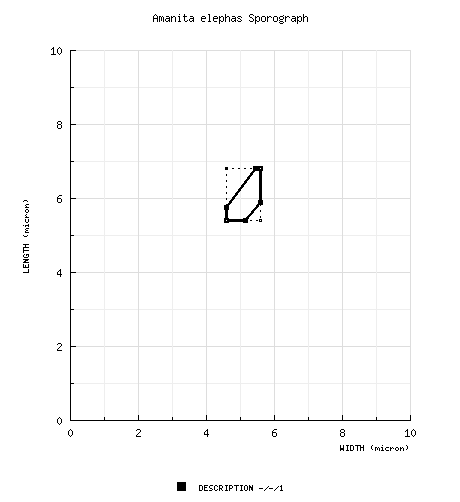
[-/-/1] 5.4 - 6.8 × 4.6 - 5.6 μm,
(Q = 1.05 - 1.25; Q = 1.15 - 1.20),
hyaline, colorless, smooth, thin-walled, amyloid, subbglobose to broadly ellipsoid to obovoid; apiculus proportionately small; contents cloudy-vacuolate; color in deposit not recorded. [Fresh spores reported to measure 7.0 - 8.0 × 5.5 - 6.0 μm.] |
| ecology |
from protolog: Terrestrial in tropical forest. |
| material examined |
from protolog: SINGAPORE: Botanic Gardens, Gardens' Jungle, xvi.viii.1940 E. J. H. Corner s.n. (holotype, L in liquid, with watercolor drawing); Reservoir Jungle, 15.iv.1941 E. J. H. Corner s.n. (paratype, L, button in liquid, with watercolor drawing). |
| discussion |
from protolog: "Amanita elephas has much in common with A. modesta; however, the different structure of the volva (no sphaerocysts), the thick cuticle, the broad, not crowded gills, and the large size [of the present taxon] demonstrate that it is different.
"As A. elephas is close to A. phalloides (Fr. : Fr.) Link, it might well be poisonous." |
| citations |
—R. E. Tulloss |
| editors |
RET |
|



 Spore data sets and their composite