| name |
Amanita pseudoporphyria |
| author |
Hongo. 1957. J. Jap. Bot. 32: 141, fig. 2(a-c). |
| name status |
nomen acceptum |
| english name |
"Hongo's False Death Cap" |
| synonyms |
?= Amanita indica R. P. Bhatt, Locq. & T. N. Lakh. in A. Kumar et al 1990. Amanitaceae India: 71, fig. 9(A-D).
The editors of this site owe a great debt to Dr. Cornelis Bas
whose famous cigar box files of Amanita nomenclatural information
gathered over three or more decades were made available to RET for computerization
and make up the lion's share of the nomenclatural information presented on this site.
|
| MycoBank nos. |
292458, 360945 |
| GenBank nos. |
Due to delays in data processing at GenBank, some accession numbers may lead to unreleased (pending) pages.
These pages will eventually be made live, so try again later.
|
| holotypes |
Amanita indica—HPUB.
Amanita pseudoporphyria—TNS per (Doi. 1991. Bull. Natl. Sci. Mus., Tokyo, Ser. B 17(2): 50]. |
| revisions |
Z. L. Yang. 1997. Biblioth. Mycol. 170: 168, figs. 138-142.
Z. L. Yang and Y. Doi. (1999). Bull. Natl. Sci. Mus. Tokyo B 25(3): 125-126, fig. 27.
Tulloss, here |
| selected illustrations |
Imazeki and Hongo. 1965. Color. Illus. Mushr. Japan 2: 40, pl. 12 (fig. 74).
Imazeki and Hongo. 1987. Color. Illus. Mushr. Japan 1: 125, pl. 30 (fig. 215).
|
| intro |
The following text may make multiple use of each data field.
The field may contain magenta text presenting data from a type study
and/or revision of other original material cited in the protolog of the present taxon.
Macroscopic descriptions in magenta are a combination of data from the protolog and
additional observations made on the exiccata during revision of the cited original
material.
The same field may also contain black text, which is data from a revision of the present
taxon (including non-type material and/or material not cited in the protolog).
Paragraphs of black text will be labeled if further subdivision of
this text is appropriate.
Olive text indicates a specimen that has not been
thoroughly examined (for example, for microscopic details) and marks other places in the text
where data is missing or uncertain.
The following material not directly from the protolog of the present taxon and not cited as the work of Dr. Z. L. Yang or another researcher is based upon
original research by R. E. Tulloss.
NOTE: Spore measurements from papers by Z. L. Yang use his "Times New Roman" face for "Q"
and "Q'"—respectively, "Q" and
"Q." |
| basidiospores |
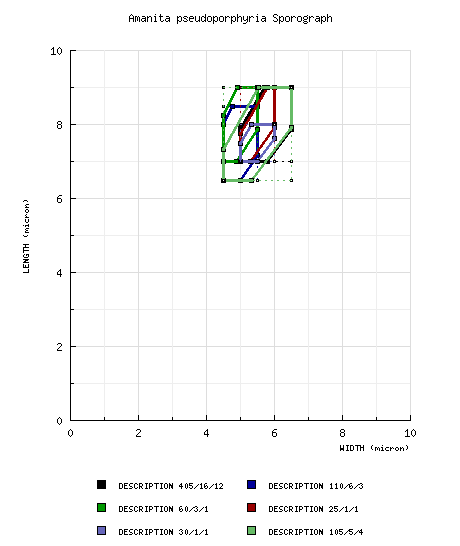
from Yang (1997): [405/16/12] (6.0-) 7.0 - 9.0 (-10.5) × (4.5-) 5.0 - 6.5 (-7.5) μm, (Q = (1.09-) 1.21 - 1.58 (-1.80); Q = 1.39 ± 0.11), broadly ellipsoid to ellipsoid, rarely subglobose or elongate, amyloid, smooth, thin-walled, colorless, hylaine; apiculus small. "White" in deposit.
from Yang and Doi (1999) including holotype: [110/6/3] (6.0-) 6.5 - 8.5 (-11.5) × (4.0-) 4.5 - 5.5 (-6.5) μm, (Q = (1.18-) 1.30 - 1.78 (-2.17); Q = 1.53 ± 0.17), hyaline, colorless, smooth, thin-walled, amyloid, ellipsoid to elongate, rarely subcylindric; apiculus small.
from Yang and Doi (1999): [60/3/1] 7.0 - 9.0 (-11.0) × (4.0-) 4.5 - 5.5 (-6.5) μm, (Q = (1.36-) 1.43 - 1.83 (-2.17); Q = 1.63 ± 0.14).
from Yang (2000): [25/1/1] 7.0 - 9.0 × 5.0 - 6.0 μm, (Q = 1.32 - 1.55 (-1.64); Q = 1.45 ± 0.09), hyaline, colorless, smooth, thin-walled, amyloid, ellipsoid, sometimes broadly ellipsoid.
from Yang et al. (2001): [30/1/1] 7.0 - 8.0 × 5.0 - 6.0 (-6.5) μm, (Q = (1.23-) 1.27 - 1.50 (-1.59); Q = 1.38 ± 0.08), ellipsoid, sometimes broadly ellipsoid, colorless, hyaline, thin-walled, amyloid.
from material of India, Nepal, and Thailand (RET): [105/5/4] (5.0-) 6.5 - 9.0 (-10.0) × (3.8-) 4.5 - 6.5 - (-7.2) μm, (L = 7.4 - 8.1 μm; L' = 7.6 μm; W = 5.2 - 5.6 μm; W' = 5.4 μm; Q = (1.19-) 1.22 - 1.63 (-1.80); Q = 1.33 - 1.51; Q' = 1.40), hyaline, colorless to yellowish, smooth, thin-walled, amyloid to strongly amyloid, often adaxially flattened, sometimes swollen at one end; apiculus sublateral, cylindric; contents mono- to multiguttulate, with additional small granules.
[NOTE: The extension of spore measurements into a smaller size range in the data of RET, is (at least in part) due to the fact that some of the material he revised was poorly dried and/or poorly preserved.—ed.] |
| ecology |
Solitary or gregarious. China: At 1800 - 2800 m elev. In conifer and mixed forests with Pinus and Quercus spp.
India: ??.
Japan: On ground in forests (e.g., Pinus).
Nepal: ??.
Thailand: ??. |
| material examined |
from protolog: JAPAN: HONSHU—Shiga-ken - Ôtsu-shi, Ishiyama-Hiratsu-chô, 23.vii.1956 T. Hongo 1506 (holotype, in herb. Hongo => TNS F-237281).
from Yang (1997): CHINA:
GUIZHOU—Guiyang (prefecture level) City - Huaxi Distr., unkn. loc., vii.1988 J. Z. Ying et al. 264 (HMAS 57698, as "Amanita manginiana" in Ying and Zang (1994: 136)), s.d. J. Z. Ying et al. 260 (HMAS 58287, as "Amanita manginiana" in Ying and Zang (1994: 136)). Tongren Prefecture - Jiangkou Co., Fanjingshan, 7.vii.1988 Z. L. Yang 157 (HKAS 20777).
SICHUAN—Liangshan Yi Autonomous Prefecture - Xichang (county level) City, Luojishan, 30.ix.1983 M. S. Yuan 255 (HKAS 11983), 18.vii.1992 M. S. Yuan 1866 (HKAS 25759).
YUNNAN—Dali Bai Autonomous Prefecture - Binchuan Co., Jizushan, 18.vii.1985 G. P. Ziao 275 (HKAS 17624).
Kunming (prefecture level) City - Jinning Co., unkn. loc., 2.ix.1985 G. C. Bi 85008 (HKAS 14866); Xishan Distr., unkn. loc., 22.vii.1942 W. F. Chiu 8193 (HMAS 4193, as "A. manginiana" in Chiu (1948: 167)); Unkn. Distr., unkn. loc., 11.vi.1973 Y. C. Zong et al. 65 (HMAS 37393, as "A. manginiana" in Ying and Zang (1994: 36)), 3.vii.1995 M. Wang 2 (HKAS 3250); Unkn. Distr., Yu Quan Gong Yuan (Jade Spring Pk.), Heilongtan (Black Dragon Pool) [25°08'40" N/ 102°44'57" E, 2000 m], 9.viii.1990 Z. L. Yang 1035 (HKAS 22721), 27.vii.1992 Z. L. Yang 1929 (HKAS 26145).
from Yang and Doi (1999): JAPAN: HONSHU—Shiga-ken - Ôtsu-shi, Ishiyama-Hiratsu-chô, 23.vii.1956 T. Hongo 1506 (holotype, in herb. Hongo => TNS F-237281). Tokyo Metropolis (Pref.) - Oume-shi, Kurosawa 3-Chôme, right-side ridge of Kurosawa-gawa R., 2.viii.1997 Y. Doi & K. Miyazaki s.n. (TNS F-182564), Oume-shi, Kurosawa 3-Chôme, left-side ridge of Kurosawa-gawa R., along hiking course, 16.vii.1997 Y. Doi & K. Miyazaki s.n. (TNS F-182479).
from Yang (2000): CHINA: JIANGSU—Nanjing (sub-provincial) City - former city of Nanjing, unkn. loc., 28.vi.1936 H. N. Shen 303 p.p. [smaller basidiome] (formerly "IBN 5485"; BPI 750771, as "A. phalloides").
from Yang et al. (2001):
CHINA: HAINAN—Lingshui Li Autonomous Co. - Diaoluoshan, 26.v.1988 T. H. Li s.n. (HMIGD 14029, as "Amanita phalloides" in Bi et al. (1997)).
RET: INDIA:
UTTARAKHAND—Garhwal - Pauri Distr., Khirsu, 28.ix.1993 V. K. & R. P. Bhatt s.n. (GUH M-20189; RET 304-8).
NEPAL:
CENTRAL REGION—Bagmati Zone, Bhaktapur District, 10 km NE of Bhaktapur City, E of Kathmandu, Nala, 30.vii.1989 H. R. Bhandary s.n. (NHMTU; RET 355-7).
THAILAND:
CHIANG MAI PROV.—ca. Hang Dong, 20.viii.1995 David Arora s.n. (SFSU; RET 178-10).
SAKON NAKHON PROV.—Poo Pan, viii.1998 D. Arora 98-43 (SFSU; RET 351-2). |
| discussion |
t.b.d.
The Japanese name for this species is "ko-tengutake-modoki" (Doi 1991). |
| citations |
Translation from German by RET.—Z. L. Yang and R. E. Tulloss |
| editors |
RET |
|



 Spore data sets and their composite