
| name | Amanita crassiconus |
| name status | nomen provisorum |
| author | Bas |
| english name | "African Thick-Warted Lepidella" |
| images |
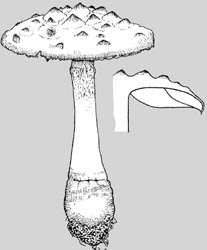 1. Amanita crassiconus - drawing by C. Bas 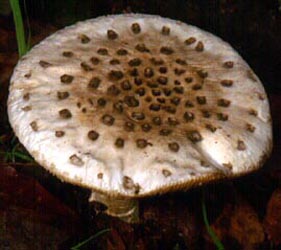  2. Amanita crassiconus - photo of David Arora |
| intro |
The following is based on the description of Bas (1969). |
| cap |
The cap of Amanita crassiconus is about 70 - 90 mm wide, plano-convex, rather fleshy, probably whitish or pale grayish, dry, with a nonsulcate, appendiculate margin. The cap is covered with pale gray, adnate warts, at the margin merely felted-flocculose with some scattered, crust-like, probably pale gray patches. No cap skin is present, and the volval material is directly attached to the pileus context. Some of the darkening of the volva in age is apparently due to the dark hyphae of an infecting hyphomycete. The flesh is white. |
| gills |
The gills are crowded, free, moderately broad, and probably white or cream. The short gills are attenuate. |
| stem |
The stem is about 80 - 100 × 8 - 10 mm, probably whitish on the upper part and grayish below, probably solid, subfelted-flocculose, exannulate (sometimes with narrow flocculose zone near the stem's top). The lower stem has thin, felted, incomplete, brownish-grayish volval girdles that disappear with aging. The stem bears a clavate-fusiform bulb measuring about 30 - 40 × 15 - 25 mm. |
| spores |
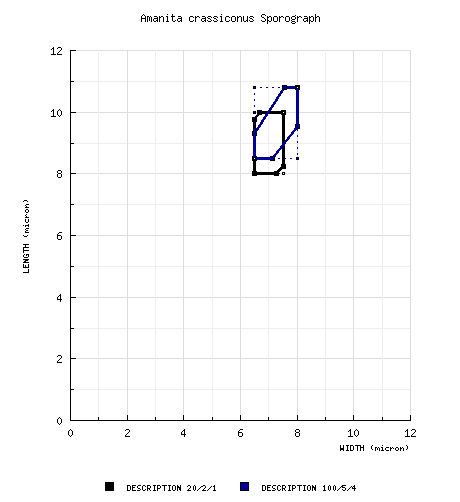
The spores measure (7.2-) 8.5 - 10.8 (-16.8) × (5.9-) 6.5 - 8.0 (-11.5) µm and are amyloid and subglobose to ellipsoid. Clamps are present at bases of basidia. |
| discussion |
The absence of a cap skin (pileipellis) is common in Amanita subsection Vittadiniae and infrequent in other parts of Amanita section Lepidella. Superficially, the present species is reminiscent of A. magniverrucata Thiers & Ammirati. The material reviewed by Dr. Bas was from the Northern Provinces of Nigeria. Associated symbionts are not known. The present provisional species was placed by Dr. Bas in his stirps Crassiconus as its single member.—R. E. Tulloss |
| brief editors | RET |

 Spore data sets and their composite