| name |
Amanita longitibiale |
| author |
Tulloss, Pérez-Silva & T. Herrera. 1995. Mycotaxon 53: 195, figs. 1-5. |
| name status |
nomen acceptum |
| english name |
"Long Stocking Death Cap" |
| synonyms |
= Amanita peckiana sensu T. Herrera & Pérez-Silva. 1984. Bol. Soc. Méx. Micol. 19: 266-67, pl. 1-3.
The editors of this site owe a great debt to Dr. Cornelis Bas
whose famous cigar box files of Amanita nomenclatural information
gathered over three or more decades were made available to RET for computerization
and make up the lion's share of the nomenclatural information presented on this site.
|
| etymology |
longus (long) + tibiale (stocking)
The name was chosen both because of the extremely long free limb of the saccate universal veil, which clearly contains the stipe base, but also to commemorate the wonderful children's books created by Astrid Lindgren that featured the character Pippi Longstocking. |
| MycoBank nos. |
412392 |
| GenBank nos. |
Due to delays in data processing at GenBank, some accession numbers may lead to unreleased (pending) pages.
These pages will eventually be made live, so try again later.
|
| holotypes |
MEXU 17384 |
| selected illustrations |
Pérez-Silva & T. Herrera. 1991. Iconogr. macromic. México. I Amanita: 65, pl. XVIII; 113, fig. 38. |
| pileus |
38 - 100 mm wide, sometimes yellowish cream (about 4A3) at first, eventually pale grayish brown (5B3) to grayish brown to umbrinous with pale gray to slightly yellowish gray margin, marginal region sometimes virgate, unevenly hemispheric to ovoid at first, then plano-convex, often with low broad umbo, subviscid, shiny when dry; context white, rather thick in disk (thickness up to about one half of stipe diameter), narrowing evenly to margin; margin inflexed at first, later decurved, nonstriate, nonappendiculate; universal veil absent or as dispersed patches, pallid, detersile, with pale orangish-brown or a pale and sordid orangish brown (5B4 or a little grayer than 5B4) tint. |
| lamellae |
free or attached by a line, with decurrent line on stipe apex, close, white, sometimes with a light pink tint, somewhat orangish tan (close to 5B5) in dried material, moderately broad to broad, with floccose and concolorous edge; lamellulae attenuate, plentiful, in several ranks. |
| stipe |
50 - 110 (includes bulb) × 6 - 30 mm, white, narrowing slightly
upward, pruinose above annulus, furfuraceous below; bulb
occupying about one third to one half of stipe length, pointed
below or radicating, usually rather slender, sometimes
as only slight swelling of stipe before start of tapering to
point; context white, sometimes with pink tones in bulb,
firm, solid to stuffed becoming hollow; partial veil
skirtlike and flaring at first, membranous, copious, persistent,
white, thin, striate above, superior to subapical to apical;
universal veil as limbate to saccate volva, adnate from
broadest part of bulb downward or attached only for as little as
bottom fifth of bulb length, forming hollow cylinder around
stipe
base, with free portion sometimes separated from bulb and slid
short distance up stipe (Fig. 1), with margin lobed unevenly
(sometimes very markedly so) or by presence of many short
vertical slits in edge, membranous and tough (remaining so in
exsiccata, white, with exterior becoming pale brownish to
ochraceous, sometimes with tints of rose at base, with inner
surface remaining pallid. |
| odor/taste |
Odor farinaceous (Mexican material) or not distinctive (Bixler s.n.). Taste mild. |
macrochemical
tests |
95% methanol (control) - negative on pileus, on lamella, in volval limb interior, and in stipe context (including bulb). 10% KOH - on pileus, immediately orange to reddish orange (7A6); on lamella, negative; other spots not tested. Spot test for tyrosinase (L-tyrosine) - on pileus and lamella surface deep pink (12A6) spottily after 15 min., in volval limb interior pink (12A4) after 5 min., on annulus pinkish white (12A2) after 5 min.; other spots not tested. Spot test for tyrosinase (paracresol) - on pileus and lamella surface pinkish white (12A2) after 10 min.; in volval limb interior, negative; other spots not tested. Spot test for laccase (syringaldazine) - negative on pileus and lamella surface, in stipe context, and in volval limb interior; other spots not tested. |
| pileipellis |
10 - 15 µm thick, yellow-brown to orange-brown in 3% KOH; filamentous, undifferentiated hyphae 2.8 - 5.0 µm wide, interwoven, extensively gelatinizing, with subradial arrangement notable near disk; vascular hyphae 2.2 - 8.0 µm wide, branching, sinuous, common. |
| pileus context |
filamentous, undifferentiated hyphae 1.8 - 15.0 µm wide, branching, mostly in fascicles, with those of largest diameter being slightly inflated; acrophysalides narrowly clavate to clavate to narrowly ellipsoid to pyriform, up to 103 × 50 µm, sometimes in chains, with walls thin to slightly thickened (up to 0.5* µm thick); vascular hyphae not observed. |
| lamella trama |
bilateral, broad, with wcs = 50 - 90 µm in specimen dried with sporulation just beginning (MEXU 23831); with elements of subhymenial base [inflated cells narrowly clavate to clavate to ovoid, up to 61 × 25 µm, thin-walled, with major axis aligned at angles from very shallow to nearly perpendicular to central stratum, occasionally curved (longest cells)] diverging from central stratum at very shallow angle and continuing in smooth broad curve until entering subhymenium at angle of 45° - 90°; filamentous, undifferentiated hyphae 1.5 - 9.0 µm wide, densely interwoven and often with constricted septa in central stratum, with some intercalary segments slightly inflated (up to 13.5 µm wide); divergent, terminal inflated cells not observed; vascular hyphae not observed; clamps scarce. |
| subhymenium |
wst-near = 80 - 120 µm in specimen dried with sporulation just beginning (MEXU 23831); wst-far = 115- 140 µm in specimen dried with sporulation just beginning (MEXU 23831); intensely ramifying, comprising small cells (inflated to subinflated to uninflated, frequently irregular or branched) taking on any angle to central stratum (including parallel to it and often developing in direction opposite to that of trama divergence), with basidia arising multiply (from inflated elements) or singly from uninflated elements or small inflated elements. |
| basidia |
31 - 73 × 7.8 - 11.2 µm, thin-walled, dominantly 4-, occasionally 2-sterigmate; clamps present, but sparsely distributed. |
| universal veil |
On stipe base, outer surface: filamentous, undifferentiated hyphae 1.2 - 7.5 µm wide, in fascicles interwoven loosely without dominant orientation, occasionally with horizontal orientation. On stipe base, interior: filamentous, undifferentiated hyphae 2.0 - 7.0 µm wide, with strong longitudinal orientation, often in fascicles, branching, plentiful; inflated cells plentiful to dominant, narrowly clavate to clavate to broadly clavate to elongate-ellipsoid, thin-walled, up to 93 × 50+ µm; vascular hyphae 2.0 - 6.0 µm wide, branching, most frequent near inner surface of limb. On stipe base, inner surface: like limb interior except for scattered fragments of fascicles of partially gelatinized, filamentous, undifferentiated hyphae. On pileus, upper surface: filamentous, undifferentiated hyphae 1.0 - 4.8 µm wide, partially gelatinizing, in fascicles having largely co-parallel orientation, but occasionally perpendicular to main group. On pileus, interior and lower layers: as on stipe base, with uncommon vascular hyphae as narrow as 2.8 µm wide. |
| stipe context |
longitudinally acrophysalidic; filamentous, undifferentiated hyphae 1.5 - 8.5 µm wide, with some of greatest diameter having walls 0.5 -1.0 µm thick; acrophysalides up to 268 × 36 µm, thin-walled, dominating; vascular hyphae 4.2 - 11.0 µm wide, branching; clamps scarce. |
| partial veil |
filamentous, undifferentiated hyphae 1.5 - 7.5 µm wide, very loosely interwoven, frequently branching, collapsing, with some (especially those of larger diameter) in radially oriented fascicles; inflated cells intercalary or terminal or in short terminal chains, clavate or as slightly inflated hyphal segments, up to 52 × 19.0 µm; vascular hyphae not observed; clamps not observed. All tissues hyaline and colorless unless otherwise stated. |
| basidiospores |
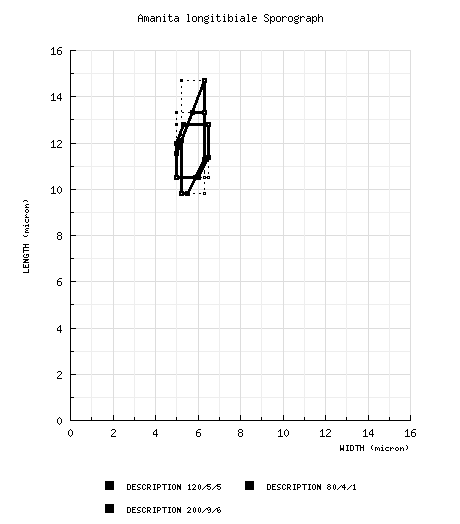
from protolog: [120/5/5] (10.0-) 10.5 - 12.8 (-14.8) × (4.2-) 5.0 - 6.5 (-7.2) μm, (L = 11.4 - 12.3 μm; L' = 11.7 μm; W = 5.4 - 5.8 μm; W' = 5.6 μm; Q = (1.56-) 1.75 - 2.40 (-3.04); Q = 2.0 - 2.28; Q' = 2.09).
The following data is from the Florida specimen listed below and is provided for comparison with the data from the protolog:[80/4/1] (9.4-) 9.8 - 14.7 × (4.9-) 5.2 - 6.3 (-7.0) μm, (L = 11.7 - 12.6 μm; L' = 12.0 μm; W = 5.7 - 5.9 μm; W' = 5.8 μm; Q = 1.78 - 2.33 (-2.38); Q = 1.99 - 2.19; Q' = 2.06).
composite of all material examined: [200/9/6] (9.4-) 10.5 - 13.3 (-14.8) × (4.2-) 5.0 - 6.3 (-7.2) μm, (L = 11.4 - 12.3 (-12.6) μm; L' = 11.8 μm; W = (5.4-) 5.6 - 5.9 μm; W' = 5.7 μm; Q = (1.56-) 1.79 - 2.31 (-3.04); Q = 1.99 - 2.19 (-2.28); Q' = 2.08), hyaline, colorless, smooth, thin-walled, amyloid, elongate to cylindric, rarely ellipsoid, sometimes constricted (frequently so in some collections, rarely so in others), sometimes expanded at one end; apiculus sublateral, cylindric, proportionately small; contents monoguttulate; ?? in deposit. |
| ecology |
Solitary. Mexico: In forest of Pinus or in Pinus-Abies forest. North Carolina: In sandy clay of mixed hardwood forest. |
| material examined |
from protolog: MÉXICO: DISTRITO FEDERAL— km 20 on Ajusco-Jalatlaco Rd., 25.vii.1980 E. Pérez-Silva & E. Chinchilla s.m. (paratype, MEXU 16140 as "A. peckiana"), 21.vii.1982 E. Aguirre et al. s.n. (holotype, MEXU 17384 as "A. peckiana"); km 25 on Ajusco-Jalatlaco Rd., 10.ix.1993 E. Pérez-Silva, T. Herrera & D. Rodríguez s.n. (paratype, MEXU 23831; paratype, RET 125-9). EDO. MÉXICO—Llano Grande, ca. Río Frío, 11.viii.1968 E. Pérez-Silva s.n. (paratype, MEXU 6348 as "A. peckiana"). U. S. A.: NORTH CAROLINA—Macon Co. - NW of Highlands, Gold Mine Rd. at jct. of Hwy. 64, 28.vii.1987 Dike Bixley s.n. (paratype, SFSU).
Post protolog: U. S. A.: FLORIDA—Brevard Co. - Eau Gallie, Wickham Pk., 9-10.xi.1985 A. Norarevian & E. R. Yetter s.n. [Tulloss 11-9/10-85-EY] (RET 081-6). |
| discussion |
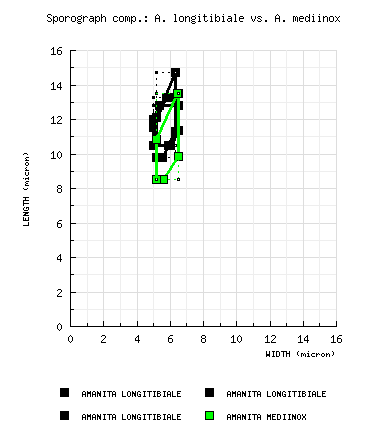
The provisionally named A. mediinox is a second North American taxon with a pigmented cap and rather elongate spores that is thought to be assignable to Amanita sect. Phalloideae at the present time. A sporograph comparison of the present species with A. mediinox is provided below.
|
| citations |
—R. E. Tulloss |
| editors |
RET |
|



 Spore data sets and their composite