

| name | Amanita virosiformis |
| name status | nomen acceptum |
| author | (Murrill) Murrill |
| english name | "Narrow-Spored Destroying Angel" |
| synonyms |
=Amanita tenuifolia (Murrill) Murrill |
| images |
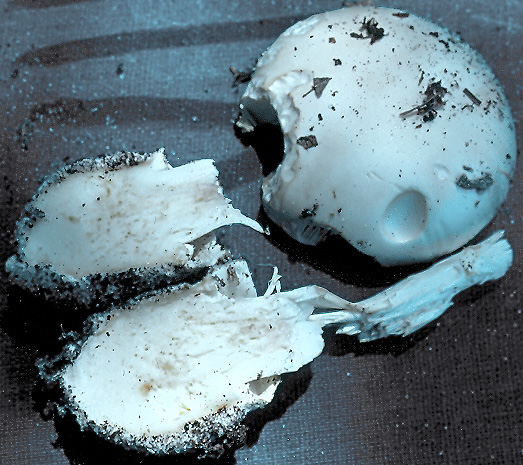  1. Amanita virosiformis, N of Frisco, Hatteras Isl., Dare Co., North Carolina, U.S.A. |
| intro | double click in markup mode to edit. |
| cap | The cap of Amanita virosiformis is 27 - 80 mm wide, slightly viscid, smooth, glabrous, shining when dry, white, becoming yellowish in the center with age or drying, with a nonstriate margin. Volval material is absent or may be present as one or two small, membranous patches in the center of the cap. The flesh is thin, fragile, and unchanging. |
| gills |
The gills are just free to narrowly adnexed, close, narrow, white, unchanging, and with edges fimbriate. |
| stem |
The stem is up to 40 - 90 × 3 - 15 mm, cylindric or narrowing upward, white, unchanging, pruinose above, glabrous and shining below. The bulb is narrowly ellipsoid to ellipsoid to subglobose to globose(?), white, large, 10 - 25 mm wide and up to 25 mm high. The volva limbate is large, membranous, white, persistent, sheathing lower stem 3 - 15 mm high, with a ragged margin. The ring is varying according to cap diameter, white, membranous, thin, superior to subapical. |
| odor/taste | Odor sometimes lacking or, often, suggesting "chloride of lime." Odor slightly of carrion in age or when drying. This species is deadly POISONOUS. |
| spores |
The spores measure (9.5-) 10.2 - 13.8 (-16.0) x (3.8-) 4.2 - 5.8 (-6.5) µm and are elongate to cylindric, infrequently baciliform and amyloid. Clamps are absent at bases of basidia. |
| discussion |
Amanita virosiformis is deadly POISONOUS. Both A. virosiformis and A. tenuifolia were originally described from Florida. The present species is known from eastern Texas and coastal North Carolina; it probably occurs in the sandy coastal plain areas of the US states along the Gulf of Mexico as well as in the similar coastal plain of the southern Atlantic coastal states of the US. This species is found near pine and oak and is solitary to gregarious. The two names on this page are treated as synonyms. A. virosiformis has historic precedence and is thus the name to be accepted. The original descriptions of the two species combined with type studies of both indicate that the only possible difference involves odor. However, the phrase chloride of lime is used to describe the odor of decaying protein associated with an outdoor toilet and the odor of carrion is simply another way of describing the odor of decaying protein. The odor of chloride of lime is not always present in the early stages of development of taxa in which it develops at or after maturity. The reader may want to examine the recently revised key to the taxa of sect. Phalloideae in North America.—R. E. Tulloss |
| brief editors | RET |

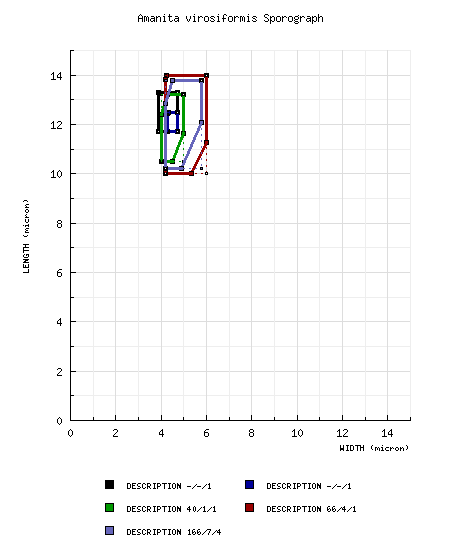
 Spore data sets and their composite