| name |
Amanita mediinox |
| author |
Tulloss nom. prov. |
| name status |
nomen provisorum |
| english name |
"Midnight Death Cap" |
| GenBank nos. |
Due to delays in data processing at GenBank, some accession numbers may lead to unreleased (pending) pages.
These pages will eventually be made live, so try again later.
|
| intro |
Olive text indicates a specimen that has not been
thoroughly examined (for example, for microscopic details) and marks other places in the text
where data is missing or uncertain.
The following material is based on original research of R. E. Tulloss.
|
| pileus |
35 - 75 mm wide, black to midnight blue at first, becoming mottled steely gray-blue with some greenish tones to grayish upon expansion, sparsely maculate in gray regions, sometimes with brownish stains around disc, ?? to planoconvex, dull when dry, ??; context off-white, becoming yellowish tan to pale reddish brown in damaged areas, with watersoaked lines above stipe and lamellae, 4.5± mm thick above stipe; margin nonstriate, nonappendiculate; universal veil absent. |
| lamellae |
free to narrowly adnate and connected to stipe apex by line, at least sometimes with faint decurrent line on upper stipe (10× lens), crowded, pale cream in mass and in side view, unchanging when cut or bruised, with edges minutely flocculose, up to 4.5 mm broad, broadest at about mid-point of radius; lamellulae subattenuate to attenuate, plentiful, of diverse lengths, unevenly distributed. |
| stipe |
100 × 8.5 mm, white to off-white to pale sordid white, without obvious staining or bruising or with brownish stains (from handling?), narrowing upward, flaring at apex, with white scales floccose-fibrillose and moderately densely placed; bulb 38 × 19 mm, sometimes with knob-like projection at bottom; context stuffed or hollow, off-white, watery yellow-tan in areas damaged by insect larvae, with central cylinder 2.5 mm wide; annulus white, apical, membranous, skirt-like, persistent, proportionately rather large (e.g., about 5 mm wide), collapsing, faintly striate above (10× lens), evenly (smoothly) subfloccose below, with edge having projecting radially-oriented bundles of white fibers; universal veil: as limbate to subsaccate volva 38 × 21 mm, less than 1 mm thick at midheight of limb, white, sometimes with pinkish brown stains on limb exterior, smooth, membranous, with limb attached at top of soft and easily compressed bulb, with limbus internus proportionately small and wedge-like, attached at base of limb (unitangent) and having very thin membranous upward extension. |
| odor/taste |
Odor fruit-like; taste not reported. |
macrochemical
tests |
none recorded. |
| pileipellis |
??; vascular hyphae
2.4 - 8.5 µm wide, sinuous, scattered and rather
common. |
| subhymenium |
cellular (pseudoparenchymatous), ??. |
| stipe context |
longitudinally acrophysalidic; filamentous undifferentiated hyphae ?? µm wide, plentiful, sometimes in broad fascicles; acrophysalides up to 320 × 20 µm, dominant away from surfaces, very narrowly cylindric; vascular hyphae 6.3 - 12.7 µm wide, rather frequent locally, apparently most common near surfaces. |
| basidiospores |
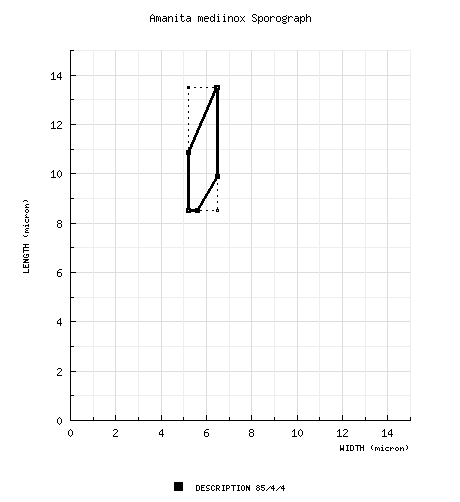
[85/4/4] (8.0-) 8.5 - 13.5 (-15.5) × (5.0-) 5.2 - 6.5 (8.5) µm, (L = 9.1 - 12.1 µm; L’ = 10.6 µm; W = 5.6 - 6.5 µm; W’ = 5.9 µm; Q = (1.40-) 1.52 - 2.09 (-2.42); Q = 1.54 - 1.89; Q’ = 1.78), hyaline, colorless, thin-walled, smooth, amyloid, dominantly elongate, also cylindric or ellipsoid, usually at least somewhat adaxially flattened but sometimes symmetric (ignoring apiculus) in lateral view, infrequently slightly constricted; apiculus sublateral, small, cyindric; contents mono- to multiguttulate; ?? in deposit. |
| ecology |
Solitary or scattered, at ca. 650 m elev. North Carolina: In mixed hardwood forest. Tennessee: In mixed forest including Tsuga canadensis and Quercus spp. Virginia: In flood plain in mixed woods including Pinus. |
| material examined |
U. S. A.:
NORTH CAROLINA—Transylvania Co. -
Pisgah Nat. For., Coon Tree Mtn., 22.vii.1995 Peek
s.n. (RET 152-9).
TENNESSEE—Sevier Co. - ca. Gatlinburg,
GSMNP, Cherokee Orchard [35.6811° N/ 83.4625° W,
945 m], 12.vii.2004 J. L. Mata s.n.
[Tulloss 7-12-04-AA] (RET 376-1).
VIRGINIA—Rockingham Co. - George
Washington Nat. For., Jct. of Dry Fork and Rte. 33,
14.viii.2003 J. Sherry JSWV03-752 (DEWV 4422);
George Washington Nat. For., S foot of Feedstone
Mtn., ca. 90 m N of US Rte 33, ca. Dry River and
For. Rd. 548, 14.viii.2003 J. Sherry JEWV03-1067
(DEWV 4423). |
| citations |
—R. E. Tulloss |
| editors |
RET |
|


 Spore data sets and their composite