
| name | Amanita lanivolva |
| name status | nomen acceptum |
| author | Bas |
| english name | "Cotton Sack Amanita" |
| images |
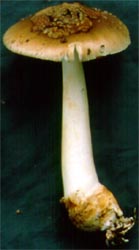 1. Amanita lanivolva, Pakaraima Mtns., Guyana.> <img src= |
| intro |
The following is based on the original description of Bas (1978) and the description of Guyanan material by C. Simmons et al. (2002). |
| cap |
The cap of A. lanivolva is 30 - 75 mm wide, plano-convex with a broad central depression, subumbonate or not, glabrous, subviscid, with a broad sulcate-striate margin (40 - 60% of the radius). The cap is moderately dark, slightly olivaceous tinged brown, a slightly more reddish browncenter, with white interstriation at the margin. In the Guyanan material of this species, sometimes a few volval warts remain in the center of the cap. This was not reported from the original Brazilian material of the species. |
| gills |
The gills are free, crowded, narrow, and white to pallid grayish. The short gills are truncate to obliquely truncate and pale buff to pale ochraceous brown in dried specimens. |
| stem |
The stem is 65 - 100 × 5 - 8 mm, tapering upward, hollow, exannulate, white, fragile, smooth, and glabrous. The flesh is white and unchanging. The limbate-saccate volva is membranous, loosely sheathing above its attachment to the bulb, covering one-quarter to one-third of the total length of the stipe and its bulb, and gray to fuscous gray. |
| spores |
The spores of Amazonian material measure 7.5 - 9.5 × 5.5 - 7 µm (Bas, 1978) and are broadly ellipsoid to ellipsoid. Clamps are present at bases of basidia. Spore measurements from Guyanan material of C. Simmons et al. (2002) are 7.4 - 9.8 × 5.0 - 6.6 (-7.2) µm. RET data from Guyanan material are as follows: (7.9-) 8.0 - 9.1 (-10.5) × (5.4-) 5.5 - 6.6 (-6.9) µm, ellipsoid to (infrequently) elongate. |
| discussion |
Amanita lanivolva was originally described from Amazonia. It is now also known from the Pakaraima Mtns. of Guyana where it occurs with Dicymbe (a genus of the Caesalpinaceae). Molecular studies have suggested that these trees are descendants of populations that existed prior to the separation of Africa and South America. (T. Henkel, pers. corresp.) This curious species is the first example of a species with a membranous volva, inamyloid spores, and a basal bulb. It must be placed in Amanita sect. Amanita because of the latter characters. There is another species (of which no detailed images exist to my knowledge) that may share the curioius characters of the present one—A. pseudospreta Raithelh.—previously placed in Amanita sect. Vaginatae (Tulloss & Halling, 1997). —R. E. Tulloss |
| brief editors | RET |

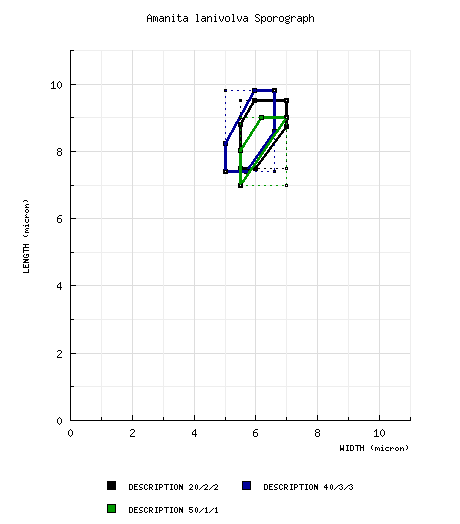
 Spore data sets and their composite