
| name | Amanita pseudospreta |
| name status | nomen acceptum |
| author | Raithelh. |
| english name | "Argentine False Hated Caesar" |
| intro | The current state of knowledge of this species is provided by Tulloss and Halling (1997). |
| cap | Amanita pseudospreta has a cap 30 - 45 mm wide that is pale gray with an ochraceous tint in the center. The cap is convex at first and becomes planar. The cap's flesh is white. The margin of the cap is short striate (about 0.3 of the radius in dried material). The volval remnants on the cap are thick gray warts. |
| gills |
The gills of this species are free to adnexed, moderately close, and cream. Short gills were not described for this species, but may be present. |
| stem |
The stem of A. pseudospreta is 60 - 85 x 6 - 12 mm, pallid and pruinose above and (possibly stained or bruised) pale reddish brown below (darker than the volva in dried material). The stipe''s base was somewhat expanded in the dried specimens suggesting there may have been a basal bulb in fresh material. The flesh of the stem is white and stuffed at first, although later hollow. The annulus is small, superior to submedian, membranous, and whitish. The volva is saccate, pallid, (in dry material beige with a white base), membranous or submembranous, and eventually collapsing on the stipe. |
| spores | The spores of this species measure (8.2-) 9.0- 11.2 (-12.2) × (7.2-) 7.8 - 10.2 (-11.2) µm and are subglobose to broadly ellipsoid (or infrequently globose or ellipsoid) and inamyloid. Clamps are found at the bases of basidia. |
| discussion |
Amanita pseudospreta is found under Nothofagus in Argentina. If there is a very similar taxon (perhaps A. lanivolva Bas is a candidate), that entity probably also occurs only in the Southern Hemisphere. The reason for comparison to A. lanivolva is that, as in the case of that species, A. pseudospreta seemed to have a bulb inside its saccate volva when the four dried specimens known to me were examined. A bulb in the sac was confirmed recently for A. lanivolva causing it to be reclassified in sect. Amanita (Simmons, Henkel and Bas, 2002). Such a reclassification of A. pseudospreta is a future possibility.—R. E. Tulloss |
| brief editors | RET |
| name | Amanita pseudospreta | ||||||||||||||||||||
| author | Raithelh. 1974. Metrodiana 5: 73. | ||||||||||||||||||||
| name status | nomen acceptum | ||||||||||||||||||||
| english name | "Argentine False Hated Caesar" | ||||||||||||||||||||
| etymology | pseudo- "false" + spretus "hated" [here intended as a direct reference to the species epithet of Amanita spreta to which Raithelhuber thought his species bore some resemblance] | ||||||||||||||||||||
| MycoBank nos. | 308582 | ||||||||||||||||||||
| GenBank nos. |
Due to delays in data processing at GenBank, some accession numbers may lead to unreleased (pending) pages.
These pages will eventually be made live, so try again later. Search:
Showing 0 to 0 of 0 entries | ||||||||||||||||||||
| holotypes | BAFC | ||||||||||||||||||||
| type studies | Tulloss and Halling. 1997. Mycologia 89: 284, 285, figs. 9-11. | ||||||||||||||||||||
| selected illustrations |
Raithelh. 1986. Metrodiana 14: 13 [unnumbered fig.; habit, spores, basidia]. Raithelh. 1987. Fl. Mycol. Argentina. Hongos I: 368, figs. 485-491. | ||||||||||||||||||||
| intro | The following is based on the type study and revision of new material reported in Tulloss and Halling (1997) and research by RET since that date. | ||||||||||||||||||||
| pileus | 30–45 mm wide, pale gray, disc a little more gray-ocher, convex, becoming planar; context white; margin short striate [per illustration (Raithelhuber 1986: 13)] (0.3±R in exsiccatum); universal veil absent or as thick, gray warts. | ||||||||||||||||||||
| lamellae | narrowly adnate to free, close to moderately close, cream; lamellulae not described. | ||||||||||||||||||||
| stipe | 60–85 × 6–12 µm, pallid, pale reddish brown below, darker than universal veil in exsiccatum, pruinate above; base slightly expanded, apparently with a small, subglobose bulb; context white, stuffed, hollow in exsiccatum; partial veil superior to submedian, whitish, small; universal veil as saccate volva, pallid, in exsiccata beige to pale orangish tan on limb with white base, collapsing on stipe, membranous or submembranous(?), up to 37 × 11 mm in exsiccata of BAFC 30.616 (width measured at apparent bulb). | ||||||||||||||||||||
| odor/taste | Odor and taste insignificant. | ||||||||||||||||||||
| macrochemical tests |
none recorded. | ||||||||||||||||||||
| pileipellis | partially gelatinized, orange-brown, 25–35 µm thick, filamentous, undifferentiated hyphae 2.0–6.0 µm wide, with strong subradial orientation; vascular hyphae not observed. | ||||||||||||||||||||
| pileus context | filamentous, undifferentiated hyphae 1.8–9.2 µm wide, branching, plentiful, often in fascicles, relatively often with refractive yellow deposit on interior of walls; acrophysalides dominating except near pileipellis, ovoid to broadly clavate to clavate to elongate, terminal or in chains, up to 58 × 45 µm, with chains of subfusiform cells (e.g., 50 × 18 µm) sometimes having rather broad septa; vascular hyphae not observed; clamps present. | ||||||||||||||||||||
| lamella trama | bilateral, with minimal divergence notable only immediately adjacent to subhymenium; wcs = 40–55 µm wide; filamentous, undifferentiated hyphae 1.2–10.2 µm wide, branching, dominating; divergent, terminal inflated cells not observed; vascular hyphae not observed; clamps not common. | ||||||||||||||||||||
| subhymenium | in many regions quite narrow, with wst-near = 0–10 µm and wst-far = 15–25 µm, with basidia arising from filamentous, undifferentiated hyphae minimally divergent from trama or from single cell or chain of two cells (such cells up to 13 µm long) of various types (uninflated hyphal segment, uninflated multiply branching cell, subglobose to clavate inflated cell). | ||||||||||||||||||||
| basidia | Basidia: 38–61+ × 7.0–14.8 µm, sometimes narrowing abruptly at point of emergence from surrounding basidioles, dominantly 4-sterigmate (opaque in holotype only, else transparent), also commonly 2-sterigmate (some opaque in holotype, else transparent), occasionally 3-sterigmate (transparent), thin-walled (when transparent), with sterigmata up to 5.5 × 2.5 µm (most narrower), narrowest observed (only one of its type seen) was 2-sterigmate and Y-shaped with short rounded sterigmata; crassobasidia with decoration as in spores of holotype not observed (LM); clamps observed, common and relatively large in BAFC 30.616. | ||||||||||||||||||||
| universal veil | From stipe base, exterior surface: extensively gelatinized in holotype; 2–4(?) hyphal diameters thick; predominated by somewhat interwoven, relatively straight or curving, broad groups of co-parallel, filamentous, undifferentiated hyphae 1.2–10.5 µm wide, branching, often containing refractive guttules or granules, partially gelatinizing; vascular hyphae rare or absent. From stipe base, interior: filamentous, undifferentiated hyphae 1.8–11.5 µm wide, branching, plentiful, disordered, interwoven, locally tightly interwoven, often in fascicles, some partially gelatinized (especially near surface), some with refractive granules apparently clinging to interior of cell walls (BAFC 30.616); inflated cells terminal, plentiful, thin-walled, occasionally pale brown, subglobose to subpyriform to pyriform (up to 66 × 50 µm) or ellipsoid (up to 84 × 54 µm) or subfusiform to narrowly fusiform to narrowly clavate to clavate to broadly clavate (up to 192 × 50 µm, near exterior surface and up to 101 × 52 µm deeper in interior); vascular hyphae not observed. From stipe base, inner surface: not distinguishable from interior. On pileus: gelatinizing, yellow-orange to orange-brown; exterior surface with thin layer of parallel filamentous, undifferentiated hyphae in some places; interior as on stipe base; with partially gelatinized, clavate inflated cells scattered over pileipellis beyond limits of patches. | ||||||||||||||||||||
| stipe context | longitudinally acrophysalidic; filamentous, undifferentiated hyphae 1.8–8.8 µm wide, branching, dominating near surface; acrophysalides thin-walled, dominating in interior, up to 173 × 52 µm; vascular hyphae not observed in interior, 4.5–7.5 µm wide in stipipellis, not common; clamps observed. | ||||||||||||||||||||
| partial veil | extensively gelatinized and difficult to rehydrate, yellow-orange to orange brown; filamentous, undifferentiated hyphae 1.5–5.8 (or greater?) µm wide, with strongly dominant radial orientation (at least when viewed from apparent underside), often in fascicles; inflated cells scattered(?), on apparent underside or in interior broadly clavate (e.g., 48 × 29 µm), on apparent upper surface or in interior ovoid (e.g., 82 × 52 µm, possibly being cells which separate partial veil from lamellae); vascular hyphae not observed. | ||||||||||||||||||||
| lamella edge tissue | not described. | ||||||||||||||||||||
| basidiospores | [114/5/2] (8.2–) 9.0–11.2 (–12.2) × (7.2–) 7.8–10.2 (–11.2) µm, (L = 9.6–10.7 µm; L’ = 10.0 µm; W = 8.4–9.6 µm; W’ = 9.0 µm; Q = (1.0–) 1.03–1.24 (–1.56); Q = 1.10–1.15; Q’ = 1.12), colorless, with 75–90% of spores of holotype as hyaline crassospores with ornamentation on interior of spore wall like that in holotype of A. morenoi, with remainder subopaque to opaque (LM) and infrequently having interior decoration slightly visible [some apparently with slightly thickened walls (when stained with Congo Red)], with spores of BAFC 30.616 entirely normal, inamyloid, cyanophilic, globose to subglobose to broadly ellipsoid, rarely ellipsoid, usually at least somewhat adaxially flattened; apiculus sublateral, rather prominent, cylindric to rounded-conic; contents in holotype visible only rarely, otherwise granular to mono- or multiguttulate, sometimes with additional small granules; whitish in deposit. | ||||||||||||||||||||
| ecology | Subgregarious to solitary. Holotype collected under Nothofagus dombeyi and Chusquea. | ||||||||||||||||||||
| material examined |
ARGENTINA: NEUQUÉN—Parq. Nac. Nahuel Huapí, Puerto Blest [41°02'00" S/ 71°24'00" W, ca 1000 m], | ||||||||||||||||||||
| discussion |
Raithelhuber (1974) described the spores of the type as verrucose. Later (Raithelhuber 1986), he stated "in manchen Exemplaren leicht punktiert." In fact, while the exterior surface of the spores of the type is smooth, 75 to 90% or more of the spores are crassospores with decoration on the interior of the spore wall as in A. morenoi. The apparent presence of a bulb within the saccate volva needs to be checked on fresh material and particularly on "buttons" of the present species. If a true bulb is present (which RET judges is the case), the taxon must be placed in sect. Amanita where it will be unusual because of the saccate volva. One other species has been described about which this same issue of placement was at question—A. lanivolva Bas (1978) described from lowland tropical forest in Brazil. The presence of the bulb in A. lanivolva is now confirmed (Simmons et al. 2002). In the specimens of BAFC 30.616, we could not find evidence of an annulus on the stipe; however, the middle regions of the stipes are badly dried and the small, submedian annulus could easily have been lost. | ||||||||||||||||||||
| citations | —R. E. Tulloss | ||||||||||||||||||||
| editors | RET | ||||||||||||||||||||
Information to support the viewer in reading the content of "technical" tabs can be found here.
| name | Amanita pseudospreta |
| bottom links | [ Keys & Checklists ] |
| name | Amanita pseudospreta |
| bottom links | [ Keys & Checklists ] |
 Spore data sets and their composite
Each spore data set is intended to comprise a set of measurements from a single specimen made by a single observer; and explanations prepared for this site talk about specimen-observer pairs associated with each data set. Combining more data into a single data set is non-optimal because it obscures observer differences (which may be valuable for instructional purposes, for example) and may obscure instances in which a single collection inadvertently contains a mixture of taxa.
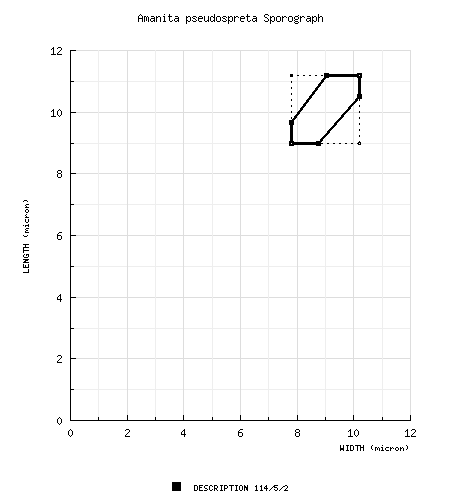

Text and User-Generated Sporographs are published under the Creative Commons License.

In the case of a taxon page, image credits are on the 'image' tab.