| name |
Amanita pudica |
| author |
(Beeli) E.-J. Gilbert. 1941a. Notules Amanites (suppl.): 4. |
| name status |
nomen acceptum |
| english name |
"African Rose Ringless Amanita" |
| synonyms |
≡ Amanitopsis pudica Beeli. 1936. Bull. Jard. Bot. État 14: 90, pl. 3 (fig. 2).
≡ Amanita pudica (Beeli) Walleyn. 1996. Bull. Jard. Bot. Belg. 65: 215-218. [Superfluous combination.]
The editors of this site owe a great debt to Dr. Cornelis Bas
whose famous cigar box files of Amanita nomenclatural information
gathered over three or more decades were made available to RET for computerization
and make up the lion's share of the nomenclatural information presented on this site.
|
| MycoBank nos. |
436823, 275575 |
| GenBank nos. |
Due to delays in data processing at GenBank, some accession numbers may lead to unreleased (pending) pages.
These pages will eventually be made live, so try again later.
|
| holotypes |
BR |
| revisions |
Walleyn. 1996. op. cit.: 217, figs. 1-2. |
| selected illustrations |
E.-J. Gilbert. 1940. Iconogr. Mycol. (Milan) 27, suppl.: tab. 59(5-6).
Buyck. 1994. Ubwoba: figs. 7, 53. |
| intro |
The following text may make multiple use of each data field.
The field may contain magenta text presenting data from a type study
and/or revision of other original material cited in the protolog of the present taxon.
Macroscopic descriptions in magenta are a combination of data from the protolog and
additional observations made on the exiccata during revision of the cited original
material.
The same field may also contain black text, which is data from a revision of the present
taxon (including non-type material and/or material not cited in the protolog).
Paragraphs of black text will be labeled if further subdivision of
this text is appropriate.
Olive text indicates a specimen that has not been
thoroughly examined (for example, for microscopic details) and marks other places in the text
where data is missing or uncertain.
The following material not directly from the protolog of the present taxon and not cited as the work of another researcher is based on original research of R. E. Tulloss.
Walleyn (1996) reported on several collections of this species, but did not present composite data with regard to the spores. The collections he examined are cited below. |
| pileus |
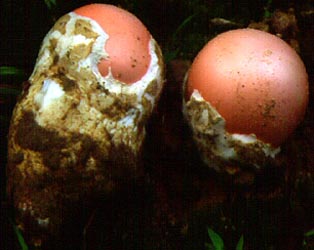
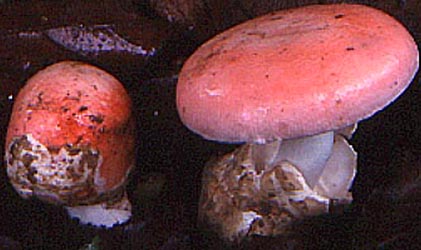
from protolog: 50 - 80 mm wide, uniformly pink, convex then planar, bare; context white, fleshy, hollow in center; margin finely striate; universal veil not present.
Walleyn (1996): bright pink, becoming partly yellowish in old basidiomes, strongly viscid; context not described; margin sulcate; universal veil not described. |
| lamellae |
from protolog: free, crowded, white; lamellulae not described. |
| stipe |
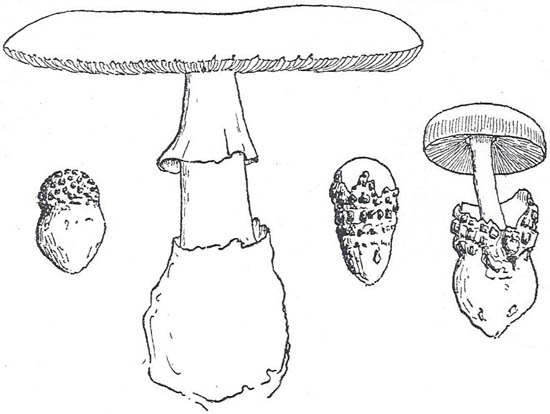
from protolog: 70 - 80 × 7 - 9 mm, white, cylindric, glabrous, smooth; bulb not described; context white; exannulate (per figure); universal veil as saccate volva (per figure), membranous, thick, with brown exterior, areolate.
Walleyn (1996): bulb with length about one-third that of stipe (per figure), approximately hemispheric (per figure), sometimes with small obconic projection below (per figure); context not described; exannulate (per figure) universal veil as robust saccate volva, with height of free limb about equal to height of enclosed bulb and separated from stipe by broad sinus (per figure), with limbus internus minimal or absent (per figure), with "warty" outer surface often colored by soil particles. |
| odor/taste |
not recorded. |
macrochemical
tests |
none described. |
| pileipellis |
from protolog: filamentous hyphae slender.
Walleyn (1996), from non-type material: as ixocutis; filamentous undifferentiated hyphae interwoven, hyaline; vascular hyphae present. |
| pileus context |
not described. |
| lamella trama |
not described. |
| subhymenium |
not described. |
| basidia |
from protolog: 26± × 8± μm, 4-sterigmate.
Walleyn (1996), from non-type material: 40 - 55 × 7.5 - 10.5 μm, 4-sterigmate; clamps probably present. [Note: Walleyn doesn't mention clamps on the basidia but mention them as present in the lamella trama, subhymenium, and universal veil. He also illustrates them as present in the lamella edge tissue. ed.] |
| universal veil |
Walleyn (1996), from non-type material: filamentous hyphae slender, frequently branching, anastomosing; inflated cells more or less spherical [40 - 50 (-100) μm wide], terminal; vascular hyphae present. |
| stipe context |
not described. |
| partial veil |
absent. |
| lamella edge tissue |
Walleyn (1996), from non-type material: inflated cells slighty clavate to broadly clavate to short-spheropedunculate, 23 - 30 × 12 - 17 μm numerous. |
| basidiospores |
from protolog: 8 × 5 - 5.5 μm, hyaline, smooth, ellipsoid, "amyloid" [sic]. [Note: This data is inadequate for generation of a sporograph. The spores are inamyloid per Walleyn (1996).—ed.]
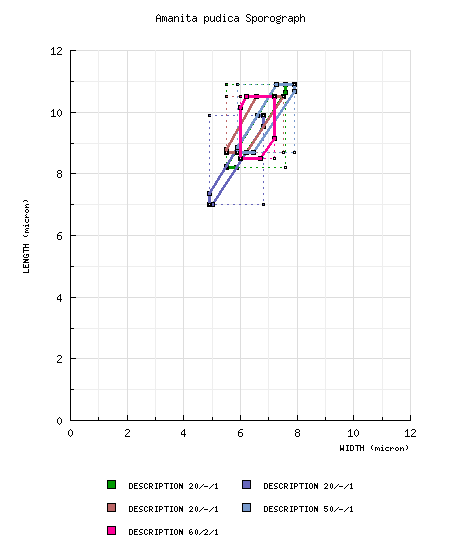
from type (Walleyn 1996): [20/-/1] 8.2 - 10.9 (-11.3) × 5.5 - 7.6 μm, (L = 9.6 μm; W = 6.5 μm; est. Q = 1.40 - 1.50; Q = 1.45), hyaline, smooth, thin-walled, ellipsoid, inamyloid, adaxially flattened; apiculus sublateral and cylindric or truncate conic (all per figure); contents mostly uniguttulate; white in deposit. [Note: Walleyn wished to illustrate the similarity of the spores in the material he examined and presented the data for each collection separately. Unfortunately, this prevents us from creating a single sporograph representing the variation in spore size and shape that Walleyn found. Walleyn only provides an average Q for each collection revised; hence, we have had to make a conservative estimate of the range of Q for each collection.—ed.]
Walleyn (1996), from Verbeken 94/71: [20/-/1] 7.0 - 9.9 × 4.9 - 6.8 μm, (L = 8.5 μm; W = 5.9 μm; est. Q = 1.40 - 1.50; Q = 1.43). [Note: See previous comment on (Walleyn 1996).]
Walleyn (1996), from Soyer 235: [20/-/1] 8.7 - 10.5 × 5.5 - 7.5 μm, (L = 9.6 μm; W = 6.5 μm; est. Q = 1.40 - 1.60; Q = 1.49). [Note: See previous comment on (Walleyn 1996).]
Walleyn (1996), from Rammeloo 5822: [50/-/1] (8.2-) 8.7 - 10.9 × 5.9 - 7.9 μm, (L = 9.8 μm; W = 6.9 μm; est. Q = 1.35 - 1.50; Q = 1.42). [Note: See previous comment on (Walleyn 1996).]
CRC: [60/2/1] (8.0-) 8.5 - 10.5 (-13.0) × (5.3-) 6.0 - 7.2 (-8.5) μm, (L = 9.1 - 9.5 μm; L' = 9.2 μm; W = 6.4 - 6.5 μm; W' = 6.5 μm; Q = (1.21-) 1.27 - 1.69 (-1.96); Q = 1.43 - 1.47; Q' = 1.45), hyaline, colorless, smooth, thin-walled, inamyloid, ellipsoid to elongate, occasionally adaxially flattened; apiculu sublateral, cylindric; contents granular or mono- to multiguttulate with additional small granules; color in deposit not recorded. |
| ecology |
from protolog: Terrestrial.
Walleyn (1996): Burundi: At 1000± m elev. In Brachystegia woodland or on old termitaria in miombo woodland dominated by Brachystegia bussei and B. utilis. Republic of Congo: In miombo woodland or at the base of a temitaria. Zambia: In miombo woodland. |
| material examined |
Walleyn (1996): BURUNDI: BURURI PROV.—Mugara [ca. 1000 m], xi.1978 Rammeloo 5822 (BR), 5872 (BR); rd. btwn. Bukemba and Kukaro, i.1979 Rammeloo 6314 (BR); ca. Rumonge, Nyamirambo, iii.1994 Verbeken 94/71 (BR), 94/85 (BR), 94/522 (BR). CONGO, DEMOCRATIC REPUBLIC OF: KATANGA PROV.—ca. Lubumbashi (formerly Elisabethville) [ca. 1,000], xii.1931 F. De Loose 8 (holotype, BR); Luiswishi, ii.1986 Schreurs 1139 (BR); Mukuen, ii.1947 Soyer 20 (BR), iii.1948 Soyer 235 (BR). ZAMBIA: COPPERBELT PROV.—ca. Kitwe, Chati-forest, xii.1990 Bart Buyck 3230 (in herb. B. Buyck).
RET/CRC: ZAMBIA: COPPERBELT PROV.—off Kitwe-Ndola Rd., Greystone Farm Nature Reserve, 23.xii.2000 D. Arora 00-406 (RET 344-4). |
| discussion |
Walleyn (1996) observed that there was a bulb inside the volval sac of A. pudica—"only the part of the primordial stem above the level of the margin of the primordial cap elongates, leaving a distinct basal bulb." Recent DNA sequencing has supports such a placement of this species. Previously, the present species was thought to belong in sect. Vaginatae.
The present species is this first known from Africa with a bulb inside a membranous, saccate volva. Several other such taxa are known from the New World and Australia. The reader may wish to compare the taxa of the provisional series Umbrinellae.
This striking species still awaits a thorough revision. |
| citations |
—R. E. Tulloss and C. Rodríguez Caycedo |
| editors |
RET |
|



 Spore data sets and their composite