| name |
Amanita islandica |
| author |
Melot. 1992. Doc. Mycol. 22(85): 20. |
| name status |
nomen acceptum |
| english name |
"Iceland Ringless Amanita" |
| etymology |
Latin adjectival form of "Iceland" |
| MycoBank nos. |
355466 |
| GenBank nos. |
Due to delays in data processing at GenBank, some accession numbers may lead to unreleased (pending) pages.
These pages will eventually be made live, so try again later.
|
| holotypes |
in herb. J. Melot |
| type studies |
Tulloss, here |
| intro |
The following text may make multiple use of each data field.
The field may contain magenta text representing a type study
by Tulloss.
The same field may also contain black text, which will represent a revision of the
species by Tulloss. Paragraphs of black text will be labeled if further subdivision of
this text is appropriate.
Olive text indicates a specimen that has not been
thoroughly examined; for example, for microscopic details or other place in the text
where data is missing; for example, a place name or a measurement.
The following is based upon original research by R. E. Tulloss. |
| pileus |
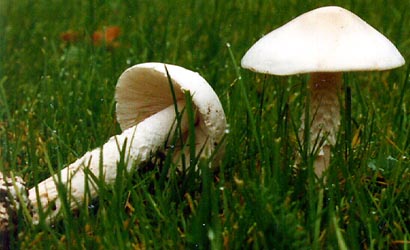
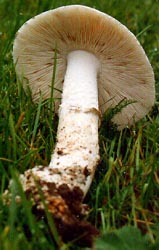
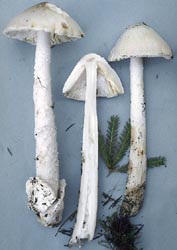
protolog & RET type study of A. islandica: 100 - 130 mm wide, white at first, but conspicuously graying, pale tan in exsiccatum, moist, subovoid, then convex, broadly umbonate; context white, proportionately very thick in disc, thin at margin, soon soft; margin densely (but short—about 0.15R in exsiccatum) sulcate, nonappendiculate; universal veil absent.
Tulloss 8-19-99-B: 136 mm wide, white, becoming sordid or brownish after refrigeration, brown on the edge of wounds, broadly campanulate, lacking distinct umbo, subshiny, waxy; context white, with brown spots in old wounds, 12 mm thick over stipe, thinning evenly to margin; margin striate (0.15R), not appendiculate; universal veil as large membranous smooth white patches, detersile, graying and darkening on some edges after refrigeration. |
| lamellae |
protolog & RET type study of A. islandica: very crowded, white, then creamy white, thin, [up to 15 mm broad,] with edge minutely flocculose and remaining white in exsiccatum; lamellulae subtruncate to subattenuate, of diverse lengths, unevenly distributed, common.
Tulloss 8-19-99-B: free, without decurrent line on stipe apex, pale yellow-orange-cream in mass, cream in side view, with no apparent bruising or staining, 8.5 mm broad; lamellulae truncate, unevenly distributed, of diverse lengths, plentiful. |
| stipe |
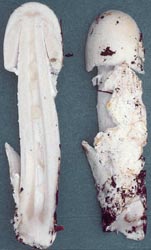
protolog & RET type study of A. islandica: up to 170 × 15 (-25) mm, robust and proportionately quite long, white, browning in lower portion; context white, with cottony-fibrillose stuffing; partial veil as copiously floccose-pulverulent region near apex (covering most of upper 40 mm of stipe in exsiccatum), white; universal veil as saccate volva, thick, white on exterior surface, with pale orangish tint on inner surface, remaining only as single large membranous patch several mm from base of stipe in portion of exsiccatum reviewed.
Tulloss 8-19-99-B: 207 × 19 mm, white, with surface fibrils graying after refrigeration, narrowing upward, flaring slightly at apex, longitudinally striatulae, with flocculent, uneven (but continuous) bands encircling stipe at bottom of flocculent sheath (with sheath descending 50 mm from stipe apex) and near stipe base (limbus internus?); context off-white, not bruising or staining except for ochraceous tint at very base, stuffed with dense white fibrillose material with fibers having longitudinal orientation, with central cylinder 9.5 mm wide, with larval tunnels concolorous; universal veil as saccate volva, smooth, slightly leathery (partially dried), white with pale yellow-brown tint and staining, 34 × 29 (most left on pileus), with limb clearly divided from stipe base by line, with stipe and inner volval surface bound rather firmly by hyphae; limbus internus not visible. |
| odor/taste |
protolog & RET type study of A. islandica: not recorded.
not recorded due to age of specimen. |
macrochemical
tests |
protolog & RET type study of A. islandica: none recorded.
none recorded. |
| pileipellis |
protolog & RET type study of A. islandica: (130-) 155 - 175 µm thick, gelatinized only at surface, otherwise partially gelatinized or ungelatinized, colorless or slightly yellowish; filamentous, undifferentiated hyphae 2.2 - 8.0 µm wide, branching, densely packed, dominantly subradially arranged; vascular hyphae 2.0 - 17.5 µm wide, common, branching, most easily seen in scalp section, sinuous, occasionally coiled or loosely tangled, with relatively common abrupt constrictions, yellow to brownish yellow in 3% KOH. |
| pileus context |
protolog & RET type study of A. islandica: filamentous, undifferentiated hyphae 2.5 - 9.0 µm wide, branching, common, often in fascicles, occasionally anastomosing, with walls thin or (rather commonly) up to 0.8 µm thick, with intercalary partially inflated segments up to 21.0 µm wide; acrophysalides plentiful, broadly fusiform to clavate (up to 136 × 31 µm) or ellipsoid (up to 59 × 35 µm), with walls up to 1.5 µm thick; refractive (not clearly vascular) hyphae 2.5 - 11.0 µm wide, uncommon. |
| lamella trama |
protolog & RET type study of A. islandica: bilateral; subhymenial base dominated by intercalary inflated cells [subglobose to broadly ellipsoid (up to 35 × 26 µm) or clavate to broadly subfusiform (up to 73 × 33 µm)], but also containing occasional filamentous, undifferentiated hyphae (often diverging at a rather shallow angle); wcs = 70 - 85 µm; filamentous, undifferentiated hyphae 2.0 - 8.0 µm wide, branching, sometimes constricted at septa, with intercalary segments in central stratum occasionally inflated (ellipsoid) or partially inflated (up to 14.0 µm wide); terminal, divergent inflated cells not observed; vascular hyphae not observed. |
| subhymenium |
protolog & RET type study of A. islandica: wst-near = 95 - 120 µm (60 - 65 µm in less mature region); wst-far = 130 - 145 µm (80 - 85 µm in less mature region); 15 - 30 µm between subhymenial base and nearest base of basidium; 50 - 55 µm between subhymenial base and farthest base of basidium; comprising inflated cells and partially inflated and uninflated hyphal segments and branched elements, because of cell width (in particular of the less inflated elements) sometimes giving pseudoparenchymatous impression, but branching structure always evident, with elements often having major diameter perpendicular to central stratum, with basidia arising from cells of all types, with uninflated elements predominant in less mature regions of lamellae; clamps not observed after extensive search. |
| basidia |
protolog & RET type study of A. islandica: 49 - 83 (-92) × 12.5 - 17.0 µm, dominantly 4-sterigmate, rarely 2- or 1-sterigmate; clamps not observed after extensive search. |
| universal veil |
protolog & RET type study of A. islandica: On pileus: absent. On stipe base, exterior surface: more orangish yellow than interior; filamentous, undifferentiated hyphae 2.0 - 8.0 µm wide, largely longitudinally oriented, often in rather broad fascicles, extensively gelatinized to partially gelatinized; inflated cells not observed; vascular hyphae 4.5 - 13.0 µm wide, infrequent, fragmented. On stipe base, interior: rather badly collapsed in holotype; filamentous, undifferentiated hyphae 2.8 - 13.0 µm wide, branching, often in fascicles (many sublongitudinally oriented, others interwoven), plentiful to dominating, occasionally with yellowish subrefractive walls, with walls thin or up to 0.5+ µm thick; inflated cells broadly clavate, singly terminal, plentiful, up to 142 × 54 µm, with walls up to 1.0± µm thick; vascular hyphae 4.5 - 8.0 µm wide, branching, scarce. On stipe base, inner surface: like interior, but more yellowish, slightly gelatinized, and having a greater concentration of (longitudinally oriented) hyphae. |
| stipe context |
protolog & RET type study of A. islandica: longitudinally acrophysalidic; filamentous, undifferentiated hyphae 2.8 - 10.8 µm wide, branching, often in fascicles, plentiful; acrophysalides dominating, up to 400 × 36 µm (but most less than 200 µm long), with walls up to 1.0 µm thick; vascular hyphae 5.6 - 19.2 µm wide, common (including at/near surface), frequently loosely coiled or twisted, with common abrupt constrictions (as in pileipellis). |
| partial veil |
protolog & RET type study of A. islandica: [Note: RET is not at all sure that the tissue here described is truly the analog of a partial veil as seen, for example, in the species of Amanita sect. Caesareae; however, this field seems an appropriate place in which to put my data.]
filamentous, undifferentiated hyphae 2.5 - 10.0 µm wide, frequently branching, with walls thin to slightly thickened, in a loose tangle, loosely coiling, sometimes with subrefractive yellowish walls, plentiful to locally dominant, often in loosely associated fascicles (many sublongitudinally oriented) of few members; inflated cells plentiful to locally dominant, without dominant orientation, singly terminal, sometimes with subterminal hyphal segment partially inflated (up to 13.0 µm wide), subcylindric to narrowly clavate to clavate (up to 88 × 18.5 µm) or broadly clavate to subpyriform (up to 54 × 30 µm), with walls thin or up to 0.5 µm thick; vascular hyphae not observed. |
| lamella edge tissue |
protolog & RET type study of A. islandica: not described. |
| basidiospores |
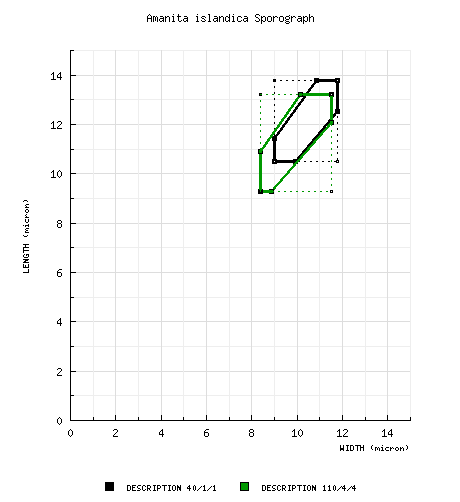
protolog & RET type study of A. islandica: [40/1/1] (9.5-) 10.5 - 13.8 (-15.0) × (8.0-) 9.0 - 11.8 (-14.5) µm, (L = 12.0 µm; W = 10.5 µm; Q = (1.03-) 1.06 - 1.27 (-1.53); Q = 1.14), hyaline, colorless, smooth, thin-walled, inamyloid, subglobose to broadly ellipsoid, infrequently globose, infrequently ellipsoid, rarely subtriangular in side view, adaxially flattened, often expanded at one end; apiculus sublateral, cylindric to narrowly truncate-conic, prominent; contents dominantly monoguttulate, occasionally multiguttulate; white to whitish [to pale cream-ivory] in deposit.
composite from all material studied: [110/4/4] (8.8-) 9.3 - 13.2 (-15.0) × (8.0-) 8.4 - 11.5 (-14.5) µm, (L = 9.8 - 12.0 µm; L' = 11.2 µm; W = 9.0 - 10.5 µm; W' = 9.9 µm; Q = (1.03-) 1.05 - 1.30 (-1.53); Q = 1.09 - 1.19; Q' = 1.14). |
| ecology |
protolog & RET type study of A. islandica: Iceland: Solitary. In grassy, sometimes open, places with Betula and conifers (all introduced).
Norway: Solitary: In mixed forest in a path on a steep, stony hillside. Sweden: With Betula and Picea. |
| material examined |
protolog & RET type study of A. islandica: ICELAND: ca. Reykjavik, Heiðmörk, s.d. J. Melot 90-16 (holotype, in herb. J. Melot).
NORWAY: BUSKERUD—Røyken, Sætre, 15.viii.1999 Vesla Johansen s.n. [Tulloss 8-19-99-B] (O 63289; RET 311-1).
SWEDEN: VÄSTRA GÖTALAND—former Älvsborg, Ulricehamn, 17.viii.1988 K. Soop KS-AA4 (RET 367-8, S), 8.ix.1989 K. Soop KS-AA4B (RET 367-9; S). |
| discussion |
protolog & RET type study of A. islandica: This species has a floccose layer sheathing the uppermost several cm of the stipe. The anatomy of this layer suggests that it may be a thin, weakly structured partial veil. For example, the sublongitudinally oriented fascicles of hyphae correspond to the subradially oriented fascicles often reported for partial veil tissue, e.g., by Tulloss (1994: 379); and the rather narrow inflated cells (Fig. ??) are reminiscent of those seen in partial veils and are not like the subglobose and pyriform cells of brief existence that allow the separation of the partial veil or upper stipe from the edges of the lamellae in Amanita.
Unlike the previously reviewed, large, robust taxa of section Vaginatae that were reported to bear at least occasional clamps (Tulloss, 1994), A. islandica apparently lacks basidial clamps. It also differs from these taxa by having a pileus that is entirely white at first and having striae of the pileus margin that occupy less than one-fifth of the pileus radius. The protolog states that the universal veil at the stipe base is a thick, saccate volva. The material of the universal veil on the stipe base in the portion of the holotype that I reviewed was in the form of a single large patch not attached to the stipe base; however, this is certainly an accident of collecting or preservation as indicated by review of a number of recent collections of the species.
The coloration of A. islandica, its apparently somewhat fragile volva, the weakly structured sheath on the upper part of its stipe, the marked thickness of the pileus context above the stipe, and the subhymenium of mostly inflated elements suggests comparison of the present species with A. arctica. [See (Tulloss, 1994) and emendation of this species on this site.]
The holotype of Amanita arctica differs from that of A. islandica in having:
-
a considerably narrower lamella trama
-
smaller cells in the subhymenium
-
a 50% thinner pileipellis in which no vascular
hyphae were observed
- [very?] infrequent
clamps on basidia and in the lamella trama
-
acrophysalides in the stipe context not exceeding
160 µm in length.
An nrITS sequence from the type of of A.
arctica has been deposited in the UNITE
database—UDB002308.
This sequence differs very little from nrITS
sequences obtained from the material of A.
islandica that have been revised in preparing
this page (RET 311-1, RET 367-8, RET 367-9)—all
three sequences differ in the 404th character from
arctica holotype sequence.
There are no nrLSU sequences in UNITE or GenBank
to compare to the nrLSU sequence we have for
RET 367-9.
The measured spores of A. arctica are, on
average, proportionately slightly broader than
those of A. islandica (Q’ = 1.09 vs.
1.14):
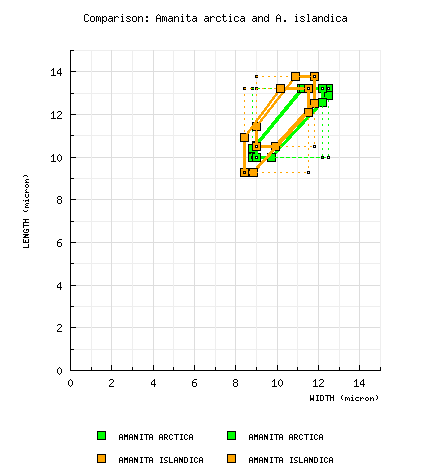
Examination and sequencing of additional collections
of both taxa would be very valuable. |
| citations |
—R. E. Tulloss |
| editors |
RET |
|



 Spore data sets and their composite