| name |
Amanita arctica |
| author |
Bas, Knudsen & T. Borgen in Knudsen & T. Borgen in Laursen et al. 1987. Arct. Alp. Mycol. 2: 239, fig. 1. [The collection figured is not conspecific with the holotype per type study cited below. Further study indicates that many of the paratypes of A. arctica are collections of Amanita nivalis Grev.. The species may require emendation due to the mixture of descriptions from the various collections in the protolog.] |
| name status |
nomen acceptum |
| english name |
"Arctic Ringless Amanita" |
| synonyms |
=Amanita arctica Bas, Knudsen & Borgen in Knudsen & Borgen in Laursen et al. 1987. Arct. Alp. Mycol. 2: 239. [p.p.]
The editors of this site owe a great debt to Dr. Cornelis Bas
whose famous cigar box files of Amanita nomenclatural information
gathered over three or more decades were made available to RET for computerization
and make up the lion's share of the nomenclatural information presented on this site.
|
| MycoBank nos. |
133879 |
| GenBank nos. |
Due to delays in data processing at GenBank, some accession numbers may lead to unreleased (pending) pages.
These pages will eventually be made live, so try again later.
|
| holotypes |
C [holotype nrITS sequence: UDB002308] |
| type studies |
Tulloss. 1994. Mycotaxon 52: 313, figs. 3-4. |
| intro |
The following text may make multiple use of each data field.
The field may contain magenta text presenting data from a type study
and/or revision of other original material cited in the protolog of the present taxon.
Macroscopic descriptions in magenta are a combination of data from the protolog and
additional observations made on the exiccata during revision of the cited original
material.
The same field may also contain black text, which is data from a revision of the present
taxon (including non-type material and/or material not cited in the protolog).
Paragraphs of black text will be labeled if further subdivision of
this text is appropriate.
Olive text indicates a specimen that has not been
thoroughly examined (for example, for microscopic details) and marks other places in the text
where data is missing or uncertain.
The following material not directly from the protolog is based on original research by R. E. Tulloss.
|
| pileus |
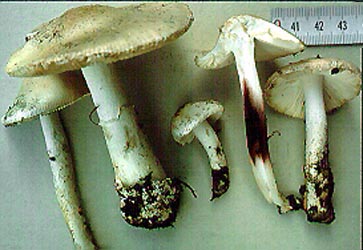
60 - 85 mm wide, whitish with or without pale yellowish disc or extremely pale grayish brown (no more deeply colored than 10YR 8/1-7/2) entirely pale ochraceous gray or whitish with beige disc (ca. 5B3), convex with indistinct umbo to campanulate at first, becoming subplanar with slight umbo, smooth, sometimes slightly greasy; context white, sometimes grayish under pileipellis, rather thick in disc; margin striate (0.1R - 0.3R), decurved, nonappendiculate; universal veil absent or with scattered small white patches. |
| lamellae |
free, close to crowded, off-white in mass, sometimes with slight pinkish reflection, white to pale cream to cream (10YR 8/2) in side view, ventricose or sometimes broadest near pileus margin, with entire edge and decorated with minute white floccules; lamellulae truncate, of diverse lengths, unevenly distributed (sparse in some sectors of pileus). |
| stipe |
70 - 130 × 11 - 20 mm, whitish, becoming yellowish brown from handling, cylindric or narrowing upward; context white, stuffed with rather dense white material, becoming hollow, with central cylinder occupying < one-third of stipe diameter; partial veil as floccose or weakly felted covering on upper stipe, rarely with submembranous flaring portion at lower extremity (only on largest specimen in photograph of holotype), whitish, not preserved well in exsiccata; universal veil as saccate to cupulate or sometimes fragmented volva, membranous, moderately thick, white, short in proportion to stipe length, often missing from exsiccata. |
| odor/taste |
Odor and taste lacking. |
macrochemical
tests |
Phenol - (single spot) on stipe context at midstipe, vinaceous chocolate to sordid vinaceous (holotype and Borgen 85.32) or pale brownish “flesh colored” after 1 min. and chocolate brown after 1 hr. Test voucher: Borgen 82.85. |
| pileipellis |
70 - 80 µm thick, barely to not at all gelatinizing; filamentous, undifferentiated hyphae 2.8 - 13.5 µm wide, branching, subradially arranged; vascular hyphae not observed. |
| pileus context |
dominated by filamentous, undifferentiated hyphae 2.2 - 15.2 µm wide, interwoven, frequently branching and anastomosing, some of the largest with walls to 0.8 µm thick, mostly thin-walled, occasionally with intercalary inflated segment, not infrequently with yellowish subrefractive walls; acrophysalides broadly ellipsoid to elongate to clavate, to 86 × 40 µm; vascular hyphae 6.0 - 8.0 µm wide, not common, frequently branching locally. |
| lamella trama |
bilateral, divergent, but somewhat obscurely so in some regions, with wcs = 70 - 90 µm (about half this width in immature material); filamentous, undifferentiated hyphae 1.5 - 10.0 µm wide, branching, with inflated intercalary segments fusiform to ellipsoid to ovoid to broadly clavate to clavate (up to 41 × 33 µm, mostly 75% of this size or smaller); divergent, terminal, inflated cells apparently absent; vascular hyphae relatively uncommon, 2.0 - 5.8 µm; clamps infrequent. |
| subhymenium |
cellular (pseudoparenchymatous) in mature material, locally cellular to subcellular or inflated ramose in less mature regions of hymenium, with wst-near = 15 - 20 µm and wst-far = 35 - 50 µm; basidia arising from subglobose to ellipsoid cells usually no longer than 12 µm, in chains; some basidia arising from points several cells deep in this region. |
| basidia |
42 - 78 × 11.0 - 17.5 µm, thin-walled, dominantly 4-sterigmate, but up to slightly under one-third 2-sterigmate; sterigmata up to 10.0 × 2.0 µm; clamps and proliferated clamps occasional to uncommon. |
| universal veil |
On pileus: absent. At stipe base, exterior surface: filamentous, undifferentiated hyphae 4.8 - 10.0 µm wide, gelatinizing, longitudinally oriented, interwoven; inflated cells and vascular hyphae not observed. At stipe base, interior: filamentous, undifferentiated hyphae 1.5 - 12.5 µm wide, branching, interwoven, dominating, not infrequently with yellowish subrefractive walls; inflated cells, terminal, singly or in short chains, ellipsoid to clavate, to 103 × 52 µm, mostly thin-walled, a few with walls 0.5 - 0.8 µm thick; vascular hyphae not common, 2.5 - 6.0 µm wide. At stipe base, inner surface: like the interior, but more extensively gelatinizing. |
| stipe context |
longitudinally acrophysalidic; filamentous, undifferentiated hyphae 3.0 - 10.5 µm wide, branching, occasionally with yellowish subrefractive walls; acrophysalides with walls 0.5 - 0.8 µm thick, often rather broad and rounded at base, to 155 × 46 µm; vascular hyphae up to 10.5 µm wide, branching. |
| basidiospores |
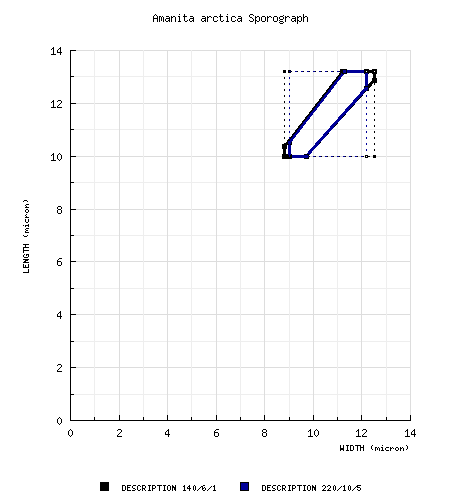
From type study of Tulloss (1994): [140/6/1] (9.0-) 10.0 - 13.2 (-18.5) × (8.2-) 8.8 - 12.5 (-16.8) μm, (L = 11.0 - 11.9 μm; L' = 11.4 μm; W = 9.9 - 10.8 μm; W' = 10.5 μm; Q = (1.0-) 1.03 - 1.18 (-1.34); Q = 1.06 - 1.12; Q' = 1.09).
composite of data from all material revised by RET: [220/10/5] (8.8-) 10.0 - 13.2 (-18.5) × (7.5-) 9.0 - 12.2 (-16.8) µm, (L = (11.0-) 11.2 - 11.9 µm; L’ = 11.5 µm; W = 9.9 - 10.7 (-10.8) µm; W’ = 10.4 µm; Q = (1.0-) 1.03 - 1.17 (-1.34); Q = 1.06 - 1.12 (-1.19); Q’ = 1.10), hyaline, colorless, inamyloid, smooth, thin-walled, globose to subglobose to broadly ellipsoid [only one “giant spore” found in this category (in holotype)]; apiculus sublateral, cylindric to narrowly truncate-conic, up to 1.5 µm wide; contents monoguttulate with or without some additional small granules; white in deposit. |
| ecology |
Solitary to subgregarious, 50± - 450 m elev. Greenland: With Salix herbacea in dwarf scrub heath on nutrient soil or in copse among Betula pubescens and S. glauca or on slightly moist dwarf scrub heath with S. glauca, B. glandulosa and Cladonia or in shrub of S. glauca. |
| material examined |
GREENLAND: Grønnedal - 15.viii.1985 Torbjørn Borgen 85.204 (holotype, C). Narssarssuaq, on "Signalhøjen," 6.viii.1985 T. Borgen 85.32 (paratype, C; fragments in TBORG). Paamiut - Qassit Qinngua [62°16’ N/ 49°18’ W], 22.viii.1982 T. Borgen 82.85 (in herb. T. Borgen). Qinngua Valley - Taserssuaq Lk. [60°16’ N/ 44°33’ W], 6.viii.1991 H. Knudsen 91.053 (C), 91.013 (C). |
| citations |
—R. E. Tulloss |
| editors |
RET |
|



 Spore data sets and their composite