| name |
Amanita
vaginata var. alba |
| author |
Gillet. 1874. Champ. (Hyménomyc.) Croiss. France: 51, pl. 22. |
| name status |
nomen acceptum |
| english name |
"European White Ringless Amanita" |
| synonyms |
For more detail see the Amanita Nomenclator (t.b.d.).
The editors of this site owe a great debt to Dr. Cornelis Bas
whose famous cigar box files of Amanita nomenclatural information
gathered over three or more decades were made available to RET for computerization
and make up the lion's share of the nomenclatural information presented on this site.
|
| etymology |
albus "white" |
| MycoBank nos. |
281296 |
| GenBank nos. |
Due to delays in data processing at GenBank, some accession numbers may lead to unreleased (pending) pages.
These pages will eventually be made live, so try again later.
|
| lectotypes |
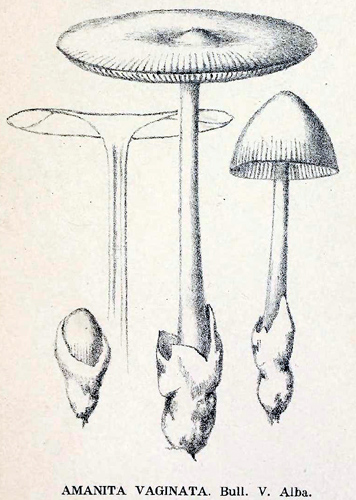
The only original material known to be available is plate 14 of (Gillet 1874); hence, it must be taken as the lectotype of this taxon. |
| lectotypifications |
See above. |
| revisions |
Tulloss in Tulloss and E. Moses. 1995. Mycotaxon 53: 463-465, figs. 6-7. [partial]
Tulloss, here |
| intro |
Olive text indicates a specimen that has not been
thoroughly examined (for example, for microscopic details) and marks other places in the text
where data is missing or uncertain.
The following material not directly from the protolog of the present taxon and not cited as the work of Dr. Z. L. Yang or another researcher is based upon original research by R. E. Tulloss. |
| pileus |
up to 100± mm wide, white to ivory, hemispheric at first, very finely rugose at first (Knudsen & Læssøe 84.517), shining, greasy; context not described; margin striate (0.2±R), nonappendiculate; universal veil usually absent. |
| lamellae |
white or whitish, ??, with fimbriate edge; lamellulae not described. |
| stipe |
130 × 15 mm, with ground color white (Watling 17518) or pale cream to pale tan (Knudsen & Læssøe 84.517), narrowing upward, cottony squarrose (distinct in exsiccatum of Knudsen & Læssøe 84.517) to fibrillose squamulose, with decoration whitish; context hollow, with central cylinder 7 - 9 mm wide; partial veil[?] at least sometimes present as friable sheath on upper stipe, never membranous, may be absent in age; universal veil as saccate volva, externally white, with inner surface whitish, membranous, 50 - 60 × 30 mm, 1 mm thick (Knudsen & Læssøe 84.517). |
| odor/taste |
Odorless. Taste not recorded. |
macrochemical
tests |
none recorded. |
| pileipellis |
245 - 540 µm thick; with suprapellis colorless and extensively gelatinized and 100 to 125 µm thick in mature material, under 25 µm thick in immature material near disc; subpellis pale yellow (Watling 17518) to yellow-orange (Borgen 91.210), scarcely gelatinized, 170 - 320 µm thick in mature material, 245 - 290 µm thick in immature material near disc; filamentous, undifferentiated hyphae 3.2 - 12.6 µm wide, densely interwoven, largely subradially oriented; vascular hyphae 3.5 - 18.9 µm wide, branching, yellow to golden yellow to yellow-brown, with irregular outline, sinuous, sometimes coiled rather tightly, relatively common. |
| pileus context |
filamentous, undifferentiated hyphae 2.8 - 11.9 µm wide, plentiful, branching, in fascicles and singly; acrophysalides clavate to narrowly ellipsoid, plentiful, with thin walls, up to 120 × 65 µm or larger; vascular hyphae 3.2 - 19.6 µm wide, branching, locally common, sinuous, often coiled or loosely tangled. |
| lamella trama |
bilateral, with well developed subhymenial base of long narrow curving cells (sometimes in short chains); wcs = 40 - 65 µm (very good inflation); filamentous, undifferentiated hyphae 2.5 - 10.0 µm wide, branching, sometimes with slightly inflated intercalary segments (up to 12.5 µm wide); apparent divergent, terminal, inflated cells of same form and disposition as elements of subhymenial base and probably separated from it by sectioning; vascular hyphae not observed. |
| subhymenium |
wst-near = 60 - 85 (-125) µm (very good inflation); wst-far = (75-) 95 - 120 (-145) µm (very good inflation); branching structure composed of uninflated and partially inflated hyphal segments and small cells of very variable form (up to 18.0 × 18.0 µm, but usually considerably smaller in at least one dimension), with as few as 1 cell between base of longer basidia and subhymenial base, with distance from subhymenial base to nearest base of a basidium/-ole 10 - 35 µm, with distance from subhymenial base to farthest base of a basidium/-ole 35 - 60 µm, with basidia arising from uninflated and partially inflated hyphal segments and small inflated cells. |
| basidia |
(48-) 56 - 75 × (7.0-) 10.0 - 16.8 µm, dominantly 4-, occasionally 2-sterigmate, with sterigmata up to 7.6 µm long not uncommon; clamps not observed. |
| universal veil |
On pileus: absent. On stipe base, exterior surface: filamentous, undifferentiated hyphae 2.5 - 10.0 µm wide, branching, colorless, loosely criss-crossed, singly or in fascicles, without dominant orientation, with some collapsed, with some gelatinized; inflated cells occasional, thin-walled, clavate to ovoid, up to 48 × 34 µm or more, infrequently gelatinized; vascular hyphae not observed. On stipe base, interior: filamentous, undifferentiated hyphae 2.2 - 10.8 µm wide, branching, plentiful to dominating, hyaline, colorless, at times in dense fascicles, sometimes slightly constricted at septa, sometimes with slightly inflated intercalary segment up to 14.5 µm wide, with walls thin or slightly thickened (up to 0.5 µm thick); inflated cells thin-walled, terminal, singly, common to plentiful, unevenly distributed, at times in small clusters, often collapsed, subglobose to ovoid to ellipsoid to elongate-ellipsoid to broadly clavate to clavate to subfusiform, up to 80 × 54 µm; vascular hyphae not observed; clamps not observed. On stipe base, inner surface: thin gelatinized layer, yellowish orange. |
| stipe context |
longitudinally acrophysalidic; filamentous, undifferentiated hyphae 1.0 - 7.5 µm wide, branching, plentiful; acrophysalides up to 330 × 52 µm, dominating, occasionally broadly rounded at base, with walls thin or up to 0.8 µm thick; vascular hyphae 4.0 - 8.8 µm wide, relatively common, sinuous, with irregular outline, sometimes loosely coiled. |
| partial veil |
(Upper stipe sheath) filamentous, undifferentiated hyphae 1.5 - 9.2 µm wide, frequently branching, often with constricted septa, dominating, thin-walled, with many filaments sublongitudinally arrange (corresponding to subradial arrangement of membranous partial veils), occasionally with yellowish subrefractive walls; inflated cells common, unevenly distributed, sometimes in clusters, terminal singly, infrequently with short rather broad (up to 10.5 µm wide) subterminal segment, subfusiform to subcylindric to narrowly clavate to clavate (up to 97 × 26 µm) or broadly clavate (up to 46 × 26 µm), thin-walled; vascular hyphae not observed. |
| basidiospores |
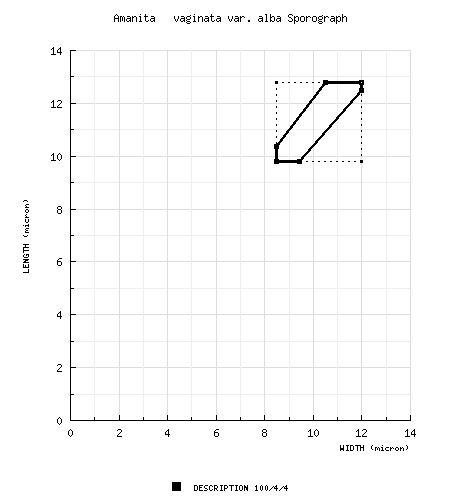
[100/4/4] (8.6-) 9.8 - 12.8 (-17.0) × (7.0-) 8.5 - 12.0 (-13.5) µm, (L = 10.8 - 11.9 µm; L’ = 11.4 µm; W = 9.5 - 11.0 µm; W’ = 10.3 µm; Q = (1.02-) 1.04 - 1.22 (-1.82); Q = 1.08 - 1.14; Q’ = 1.11), hyaline, colorless, thin-walled, smooth, inamyloid, globose to subglobose, infrequently broadly ellipsoid, rarely ellipsoid, adaxially flattened, occasionally expanded at one end; apiculus sublateral, cylindric; contents granular to mono- to multiguttulate; color in deposit unknown. |
| ecology |
Solitary. Greenland: in moist, slightly sloping, dwarf scrub heath, with Salix glauca at 300± m elev. (Borgen 91.210) or in moss beneath Betula pubescens (Knudsen & Læssøe 84.517) or in shrub of S. glauca (Knudsen 91.069). U.K.: Under Betula in upland woods (Watling 17581). |
| material examined |
GREENLAND: Ivigtut
[61°12’N/48°10’W], 16.viii.1991 H. Knudsen 91.069
(C, as “A. arctica”). Ivittuut
Municipality, Grønnedal, ca. Grønnedal hut,
17.viii.1991 T. Borgen 91.210 (RET 139-5;
TBORG). Narssarssuaq [61°10’ N/ 45°25’ W],
6-11.viii.1984 H. Knudsen & T. Læssøe 84.517
(C, as nonformant paratype of
"A. arctica").
GERMANY:
BADEN-WÜRTTEMBERG—Stuttgart-Weilimdorf,
Neuer Friedhof, 13.vii.1995 A. Bollman 95/167 (in
herb. Andreas Gminder; RET 306-9).
NORWAY:
AKERSHUS—Nannastad, Tømte, 12.ix.1967
Bodil Lange s.n. (O).
U.K.:
SCOTLAND—Perthshire - near Blairgowrie,
Enocdhu, Kindrogan, Dalreoch, 6.ix.1984 R. Watling
17518 (E). |
| discussion |
As the material under this name in the RET herbarium
is being sequenced, we are finding that the DNA derived
to date represents more than one species.
Apparently, as in the other parts of the world, many
species of section the genus Amanita may have
occasional basidiomes that lack pigment.
As specimens are found that should be assigned to
originally described with pigmented pilei, the material
examined is removed from this page and placed on the
appropriate page. To date sequences originally
included on the present page have been moved to the
pages for A. coryli and A. fulva.
The accompanying data also is moved. |
| citations |
—R. E. Tulloss |
| editors |
RET |
|


 Spore data sets and their composite