

| name | Amanita griseoturcosa |
| name status | nomen acceptum |
| author | T. Oda, C. Tanaka & Tsuda |
| english name | "Turquoise Death Cap" |
| intro | The following is based on the original description of this species (Oda et al. 2002a). |
| cap | The cap of Amanita griseoturcosa is 40 - 60 mm wide, hemispherical at first, then convex to plane, grayish-turquoise or turquoise gray to dark turquoise, smooth, often appearing finely innately fibrillose, with a nonstriate and nonappendiculate margin. The flesh is white and 2 - 3 mm thick over the stem. |
| gills | The gills are free, 3 - 4 mm broad, white, and crowded. The short gills are truncate to subtruncate and of at least one to three lengths. |
| stem | The stem is 50 - 80 × 4 - 7 mm, cylindrical or slightly tapering upward, white, smooth to slightly scaly, stuffed to slightly hollow. The bulb is fusiform, 7 - 13 mm wide. The ring is apical or in the upper part of the stem, white, skirt-like, persistent, membranous, and striate on the upper surface. The limbate volva is membranous, often adherent to the stem, and the highest point on the stem is 20 mm. |
| odor/taste | As a precaution, this species should be considered deadly POISONOUS. |
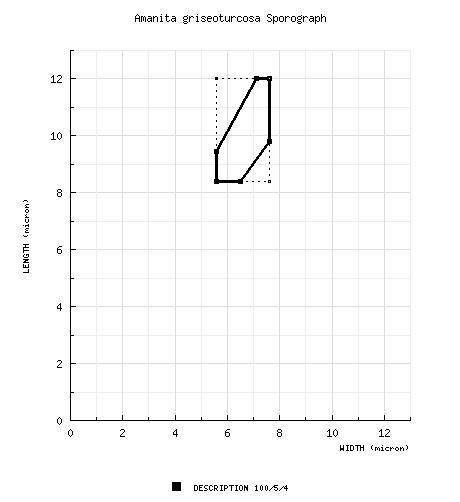
| spores | The spores of this species measure (8.0-) 8.4 - 12.0 (-13.2) × (5.2-) 5.6 - 7.6 (-8.0) μm and are broadly ellipsoid to ellipsoid to elongate and amyloid. Clamps are not present at bases of basidia. |
| discussion |
This species is known from the metropolis of Tokyo and the prefectures of Chiba and Miyagi (Japan) and is associated with fir, pine, oak, beech, and chestnut. The group of species to which Amanita griseoturcosa should be compared are those members of section Phalloideae with a pigmented virgate cap and spores, on average, with a length one and a half times the width or longer. The only species falling in this group is Amanita pseudoporphyria Hongo which has been recently revised by Yang (1997). The present species differs from A. pseudoporphyria by having blue tints in the cap color, a markedly smaller fruiting body, and larger and proportionately more narrow spores. An undescribed species from eastern North America known from the central Appalachian mountains is also black to gray with a bluish tint. The original collection sent to RET was described as "midnight blue," but to RET the mature material seems gray and virgate without blue tints. This species is clearly distinct although possibly related to A. griseoturcosa but having spores that are longer and proportionately narrower.—R. E. Tulloss and L. Possiel |
| brief editors | RET |
| name | Amanita griseoturcosa |
| author | T. Oda, C. Tanaka & Tsuda. 2002a. Mycoscience 43: 354, figs. 11-14. |
| name status | nomen acceptum |
| english name | "Turquoise Death Cap" |
| etymology | griseus, "gray" + turcosus, "turquoise" |
| MycoBank nos. | 374038 |
| GenBank nos. |
Due to delays in data processing at GenBank, some accession numbers may lead to unreleased (pending) pages.
These pages will eventually be made live, so try again later. |
| holotypes | CBM |
| intro |
The following text may make multiple use of each data field. The field may contain magenta text presenting data from a type study and/or revision of other original material cited in the protolog of the present taxon. Macroscopic descriptions in magenta are a combination of data from the protolog and additional observations made on the exiccata during revision of the cited original material. The same field may also contain black text, which is data from a revision of the present taxon (including non-type material and/or material not cited in the protolog). Paragraphs of black text will be labeled if further subdivision of this text is appropriate. Olive text indicates a specimen that has not been thoroughly examined (for example, for microscopic details) and marks other places in the text where data is missing or uncertain. The following material is derived from the protolog of the present species. |
| pileus | from protolog: 40 - 60 mm wide, grayish turquoise to turquoise-gray to dark turquoise (24C-F2-4), often virgate, hemispheric at first, then convex to planar, smooth; context white; margin non-striate; universal veil absent. |
| lamellae | from protolog: free, crowded, white, 3 - 4 mm broad; lamellulae truncate to subtruncate, in 1 - 3 ranks. |
| stipe | from protolog: 50 - 80 × 4 - 7 mm wide, white, cylindric or slightly narrowing upward, smooth to slightly scaly; bulb fusiform; context stuffed to slightly hollow; partial veil apical, white, membranous; universal veil "saccate," membranous, 15 - 20 × 7 - 13 mm, often adherent to bulb. |
| odor/taste | not recorded. |
| macrochemical tests |
none recorded. |
| pileipellis | from protolog: ca. ?80 - ?140 μm thick; suprapellis ca. 20 - 40 μm thick, gelatinized, colorless; subpellis ca. 30 - 60 μm thick, ungelatinized, slightly grayish-turquoise; filamentous hyphae 1 - 10 μm wide, interwoven, with at least some subradially oriented; vascular hyphae rare to locally frequent, 2 - 10 μm wide; clamps absent. [Note: The authors continue to describe what they call a third layer of the pileipellis, which no other author has described in Amanita. The upper part of the pileus context, immediately below the pileipellis is often more dense and contains smaller, narrower acrophysalides than does the remainder of the pileus context. It is possible that the authors may be describing this upper region of context: "lower layer (ca. 30 - 50 μm thick) consisting of subradial to interwoven rows of cylindric to cylindro-clavate to clavate inflated cells, 60 - 100 × 15 - 20 μm, mixed with colorless hyphae 2 - 7 μm wide...."—ed.] |
| pileus context | not described. [Note: However, see note in "pileipellis" data field, above.—ed.] |
| lamella trama | from protolog: bilateral; wcs = ca. 20 - 60 μm; filamentous branching hyphae 1 - 10 μm wide, abundant, branching; inflated cells of subhymenial base (lateral strata) cylindric to narrowly clavate to clavate to fusiform to subfusiform, 23 - 100 × 10 - 40 μm; vascular hyphae absent. [Note: Form of divergence and presence/absence of terminal cells in the subhymenial base are not reported.—ed.] |
| subhymenium | from protolog: inflated ramose, 25± thick; inflated cells dominantly globose, also subglobose to broadly ellipsoid to ellipsoid to pyriform to clavate to fusiform, 10 - 32 × 7 - 20 μm, "usually" in 2 - 3 layers. |
| basidia | from protolog: 34 - 50 × 8 - 12 μm, 4-sterigmate, with sterigmata 2 - 6 μm long; clamps absent. |
| universal veil | from protolog: On pileus: absent. On stipe base: filamentous hyphae dominating, 1 - 7 μm wide, colorless, branching, interwoven to subparallel; inflated cells variiform, 15 -85 × 13 -55 μm, colorless, terminal singly or sometimes in short chains; vascular hyphae occasional, 2 - 10 μm wide; clamps absent. [This description does not recognize the layering that is typical of membranous, limbate universal veils. It is probable that the situation is more complex than is represented in the protolog.—ed.] |
| stipe context | from protolog: longitudinally acrophysalidic; filamentous hyphae 1 - 10 μm wide; acrophysalides 105 - 300 × 16 - 25 μm; vascular hyphae rare or absent. |
| partial veil | from protolog: filamentous hyphae 1 - 6 μm wide, branching, interwoven; inflated cells globose to subglobose to broadly ellipsoid to elongate to cylindric, 3 - 20 × 2 - 5 μm, terminal singly or in short chains, scattered, locally fairly abundant; vascular hyphae rare; clamps absent. [Note: The description describes two classes of inflated cells—one (the smaller and narrower group) said to be mixed with other elements and "absent" to "locally abundant" and the other not described as mixed with other elements and and described as "abundant". The former group of cells is typical of inflated cells in the interior of the partial veil tissue. The latter group of cells probably represents lamella edge tissue left on the upper surface of the partial veil. These cells are described as in the "lamella edge tissue" data field below. The editors are interested in clarification of this issue.—ed.] |
| lamella edge tissue | from protolog: inflated cells abundant, globose to subglobose to broadly ellipsoid to ovate to clavate to pyriform to fusiform to subfusiform to sphaeropedunculate, 15 - 50 × 11 - 30 μm, terminal or in chains. [Note: This material was not described from a lamella edge, but is probably lamella edge tissue found on the upper surface of the partial veil. See note in "partial veil" data field.—ed.] |
| basidiospores | from protolog: [100/5/4] (8.0-) 8.4 - 12.0 (-13.2) × (5.2-) 5.6 - 7.6 (-8.0) μm, (Q = (1.25-) 1.29 - 1.69 (-1.83); Q' = 1.50 ± 0.13), hyaline, smooth, amyloid, broadly ellipsoid to ellipsoid to elongate, at least somewhat adaxially flattened (per figure); apiculus sublateral and cylindric (per figure); contents not described; color in deposit not recorded. |
| ecology | from protolog: In forest of Abies firma Siebold et Zucc. mixed with Pinus densiflora Siebold et Zucc. and Quercus serrata Thunb. ex Murray or in broad-leaved forest of Q. mongolica var. grosseserrata Rehder et E. H. Wilson mixed with Fagus crenata Blume and Castanea crenata Siebold et Zucc. |
| material examined | from protolog: JAPAN: HONSHU—Chiba-ken - Chiba-shi, Wakaba-ku, Noro-cho, Izumi-Shizenkouen, 1.x.2000 member Chiba Mycol. Club s.n. (holotype, FB-30253). Miyagi-ken - Sendai-shi, Aoba-ku, Banzan, 15.ix.1999 Y. Ando s.n. (paratype, CBM FB-30252), 23.ix.2000 Y. Ando s.n. (paratype, CMB FB-30282). Tokyo-to - Nishitama-gun, Okutama-cho, Mt. Tsukiyomi, 3.viii.2000 K. Maruyama s.n. (paratype, CBM FB-30738). |
| discussion |
The group of species to which Amanita griseoturcosa should be compared are those members of section Phalloideae with a pigmented, virgate cap and spores with Q' of about 1.50. The only species falling in this group is Amanita pseudoporphyria Hongo which has been recently revised by Yang (1997). The present species differs from A. pseudoporphyria by having blue tints in the cap color, a markedly smaller fruiting body, and larger and proportionately more narrow spores as illustrated in the following sporograph comparison. An provisionally named species ("A. mediinox") from eastern North America known from the central Appalachian mountains is also black to gray with a bluish tint. The original collection sent to RET was described as "midnight blue," but to RET the mature material seems gray and virgate without blue tints. This species is clearly distinct although possibly related to A. griseoturcosa but having spores that are longer and narrower as illustrated in the following sporograph comparison: |
| citations | —R. E. Tulloss |
| editors | RET |
Information to support the viewer in reading the content of "technical" tabs can be found here.
| name | Amanita griseoturcosa |
| bottom links |
[ Section Phalloideae page. ] [ Amanita Studies home. ] [ Keys & Checklists ] |
| name | Amanita griseoturcosa |
| bottom links |
[ Section Phalloideae page. ] [ Amanita Studies home. ] [ Keys & Checklists ] |
 Spore data sets and their composite
Each spore data set is intended to comprise a set of measurements from a single specimen made by a single observer; and explanations prepared for this site talk about specimen-observer pairs associated with each data set. Combining more data into a single data set is non-optimal because it obscures observer differences (which may be valuable for instructional purposes, for example) and may obscure instances in which a single collection inadvertently contains a mixture of taxa.

Text and User-Generated Sporographs are published under the Creative Commons License.

In the case of a taxon page, image credits are on the 'image' tab.