

| name | Amanita griseopantherina |
| name status | nomen acceptum |
| author | Yang-Yang Cui, Qing Cai & Zhu L. Yang |
| english name | "East Asian Gray Panther" |
| intro |
This text is derived from the original
description of Amanita griseopantherina. The fruiting bodies of Amanita griseopantherina are medium-sized to large. |
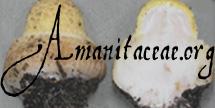
| cap | The cap of the present species is 60 – 140 mm wide, plano-convex to planar, lacks a raised center. The cap is yellow-brown, brown to dark brown, often darker at the center. The volva is present as pyramidal to conical, bumpy, dirty white to gray warts. The cap’s margin is slightly grooved for about 10% of the radius. There is no material hanging from the margin. The flesh is white. |
| gills | The gills are free, crowded, and white. The short gills are truncate and plentiful. |
| stem | The stem is 70 – 200 × 10 – 30 mm, subcylindric to narrowing upwards; its surface is white to dirty white, covered with white to brownish fibrils. The stem's basal bulb is 20 – 35 mm wide, subglobose, spindle-shaped to ellipsoid. The volva forms a short "rolled sock" at the top of the bulb. The ring hangs near the stem's top and is white to brownish. |
| odor/taste | The odor and taste of this species were not recorded. |
| spores | The spores measure 9.5 – 12.0 × 8.0 – 10.0 µm and are mostly broadly ellipsoid, occasionally subglobose or ellipsoid, and inamyloid. Clamps are common at bases of basidia. |
| discussion |
Amanita griseopantherina occurs in
subalpine forests dominated by Fir(Abies)and
Spruce (Picea), and fruits from summer to
autumn in southwestern China. Amanita griseopantherina can be confused with A. flavopantherina Cui Yang-Yang et al. because of their similar appearance and habitat. However, A. flavopantherina has a darker brown cap covered with yellow volval remnants, a white to yellow flesh, a relatively lower and yellower rings with an obviously brown edge, a browner stem, and broadly ellipsoid to ellipsoid spores [Q = (1.09–) 1.20 – 1.47 (–1.64)]. Amanita griseopantherina is similar to A. pantherina (DC.) Krombh. and A. pakistanica Tulloss et al. However, A. pantherina, a species described from Europe but not found in China, has a relatively lower ring, narrower spores and no clamps. Amanita pakistanica has a cap with a raised center covered with patchy or flaky, detersile volval remnants and relatively narrower spores [Q = (1.16-) 1.25 - 1.69 (-1.97)].—Yang-Yang Cui and Rachel Warner |
| brief editors | ZLY & RET |
| name | Amanita griseopantherina | ||||||||||||||||||||||||||||||||
| author | Yang-Yang Cui, Qing Cai & Zhu L. Yang. (2018). Fungal Diversity ??: ?, figs. 3(c-d), 5. | ||||||||||||||||||||||||||||||||
| name status | nomen acceptum | ||||||||||||||||||||||||||||||||
| english name | "East Asian Gray Panther" | ||||||||||||||||||||||||||||||||
| MycoBank nos. | 824964 | ||||||||||||||||||||||||||||||||
| GenBank nos. |
Due to delays in data processing at GenBank, some accession numbers may lead to unreleased (pending) pages.
These pages will eventually be made live, so try again later. Search:
Showing 1 to 4 of 4 entries | ||||||||||||||||||||||||||||||||
| holotypes | HKAS 83560 | ||||||||||||||||||||||||||||||||
| editors | RET | ||||||||||||||||||||||||||||||||
Information to support the viewer in reading the content of "technical" tabs can be found here.

Text and User-Generated Sporographs are published under the Creative Commons License.

In the case of a taxon page, image credits are on the 'image' tab.