| name |
Amanita pakistanica |
| author |
Tulloss, S. H. Iqbal & A. N. Khalid. 2001. Mycotaxon 77: 458, figs. 1-4. |
| name status |
nomen acceptum |
| english name |
"Pakistani Panther" |
| etymology |
"Pakistani" or "having to do with Pakistan" |
| MycoBank nos. |
466514 |
| GenBank nos. |
Due to delays in data processing at GenBank, some accession numbers may lead to unreleased (pending) pages.
These pages will eventually be made live, so try again later.
|
| holotypes |
LAH; isotype, NY |
| intro |
The following text may make multiple use of each data field.
The field may contain magenta text presenting data from a type study
and/or revision of other original material cited in the protolog of the present taxon.
Macroscopic descriptions in magenta are a combination of data from the protolog and
additional observations made on the exiccata during revision of the cited original
material.
The same field may also contain black text, which is data from a revision of the present
taxon (including non-type material and/or material not cited in the protolog).
Paragraphs of black text will be labeled if further subdivision of
this text is appropriate.
Olive text indicates a specimen that has not been
thoroughly examined (for example, for microscopic details) and marks other places in the text
where data is missing or uncertain.
The following material is based on the protolog of the
present taxon and on genetic sequence data supplied to
RET as part of a joint project with Drs. Santiago
Sanchez-Ramírez and Jean-Marc Moncalvo and a joint
project with Dr. József Geml. |
| pileus |
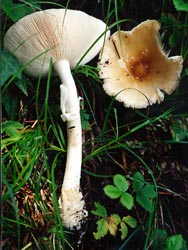
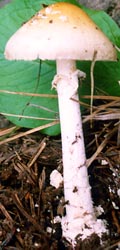
protolog: up to 80 mm wide, white to cream-colored to pale tan with orange-tan to light brown to brown disc, campanulate to convex when young, plane then concave at maturity, umbonate; context white, rather fleshy; margin striate (0.15R - 0.2R), nonappendiculate; universal veil absent or as patches or small flakes, white, membranous to submembranous, detersile. |
| peridium |
double click in markup mode to edit. |
| lamellae |
protolog: free, crowded, white to pale pinkish; lamellulae truncate, of diverse lengths, plentiful, unevenly distributed. |
| stipe |
protolog: up to 150 × 10 mm, white, narrowing upward, with pallid ridges encircling or partially encircling the stipe at various angles in lower half; context white; partial veil superior to supramedian, white, membranous, pendent, thin and rather easily torn, with edge slightly thickened; universal veil as saccate volva, up to 32 × 30 µm, subovoid, membranous to submembranous, white to off-white, sheathing, attached in part to sides of stipe base, with limbus internus small and placed at point of attachment to stipe.
[Note: The above must be modified as follows: bulb present at stipe base, proportionately small (not detected in exsiccata), white; universal veil limbate. |
| odor/taste |
protolog: not recorded. |
macrochemical
tests |
protolog: none recorded. |
| pileipellis |
protolog: 60 - 75 µm thick, orange-yellow to yellow-orange to orange-brown, with very limited partial gelatinization and decoloration present only at surface (one or two hyphal layers), not distinctly divided into sub- and suprapellis; filamentous, undifferentiated hyphae 2.6 - 8.3 µm wide, branching, subradially arranged, closely packed horizontally and vertically; vascular hyphae 3.2 - 14.1 µm wide, infrequently branching, common, sinuous; clamps rather common. |
| pileus context |
protolog: filamentous, undifferentiated hyphae 2..6 - 11.5 µm wide, branching, plentiful, singly and in fascicles interwoven in open lattice structure; acrophysalides plentiful, thin-walled, clavate to broadly clavate to subpyriform, e.g., 104 × 52 µm; vascular hyphae 4.5 - 23 µm wide, infrequently branching, scattered; clamps present, frequency unknown due to condition of available material. |
| lamella trama |
protolog: based on material preserved in FAA; bilateral; wcs = 40 - 55 µm (good rehydration); central stratum comprising filamentous, undifferentiated hyphae with partially inflated intercalary cells (ellipsoid to elongate to clavate to narrowly clavate) up to 22 µm wide; divergent, inflated cells predominantly (if not all) intercalary, subclavate, up to 20 μm wide; filamentous, undifferentiated hyphae 2.0 - 6.0 µm wide, branching; refractive hyphae 1.8 - 2.8 µm wide, sinuous, rare; clamps present. |
| subhymenium |
protolog: based on material preserved in FAA; wst-near = 50-; wst-far = 70- (good rehydration in both cases, but measured closer to pileus than to middle of lamella);comprising two layers of inflated cells (globose to subglobose to ellipsoid to narrowly ellipsoid, infrequently clavate, up to 22 × 20 µm), cell subtending basidium dominantly having major diameter perpendicular to central stratum, with basidia arising from cells of all shapes. |
| basidia |
protolog: 36 - 49 × 7.7 - 11.2 µm, 4-, and occasionally 2-sterigmate, with sterigmata up to 5.0 × 2.6 µm; clamps rather common. |
| universal veil |
protolog: On pileus: similar in overall structure to material on stipe base, compressed vertically, with outer layer sometimes missing, with inflated cells dominating throughout remainder. On stipe base, exterior surface: filamentous, undifferentiated hyphae in fascicles and singly, in moderately open lattice structure, with many hyphae sublongitudinally oriented, gelatinized to partially gelatinized. On stipe base, interior: filamentous, undifferentiated hyphae 2.6 - 12.5 (-22) µm wide, branching, singly and in narrow fascicles, interwoven in open lattice structure, dominating near exterior surface, infrequently with yellowish subrefractive walls; inflated cells terminal singly, common, dominating away from exterior surface (especially near inner surface), sometimes clustered locally, thin-walled, clavate to broadly clavate to ellipsoid to broadly ellipsoid, up to 191 × 90 µm, rather commonly ≥ 100 µm long, smaller and proportionately narrower near exterior surface; vascular hyphae scattered, very infrequent, 10.2 - 22 µm wide, sinuous, occasionally branching; clamps scattered, unevenly distributed. On stipe base, inner surface: as thin fragmented layer; filamentous, undifferentiated hyphae gelatinized to partially gelatinized, fasciculate, frequently with sublongitudinal orientation. |
| stipe context |
protolog: longitudinally acrophysalidic; filamentous, undifferentiated hyphae 2.5 - 8.8 µm wide, branching, dominating at surface; acrophysalides thin-walled, dominating away from surface, up to 508 × 36 µm, commonly with length ≥ 250 µm; vascular hyphae presence uncertain (if present then rare, weakly pigmented, 9.0± µm wide). |
| partial veil |
protolog: description based on material preserved in FAA; partially gelatinized in material available; filamentous, undifferentiated hyphae 1.0 - 5.0 µm wide, dominating, with dominant radial orientation, with plentiful branching, often in broad fascicles; inflated cells uncommon, clavate, thin-walled, collapsing, up to 47 × 15± µm, radially oriented; vascular hyphae 3.0 - 6.0 µm wide, sinuous, infrequent. |
| lamella edge tissue |
not described. |
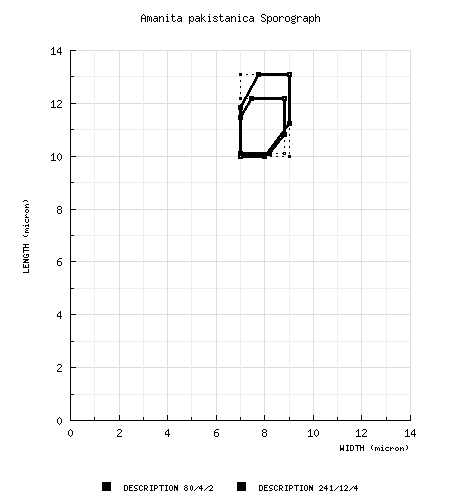
| basidiospores |
protolog: [80/4/2] (10.0-)
10.1 - 12.2 (-12.8) × (6.5-) 7.0 - 8.8 (-9.2) µm,
(L = 10.5 - 11.6 µm; L’ = 11.0 µm;
W = 7.8 - 8.1 µm; W’ = 8.0 µm; Q = (1.17-)
1.23 - 1.64 (-1.97); Q = 1.29 - 1.48; Q’ =
1.39), hyaline, colorless, thin-walled, smooth,
inamyloid, broadly ellipsoid to ellipsoid,
infrequently elongate; apiculus sublateral,
cylindric; contents dominantly monoguttulate,
occasionally multiguttulate; color in deposit not
recorded.
composite data from all material revised
by RET: [241/12/4]
(8.5-) 10.0 - 13.1 (-15.5) × (6.5-) 7.0 - 9.0 (-10.5)
µm, (L = 10.8 - 11.8 µm; L’ = 11.4 µm;
W = (7.4-) 7.6 - 8.6 µm; W’ = 7.9 µm; Q =
(1.16-) 1.25 - 1.69 (-1.97); Q = (1.25-) 1.29 -
1.58; Q’ = 1.46). |
| ecology |
protolog: Solitary.
Pakistan: At 2400± m elev. Associated
with Abies pindrow Spach. |
| material examined |
protolog:
PAKISTAN:
N.W.
FRONTIER PROV.—Hazara Distr. - Nathiagali,
10.vii.1994 A. N. Khalid 1071994 (paratype, LAH;
RET 140-3), 24.viii.1999 A. N. Khalid 24899 (holotype,
LAH; isotype, NY 00632703, nrITS seq'd.).
RET: INDIA:
UTTARAKHAND—unkn. loc., 2002 K. C.
Semwal & R. P. Bhatt 502 (RET 411-7, nrITS & nrLSU
seq'd.).
PAKISTAN:
AZAD JAMMU AND KASHMIR
PROV.—Unkn. Distr., unkn. loc., 18.ix.2003
Kishwar Sultana Nazir and M. K. Leghari s.n.
(RET 569-6).
KHYBER PAKTUNKHWA PROV.—Abottabad
Distr. - Khanspur, 8.viii.2000 A. N. Khalid 78000
(RET 317-6, nrITS & nrLSU seq'd.).
NORTHWEST
FRONTIER PROV.—Hazara Distr. - Nathiagali,
10.vii.1994 A. N. Khalid 1071994 (paratype, LAH;
RET 140-3), 24.viii.1999 A. N. Khalid 24899 (holotype,
LAH; isotype, NY 00632703, nrITS seq'd.). Unkn. Distr. -
ca. Gilga, ca. Hunza R., 11.ix.2001 Ray Boehne & local
villagers s.n. (RET 352-1, nrITS seq'd.). |
| discussion |
In the protolog of the present species, the authors
incorrectly placed it in sect. Caesareae.
A partial nrITS sequence produced as part of a study of
sect. Caesareae in the J.-M. Moncalvo laboratory
(Royal Ontario Museum, Toronto, Canada) did not support
the original placement to section. The sequence was
made available to RET as part of a joint project with
Santiago Sanchez, Jean-Marc Moncalvo and others.
Very clearly a comparison to previously accessioned
sequences in GenBank indicate that a placement in
sect. Amanita is much more likely. The
discussion from the protolog is then no longer
relevant.
Because of the clamps on the bases of basidia,
placement of this species within sect. Amanita
would fall with subsect. Amanita in the sense
proposed on this site.
Further genetic work with Jozsef Geml and Naomi
Goldman shows that material identified
previously as A. pantherina sensu Abraham and
Kachroo should be included in A.
pakistanica.
The isotype deposited in NY was previously in RET's
herbarium with accession number RET 312-1.
protolog: The present species
has been called both "Amanita sp. PAK4" and
"Amanita sp. PAK5" in
correspondence and in keys that have been publicly
circulated by Tulloss. |
| citations |
—R. E. Tulloss and J. Geml |
| editors |
RET |
|



 Spore data sets and their composite