The following is based on the photographs and field annotations of David Arora.
cap
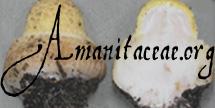
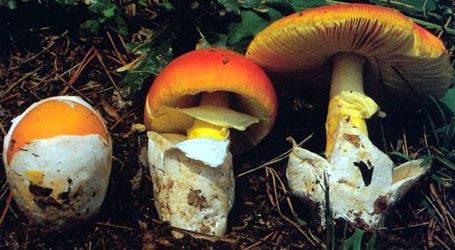
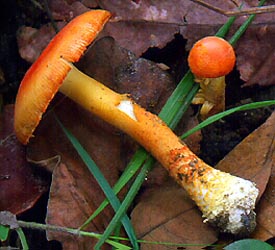
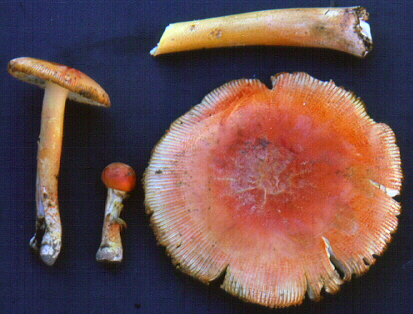
The cap of Amanita sp-Arora-382 is 50-130 mm wide and convex to planoconvex; its margin is grooved. The cap is bright orange to red-orange, slightly reddish-orange at the center, apricot towards the margin, with the very edge pale apricot. A volva is present as very fine, flattened pallid remnants (probably reddish cinnabar at first), which may go unnoticed upon initial examination.
gills
The gills are whitish to pale yellow becoming slightly buff with age, yellowish-apricot in mass, and white with a darker edge in side view.
stem
The stem narrows upward and (possibly) flares at the top; it lacks a ring; and has a base that is with narrowly club-shaped to slightly bulbous. The colors are like those on the cap only paler—yellow to apricot throughout and white at the base. The stem bears volval remnants in the form of deep reddish orange, powdery-flocculence, sometimes forming fragmented to scaly reddish-cinnabar rings on the stem's lower third, above the bulb.
odor/taste
No odor or taste was recorded.
spores
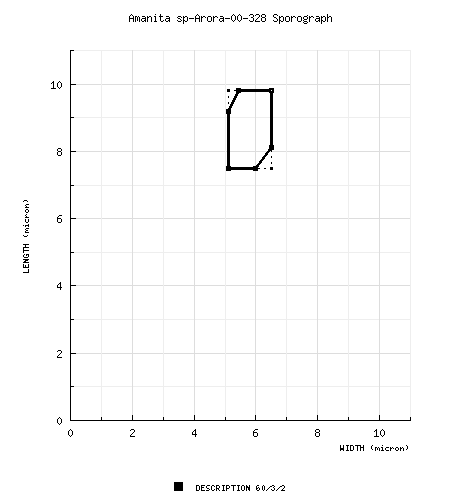
The spores of this species measure (7.3-) 7.5 - 9.8 (-11.0) × (4.5-) 5.1 - 6.5 (-7.6) µm and are inamyloid and broadly ellipsoid to ellipsoid to elongate. The presence or absence of clamps on the basidia is not known at present.
discussion
This species occurs in small groups in open woodland in Zambia where it appears to grown in association with Msasa (Brachystegia spiciformis) and Uapaca sp.
It is not eaten by the local people.—C. Rodríguez Caycedo, R. E. Tulloss, D. Arora
brief editors
RET
name
Amanita sp-Arora-00-328
name status
cryptonomen temporarium
GenBank nos.
Due to delays in data processing at GenBank, some accession numbers may lead to unreleased (pending) pages.
These pages will eventually be made live, so try again later.
RET: [60/3/2] (7.3-) 7.5 - 9.8 (-11.0) × (4.5-) 5.1 - 6.5 (-7.6) µm, (L = 8.3 - 8.9 µm; L’ = 8.6 µm; W = 5.4 - 6.2 µm; W’ = 5.8 µm; Q = (1.22-) 1.25 - 1.80 (-1.83); Q = 1.34 - 1.64; Q’ = 1.48), hyaline, colorless, smooth, with wall thin to slightly thickened, inamyloid, broadly ellipsoid to ellipsoid to elongate, adaxially flattened; apiculus sublateral, cylindric, proportionately large; contents monoguttulate; color in deposit unknown.
ecology
In small group. Under Brachystegia spiciformis Benth. (msasa) and Uapaca.
material examined
RET: ZAMBIA: COPPER BELT PROV.—Garneton, ca. Kitwe, 17.xii.2000 D. Arora 00-328 (RET 346-2; SFSU, as Amanita bingensis); off Kitwe-Ndolo Rd., Greystone Farm, 28.xii.2000 D. Arora 00-454 (RET 347-10; SFSU, as Amanita bingensis).
discussion
At first, this material was thought to be assignable to A. bingensis; however, a review of the protolog of that species, its type, and a recent West African collection of Desjardin possibly assignable to A. bingensis (A. sp-DED-8271), have convinced us otherwise.
citations
—R. E. Tulloss and D. Arora
editors
RET
Information to support the viewer in reading the content of "technical" tabs
can be found here.
Each spore data set is intended to comprise a set of measurements from a single specimen made by a single observer;
and explanations prepared for this site talk about specimen-observer pairs associated with each data set.
Combining more data into a single data set is non-optimal because it obscures observer differences
(which may be valuable for instructional purposes, for example) and may obscure instances in which
a single collection inadvertently contains a mixture of taxa.




 Spore data sets and their composite