

| name | Amanita barrowsii | ||||||||||||||||||||
| author | A. H. Sm. in ms. | ||||||||||||||||||||
| name status | nomen provisorum | ||||||||||||||||||||
| english name | "Barrows' Ringless Amanita" | ||||||||||||||||||||
| GenBank nos. |
Due to delays in data processing at GenBank, some accession numbers may lead to unreleased (pending) pages.
These pages will eventually be made live, so try again later. Search:
Showing 0 to 0 of 0 entries | ||||||||||||||||||||
| intro |
Olive text indicates a specimen that has not been
thoroughly examined (for example, for microscopic details) and marks other places in the text
where data is missing or uncertain. The following is based upon annotation of the collections by Barrows and original research by R. E. Tulloss. | ||||||||||||||||||||
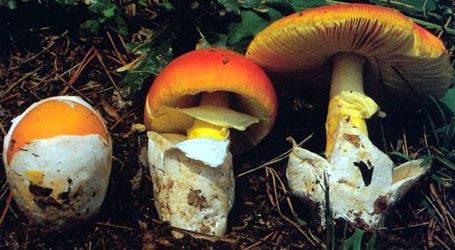
| pileus | 60 - 120 mm wide, orange, fading to dull orange, with metallic sheen, unchanging when cut or bruised, drying approx. tawny, obtuse, becoming broadly campanulate to plano-umbonate or broadly convex, viscid; context ??, unchanging when cut or bruised; margin nonstriate or only very slightly striate (about 5 mm long), nonappendiculate; universal veil absent. | ||||||||||||||||||||
| lamellae | free, close, white with warm orange cast, unchanging when cut or bruised, tawny in dried material, with pallid, crenulate edges, narrow; lamellulae ??. | ||||||||||||||||||||
| stipe | 100 - 180 × 10 - 20 mm, pallid to buff and drying slightly paler than pileus, narrowing upward, with base buried 50 - 80 mm in substrate, squamulose from rupturing of stipe surface; context not recorded; exannulate, sometimes with floccose material near apex; universal veil as thick saccate volva (as in A. caesarea), tough, exterior white, interior surface dull orange. | ||||||||||||||||||||
| odor/taste | Odor not recorded. Taste sweetish at first, but leaving bitter aftertaste. | ||||||||||||||||||||
| macrochemical tests |
none recorded. | ||||||||||||||||||||
| pileipellis | double click in markup mode to edit. | ||||||||||||||||||||
| lamella trama | bilateral, with shallow angle of divergence; wcs = 25± µm [quality of rehydration not recorded]; filamentous, undifferentiated hyphae 1.0 - 5.2 µm wide, branching; inflated cells obscured by hyphae of central stratum, bean-shaped to clavate to elongate-ventricose, up to 49 × 10.0 µm, apparently all intercalary; vascular hyphae 2.5 - 4.1 µm wide, infrequent, apparently restricted[?] to central stratum. | ||||||||||||||||||||
| subhymenium | [old data, wst-xx values not recorded, quality of rehydration not recorded.] | ||||||||||||||||||||
| basidia | 45 - 77 × 10.0 - 14.9 µm, slightly over half 4-sterigmate, with remainder 2-sterigmate; sterigmata up to 8.0 × 2.0 µm; clamps ??present, rather small. | ||||||||||||||||||||
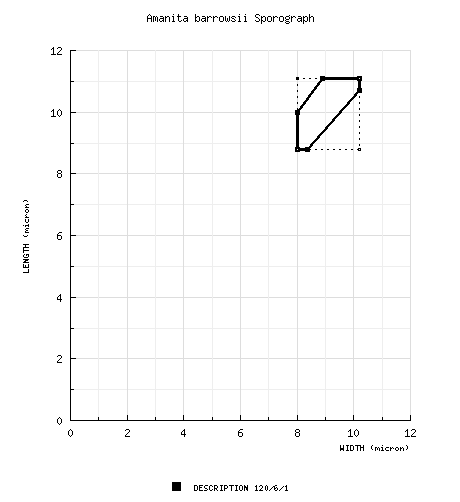
| basidiospores | [120/6/1] (7.8-) 8.8 - 11.1 (-13.0) × (6.2-) 8.0 - 10.2 (-11.0) µm, (L = 9.4 - 11.0 µm; L’ = 10.2 µm; W = 8.3 - 9.7 µm; W’ = 9.0 µm; Q = (1.02-) 1.05 - 1.25 (-1.47); Q = 1.11 - 1.18; Q’ = 1.14), hyaline, colorless, smooth, thin-walled, inamyloid, globose to subglobose to broadly ellipsoid, infrequently ellipsoid, often adaxially flattened; apiculus sublateral, cylindric to truncate-conic; contents mono- or multiguttulate, often with additional granules; white in deposit. | ||||||||||||||||||||
| ecology | Gregarious, at 3000± m elev. Under Populus tremuloides or in mixed forest with P. tremuloides and conifers. | ||||||||||||||||||||
| material examined | U.S.A.: NEW MÉXICO—Santa Fe Co. - mtns. ca. Santa Fe, viii.1957 Charles As. Barrows 506 (MICH), viii.1959 C. A. Barrows 1203 (MICH). Unkn. Co. - Sangre de Cristo Mtns., viii.1959 C. A. Barrows 1198 (MICH). | ||||||||||||||||||||
| discussion |
RET has serious doubts concerning the his old notes' reporting scattered small clamps at the bases of basidia. Drafts of the A. H. Smith Ms. (e.g., in MICH and in possession of various individuals) say, "...appears related to A. fulva but has a tougher volva with an orange inner surface and a very weakly striate pileus margin." Sporographs of the present species and A. americrocea Tulloss nom. prov. (green figure) are presented here. The reader can see the techtab discussion for the latter species for a discussion of this comparison. Possible additional material is present in RET's herbarium from Colorado and New Mexico. Comparison to A. americrocea is important. | ||||||||||||||||||||
| citations | —R. E. Tulloss | ||||||||||||||||||||
| editors | RET | ||||||||||||||||||||
Information to support the viewer in reading the content of "technical" tabs can be found here.
 Spore data sets and their composite
Each spore data set is intended to comprise a set of measurements from a single specimen made by a single observer; and explanations prepared for this site talk about specimen-observer pairs associated with each data set. Combining more data into a single data set is non-optimal because it obscures observer differences (which may be valuable for instructional purposes, for example) and may obscure instances in which a single collection inadvertently contains a mixture of taxa.

Text and User-Generated Sporographs are published under the Creative Commons License.

In the case of a taxon page, image credits are on the 'image' tab.