| name |
Limacella lenticularis var. fischeri |
| author |
(Kauffman) H.V. Sm.,
1945.
Pap. Michigan Acad. Sci. 30: 141.
≡Lepiota fischeri Kauffman.
1918.
Agar. Michigan 1: 630.
≡Limacella guttata var. fischeri
(Kauffman) Singer nom. inval. 1986. Agaricales,
4th ed.: 454. [Failure to give
full and complete bibliographic citation for
basionym. ICBN §33.2]
|
| name status |
insufficiently known |
| english name |
"Fischer's Vanguard Limacella" |
| MycoBank nos. |
not available, 101503, 346232 |
| GenBank nos. |
Due to delays in data processing at GenBank, some accession numbers may lead to unreleased (pending) pages.
These pages will eventually be made live, so try again later.
|
| holotypes |
MICH |
| selected illustrations |
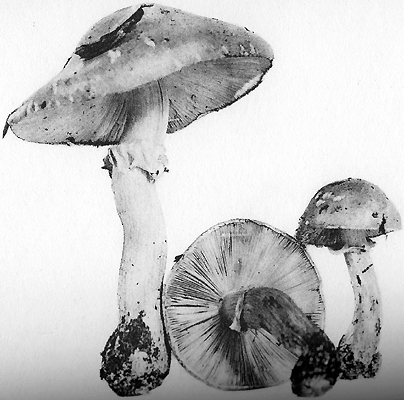
Kauffman, 1918. Agaric. Michigan 2: pl. CXXVII. |
| intro |
The following text may make multiple use of each data field.
The field may contain magenta text presenting data from a type study
and/or revision of other original material cited in the protolog of the present taxon.
Macroscopic descriptions in magenta are a combination of data from the protolog and
additional observations made on the exiccata during revision of the cited original
material.
The same field may also contain black text, which is data from a revision of the present
taxon (including non-type material and/or material not cited in the protolog).
Paragraphs of black text will be labeled if further subdivision of
this text is appropriate.
Olive text indicates a specimen that has not been
thoroughly examined (for example, for microscopic details) and marks other places in the text
where data is missing or uncertain.
The following material is based on the protolog of the present species and the revision of Smith (1945 ). |
| pileus |
from protolog: 40–90 mm wide, white to pale alutaceous, convex-campanulate, obtuse, even, subviscid; context white, thick, fleshy, rather soft; margin nonstriate [per plate]; gluten layer not described.
[Note: The “pileipellis” is said to be "separable and continuous." we take this to mean that the gluten layer along with the upper pileus context (in part) can be peeled away from the remaining pileus context.—ed.] |
| lamellae |
from protolog: free and somewhat remote, crowded, white, rather narrow, "plane," with entire edge; lamellulae not described. |
| stipe |
from protolog: 40–100 × 4–10 mm, proportionally thick, somewhat curved, striate, fibrillose, lacking colored droplets exuding from surface above partial veil; bulb globose or only slightly evident; context solid, firm, fibrous-fleshy, separable from pileus; partial veil superior, large, membranous, at length pendulous, white, subpersistent, fragile, lacking colored surface droplets seen in L. guttata; gluten layer not described. |
| odor/taste |
from protolog: Odor becoming strong on drying, like that of Tricholoma sulfureum. Taste slight. |
macrochemical
tests |
none recorded. |
| pileipellis |
absent |
| pileus context |
not described in protolog. |
| lamella trama |
not described in protolog. |
| hymenial trama |
from protolog: divergent. |
| subhymenium |
not described in protolog. |
| basidia |
from protolog: 1- to 2-sterigmate or rarely 3- or 4-sterigmate, with sterigmata 5–7 µm long, with sterigmata rarely forked. |
| gluten layer |
not described in protolog. |
| partial veil |
not described in protolog. |
| lamella edge tissue |
not decribed in protolog.
probably fertile. |
| basidiospores |
from protolog: 3 - 4 × 2 - 3 μm, smooth, ovoid.
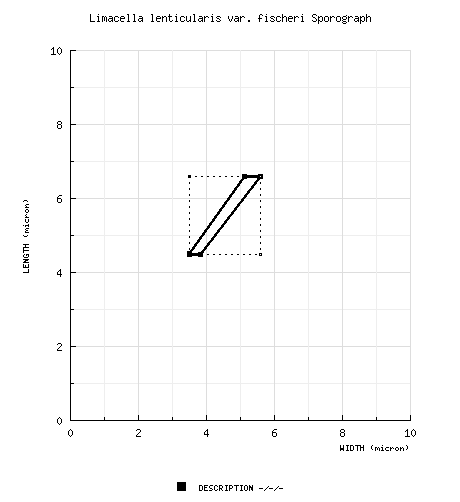
from Smith (1945): [-/-/-] 4.5 – 6.6 × 3.5 – 5.6 µm, (est. Q = 1.18 - 1.29; est. Q’ = 1.22), smooth, ovoid. |
| ecology |
from protolog: Gregarious, infrequent. Michigan, U.S.A.: On ground in low frondose woods. Near Detroit, September and October. |
| material examined |
from protolog: U.S.A.: MICHIGAN—Wayne Co. - ca. Detroit, 4.x.1907 O. E. Fischer s.n. (holotype, MICH).
CANADA: ONTARIO— ? - ?, s.d. ? s.n. (?).
U.S.A.: MICHIGAN—Wayne Co. - ca. Detroit, 4.x.1907 O. E. Fischer s.n. (holotype, MICH).
PENNSYLVANIA— ? - ?, s.d. ? s.n. (?). |
| discussion |
Given the available data, we cannot be sure to which section of Limacella this species belongs despite its similarities to L. guttata, the type species of sect. Amanitellae.
According to the protolog: "Related to L. lenticularis (Amanita lenticularis Fr.), and is perhaps its American counterpart. Our plants differ in lacking the dark green drops oozing from apex of stem and annulus (See Quélet and Bataille, Flora Monographic des Amanites et des Lepiotes, 1902), and in character of stem which is said to be stuffed or hollow and floccose-scaly in the European plant. Quélet, Ricken and Battaille give the spores [of L. lenticularis] 6 to 8 micr. It also differs from L. persoonii Fr. in stem and gill characters."
The differences between the present species and L. guttata in spore size, the character of the upper stipe and upper surface of the partial veil, and in the number of sterigmata per basidium suggest that other differences should be sought as well. This taxon may very well be a good species in its own right (as Kauffman first proposed).
The type must be compared to that of L. solidipes.
It appears the present entity is assignable to sect. Amanitellae and should be compared to L. roseicremea. |
| citations |
—R. E. Tulloss |
| editors |
RET |
|



 Spore data sets and their composite