

| name | Limacella solidipes |
| name status | nomen acceptum |
| author | (Peck) H. V. Sm. |
| english name | Peck's Vanguard Limacella |
| intro | The following is derived from the description of Smith (1945 ). |
| cap | The cap of L. solidipes is 30 – 70 mm wide, white at first, becoming "pale pinkish buff" (very pale tan), broadly convex to plane, with surface subrimose in age, but never fibrillose or scaly, always opaque and dull, and viscid when moist. The cap's flesh is white, and 5± mm thick above the stem. The cap's margin was not described. Considering the mention of viscidity and what little is known about the microscopic structure of the gluten layer, the cap was probably originally glutinous. |
| gills | The gills are attached to stipe by narrow tooth or are simply approximate, and crowded. They exhibit no color change when cut or broken. The short gills were not described. |
| stem | The stem is 80 – 100 × 10 – 12 mm, cylindric, glabrous above the partial veil and beaded with hyaline droplets, sparsely fibrillose below partial veil, and never scaly. A bulb is absent from the stem or exists only as a slight expansion of the stem's base. The stem's flesh is solid and firm. There is a ring on the stem that is superior, white, persistent, ample, and skirt-like. No gluten layer was described on the stem. |
| odor/taste | Odor and taste of this species are reportedly both strongly of flour or meal ("farinaceous"). |
| spores | The spores reportedly measure 4 – 5 × 4 – 5 µm and are estimated to be between globose and broadly ellipsoid. The reaction in Melzer's Reagent was not reported, but the spores are probably inamyloid. Clamp connections were seen in the lamella trama; hence, they are probably present at the bases of basidia. |
| discussion |
The presence of a membranous, persistent ring on the stem and the reported microscopic characters of the hyphae of the presumed gluten layer suggest the placement of the present species in L. sect. Amanitellae. Smith thought that L. mcmurphyi might be a synonym of the present species; however, our examination of the type of the latter has not been able to confirm that it is appropriately placed in sect. Amanitellae. Further study is necessary.—R. E. Tulloss |
| brief editors | RET |
| name | Limacella solidipes | ||||||||||||||||||||
| author |
(Peck) H.V. Sm.
1945 .
Pap. Michigan Acad. Sci. 30: 142. ≡Lepiota solidipes Peck, 1899. Bull. New York St. Mus. 5: 647. | ||||||||||||||||||||
| name status | nomen acceptum | ||||||||||||||||||||
| english name | Peck's Vanguard Limacella | ||||||||||||||||||||
| etymology | solidus, "solid" + pes, "leg" or "foot"; hence, "solid-stemmed" | ||||||||||||||||||||
| MycoBank nos. | 287782, 209997 | ||||||||||||||||||||
| GenBank nos. |
Due to delays in data processing at GenBank, some accession numbers may lead to unreleased (pending) pages.
These pages will eventually be made live, so try again later. Search:
Showing 0 to 0 of 0 entries | ||||||||||||||||||||
| holotypes | NYS?? | ||||||||||||||||||||
| type studies |
Olive text indicates a specimen that has not been
thoroughly examined (for example, for microscopic details) and marks other places in the text
where data is missing or uncertain. The following material not directly from the protolog of the present taxon and not cited as the work another researcher is based upon original research by R. E. Tulloss. | ||||||||||||||||||||
| intro | The description is derived from the revision of Smith (1945 ). Her assumption of possible synonymy with L. mcmurphyi appears to be incorrect. See discussion. | ||||||||||||||||||||
| pileus | 30 – 70 mm wide, white at first, becoming "pale pinkish buff" (very pale alutaceous), broadly convex to plane, with surface subrimose in age, but never fibrillose or scaly, always opaque and dull, viscid when moist; context white, 5± mm thick over stipe, thinning toward margin; margin ??; gluten layer ??. | ||||||||||||||||||||
| lamellae | attached to stipe by narrow tooth or simply approximate, crowded, no color change when cut or broken, with edge even; lamellulae not described. | ||||||||||||||||||||
| stipe | 80 – 100 × 10 – 12 mm, cylindric, glabrous about partial veil, beaded with hyaline droplets, sparsely fibrillose below partial veil, never scaly; bulb absent or a slight expansion of stipe base; context solid, firm; partial veil superior, white and persistent, ample, pendulous; gluten layer ??. | ||||||||||||||||||||
| odor/taste | both strongly farinaceous. | ||||||||||||||||||||
| macrochemical tests |
none recorded. | ||||||||||||||||||||
| pileipellis | absent?? | ||||||||||||||||||||
| lamella trama | bilateral, floccose, filamentous, becoming more compact toward hymenium, with cells about equal in width (3–8 µm wide), hyaline; central stratum composed of "very large cells"; clamps present. | ||||||||||||||||||||
| subhymenium | comprising small, compactly arranged cells, hyaline. | ||||||||||||||||||||
| basidia | 19 – 32 × 4.5 – 6 µm, 4-sterigmate. | ||||||||||||||||||||
| gluten layer |
On pileus: hyphae supporting volval gluten erect, having "distinctive rather blunt-pointed end cells" which taper somewhat like the filaments of Rivularia. [Note: Rivularia is a hair-like blue-green alga with each multicelled filament having a terminal cell with a well-differentiated shape.] | ||||||||||||||||||||
| lamella edge tissue | fertile?? | ||||||||||||||||||||
| anatomical figures | |||||||||||||||||||||
| basidiospores | [-/-/-] 4 – 5 × 4 – 5 µm, (est. Q = 1.0 – 1.25); apiculus "distinctive"; contents not described; color in deposit unknown. | ||||||||||||||||||||
| ecology | Growing "on humus under alder (Alnus) on swampy ground." | ||||||||||||||||||||
| material examined | U.S.A.: NEW YORK—?? (holotype, NYS??). | ||||||||||||||||||||
| discussion |
This taxon has some resemblance to L. roseicremea—cap colors, solid stipe, persistent partial veil, etc.; however, while the present taxon apparently has narrow, terminal cells on the gluten supporting hyphae of the gluten layer on the pileus [Smith’s (1945 ) description suggests placement in subsect. Limacella], L. roseicremea has subconic terminal cells arising from subtending inflated cells—a character typical of subsect. Amanitellae. H. V. Smith (1945) referred L. mcmurphyi here, but says she had not checked the lamella trama. In fact, she did not have any information based on microscopic examination of mcmurphyi. It has now been observed that L. mcmurphyi has bilateral lamella trama. However, it cannot be the same taxon as L. solidipes. Examination of the type of L. mcmurphyi indicates that that the gluten-retaining hyphae are not of the type associated with section Amanitellae—they do no have inflated subterminal cells, for example. Moreover, a drawing of the fresh collection in the holotype packet does not show a skirt-like partial veil, but simply a wiggly line encircling the upper stipe. The two species are maintained as separate on this site. Could the pink tones on the cap in Smith's description of L. solidipes have derived from the original description of L. mcmurphyi? Check Peck's description. Smith's description of the tapering tip-cells of the hyphae of the gluten layer and the stipe's persistent, membranous annulus suggest that this species should be placed in Limacella sect. Amanitellae. On this site, we have tentatively made this assignment. | ||||||||||||||||||||
| citations | —R. E. Tulloss | ||||||||||||||||||||
| editors | RET | ||||||||||||||||||||
Information to support the viewer in reading the content of "technical" tabs can be found here.
| name | Limacella solidipes |
| bottom links | [ Keys & Checklists ] |
| name | Limacella solidipes |
| bottom links | [ Keys & Checklists ] |
 Spore data sets and their composite
Each spore data set is intended to comprise a set of measurements from a single specimen made by a single observer; and explanations prepared for this site talk about specimen-observer pairs associated with each data set. Combining more data into a single data set is non-optimal because it obscures observer differences (which may be valuable for instructional purposes, for example) and may obscure instances in which a single collection inadvertently contains a mixture of taxa.
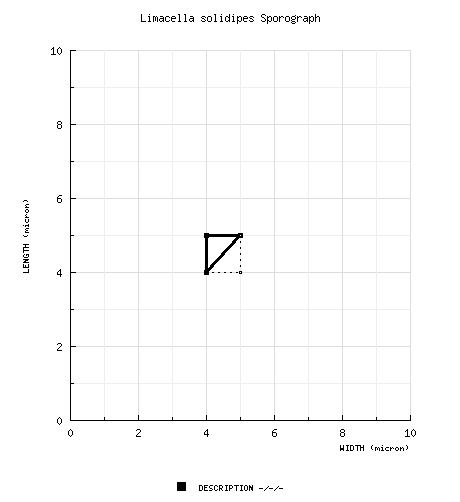

Text and User-Generated Sporographs are published under the Creative Commons License.

In the case of a taxon page, image credits are on the 'image' tab.