
| name | Amanita yema |
| name status | nomen acceptum |
| author | Guzmán & Ram.-Guill. |
| english name | "Yolk-Colored Caesar" |
| synonyms |
=Amanita tecomate Guzmán & Ram.-Guill. |
| intro |
The following description is based on the original description by Guzmán and Ramírez-Guillén (2001) |
| cap |
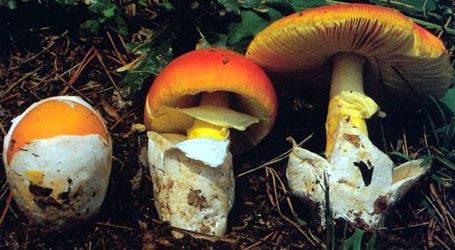
The cap of A. yema is (50-) 80 - 140 (-190) mm wide, blood red to red-brown, red in the center, shading gradually to crimson red, orange red, orange yellow at the margin, sometimes unevenly colored with orange-red spots in older specimens, ovoid to globose when young, convex to plano-convex, sometimes slightly umbonate with age, sometimes with a roughened or tomentose center, viscid when moist, shiny when dry, with modertate or short striate margin. The volva is absent or present as a large, irregular, thick, white patch. The flesh is white, red below the cap skin. |
| gills |
The gills are touch the stem, pale yellowish white to yellow, with a concolorous and subfloccose edge. Short gills are not described, but are probably truncate. |
| stem |
The stem is (65-) 125 - 180 (-220) × 15 - 25 (-40) mm, white to pale yellowish white or yellow, orange-yellow towards the base, sometimes with brownish or reddish staining after handling, hollow or stuffed with cottony white fibers. The ring is membranous, skirt-like, thick, yellow or orange-yellow or pinkish yellow, striate on the upper surface, floccose-scaly below. The volva is saccate, white, membranous, up to 5 mm thick, with two or more irregular lobes, smooth inside, with a short white internal limb, roughened or somewhat scaly outside colored by the substrate. The flesh is white, yellowish in the stem skin. |
| odor/taste |
The odor and taste are mild but pleasant. |
| spores |
The spores measure (9-) 10 - 13 (-16) × (6-) 7 - 8 (-10) µm and are broadly ellipsoid to elongate and inamyloid. Clamps are present at bases of basidia. |
| discussion |
Amanita yema was originally described from central Mexico where it is reported from a large number of localities. This species is known from coast to coast in central Mexico in association with pine-oak (Pinus-Quercus) and pine (Pinus) forests. This species grows solitarily or in small groups. The authors separate A. yema and A. tecomate only by a difference in spore size. The spore shapes are in fact essentially identical. The arguments given for the separation are not convincing to us. The two "species" are said to be commonly sold in a mixture in public markets. On the available evidence, RET believes the two names refer to a single species and selects the name A. yema to apply to it. According to the original description A. yema can be assigned to Amanita stirps Caesarea and is strikingly similar to Amanita basii Guzmán & Ramírez-Guillén and A. laurae Guzmán & Ramírez-Guillén, which were described in the same publication. |
| brief editors | RET |
| name | Amanita yema | ||||||||||||||||||||
| author | Guzmán & Ram.-Guill. 2001. Biblioth. Mycol. 187: 34, figs. 2, 80-89, 101, 105. | ||||||||||||||||||||
| name status | nomen acceptum | ||||||||||||||||||||
| english name | "Yolk-Colored Caesar" | ||||||||||||||||||||
| synonyms |
?=Amanita tecomate Guzmán & Ram.-Guill. 2001. Biblioth. Mycol. 187: 26, figs. 2, 61-71, 106. The editors of this site owe a great debt to Dr. Cornelis Bas whose famous cigar box files of Amanita nomenclatural information gathered over three or more decades were made available to RET for computerization and make up the lion's share of the nomenclatural information presented on this site. | ||||||||||||||||||||
| MycoBank nos. | 485192, 485190 | ||||||||||||||||||||
| GenBank nos. |
Due to delays in data processing at GenBank, some accession numbers may lead to unreleased (pending) pages.
These pages will eventually be made live, so try again later. Search:
Showing 0 to 0 of 0 entries | ||||||||||||||||||||
| holotypes | A. yema and A. tecomate (both)—XAL | ||||||||||||||||||||
| intro |
The following text may make multiple use of each data field. The field may contain magenta text presenting data from a type study and/or revision of other original material cited in the protolog of the present taxon. Macroscopic descriptions in magenta are a combination of data from the protolog and additional observations made on the exiccata during revision of the cited original material. The same field may also contain black text, which is data from a revision of the present taxon (including non-type material and/or material not cited in the protolog). Paragraphs of black text will be labeled if further subdivision of this text is appropriate. Olive text indicates a specimen that has not been thoroughly examined (for example, for microscopic details) and marks other places in the text where data is missing or uncertain. The following material is derived from the protolog of the present species (Guzmán and Ramírez-Guillén 2001). | ||||||||||||||||||||
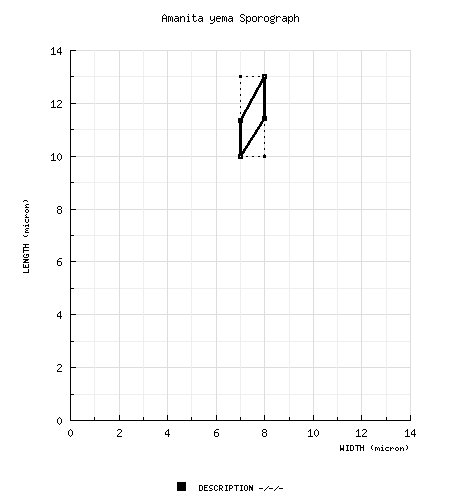
| basidiospores | from protolog: [-/-/-] (9-) 10 - 13 (-16) × (6-) 7 - 8 (-10) μm, (est. Q = 1.43 - 1.62; Q' = 1.53), hyaline, inamyloid, ellipsoid to elongate, at least frequently adaxially flattened (per figure); apiculus sublateral, "small"; contents not reported; white in deposit. [Note: A conservatively estimated range of Q is provided so that an approximate sporograph can be generated. Spore ranges were presented with multiple larger dimensions in parentheses instead of the single upper limit of observed size that is standard on this site. We present here the largest of the authors' values as the upper limits of length and width.—ed.] | ||||||||||||||||||||
| ecology | from protolog: . | ||||||||||||||||||||
| material examined |
from protolog: MÉXICO: VERACRUZ EDO.—Mpio. Xico- from protolog of A. tecomate: MÉXICO: VERACRUZ EDO.—Mpio. Xalapa - old Xalapa to Coatepec rd., SE of Jardín Botánico Francisco J. Clavijero, Ejido Bentio Juárez, 7.vii.1983 Chacón 1123-A (holotype of Amanita tecomate, XAL). | ||||||||||||||||||||
| citations | —R. E. Tulloss | ||||||||||||||||||||
| editors | RET | ||||||||||||||||||||
Information to support the viewer in reading the content of "technical" tabs can be found here.
| name | Amanita yema |
| bottom links |
[ Keys & Checklists ] |
| name | Amanita yema |
| bottom links |
[ Keys & Checklists ] |
 Spore data sets and their composite
Each spore data set is intended to comprise a set of measurements from a single specimen made by a single observer; and explanations prepared for this site talk about specimen-observer pairs associated with each data set. Combining more data into a single data set is non-optimal because it obscures observer differences (which may be valuable for instructional purposes, for example) and may obscure instances in which a single collection inadvertently contains a mixture of taxa.

Text and User-Generated Sporographs are published under the Creative Commons License.

In the case of a taxon page, image credits are on the 'image' tab.