
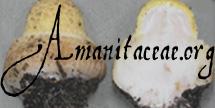
| name | Amanita laurae |
| name status | nomen acceptum |
| author | Guzmán & Ram.-Guill. |
| english name | "Laura's Caesar" |
| intro | The following description is based on the original description by Guzmán and Ramírez-Guillén (2001). |
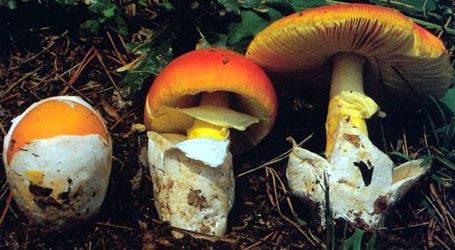
| cap | The cap of A. laurae is (50-) 70 - 150 (-200) mm wide, dark red when young, orange-red to orange-yellow to yellow at maturity [Note: illustrations show the red color concentrated in the center of the cap and the margin strongly yellow], ovate at first then broadly bell-shaped, convex to plano-convex at maturity, without an umbo, smooth, viscid when moist, with a short to moderately striate margin. The volva is present as membranous, white patches. The flesh is white, reddish orange below the cap skin, and compact. |
| gills | The gills touch the stem and are yellow with an edge of the same color. |
| stem | The stem is (80-) 120 - 200 (-240) × (15-) 20 - 30 (-35) mm, cylindric or slightly narrowing upward, yellow to yellow-orange to orange-red, and hollow to stuffed with white cottony fibrils. The ring is membranous, skirt-like, up to 1 mm thick, yellow to orange, striate above and smooth or subfloccose below. The saccate volva is membranous, thick, irregularly divided into two or more lobes, white on the outer surface and whitish to orange-brown on the inner surface. |
| odor/taste | The odor and taste are pleasant and somewhat sweet. |
| spores | The spores measure (8-) 9 - 11 (-14) × (6-) 7 - 7.5 (-10) µm and are subglobose to ellipsoid and inamyloid. Clamps are present at bases of basidia. |
| discussion | This species was originally described from and known only from Mexico, especially in the state of Jalisco, in association with pine-oak (Pinus-Quercus) and pine (Pinus) forests. The authors believe it may occur in Guatemala.—R. E. Tulloss and L. Possiel |
| brief editors | RET |
| name | Amanita laurae | ||||||||||||||||||||
| author | Guzmán & Ram.-Guill. 2001. Biblioth. Mycol. 187: 22, figs. 2, 38-50, 100, 101. | ||||||||||||||||||||
| name status | nomen acceptum | ||||||||||||||||||||
| english name | "Laura's Caesar" | ||||||||||||||||||||
| MycoBank nos. | 485189 | ||||||||||||||||||||
| GenBank nos. |
Due to delays in data processing at GenBank, some accession numbers may lead to unreleased (pending) pages.
These pages will eventually be made live, so try again later. Search:
Showing 0 to 0 of 0 entries | ||||||||||||||||||||
| holotypes | IBUG; isotype, XAL | ||||||||||||||||||||
| intro |
The following text may make multiple use of each data field. The field may contain magenta text presenting data from a type study and/or revision of other original material cited in the protolog of the present taxon. Macroscopic descriptions in magenta are a combination of data from the protolog and additional observations made on the exiccata during revision of the cited original material. The same field may also contain black text, which is data from a revision of the present taxon (including non-type material and/or material not cited in the protolog). Paragraphs of black text will be labeled if further subdivision of this text is appropriate. Olive text indicates a specimen that has not been thoroughly examined (for example, for microscopic details) and marks other places in the text where data is missing or uncertain. The following material is derived from the protolog of the present species (Guzmán and Ramírez-Guillén 2001). | ||||||||||||||||||||
| pileus | from protolog: (50-) 70 - 150 (-200) mm wide, dark red (ca. 11B2 or 11A8) when young, orange-red (darker than 7A-B8 or 8A8) or orange-yellow (6A7-8) or yellowish (5A8) when mature, with older or dried specimens mostly tan with faint yellow tinges, conical to ovate when young, convex to plano-convex at maturity, without trace of umbo, smooth, viscid to lubricious; context fleshy, compact, white except reddish orange below pileipellis; margin striate to "slightly sulcate-striate," with striations rather short (per figure); universal veil absent or as white membranous patch. | ||||||||||||||||||||
| lamellae | from protolog: adnexed, yellowish (3A4-5 or 4A3) to yellow (3A8), with concolorous, "subglobose" (sic) edge; lamellulae not described. | ||||||||||||||||||||
| stipe | from protolog: (80-) 120 - 200 (-240) × (15-) 20 - 30 (-35) mm, cylindric or slightly narrowing upward, with ground whitish (2-4A2) or white, with initial covering yellow (4A6-8) to yellow-orange (5A5) to yellow-red (6-7A8) or yellowish (4A3-5), cracking or splitting at maturity, with initial covering eventually entirely lost; context stuffed "with white mycelium" or hollow; partial veil superior (per figure), yellow (3A8) to orange (5A8), membranous, pendent, up to 1 mm thick, striate above, smooth or subfloccose below, with subcrenulate edge; universal veil as saccate volva, pyriform to subcylindric to globose, membranous "above"?, thick, irregularly lobed or divided into two or more lobes, white on exterior surface, whitish to orange-brown on interior surface, with limbus internus not observed. [Note: The authors interpret the initial covering of the stipe as the stipe surface; however, if the species conforms to all others in sect. Caesareae that have been revised, the initial covering is likely to be a felted extension of the limbus internus of the universal veil.—ed.] | ||||||||||||||||||||
| odor/taste | from protolog: Odor and taste pleasant, mild, somewhat sweet. | ||||||||||||||||||||
| macrochemical tests |
none recorded. | ||||||||||||||||||||
| pileipellis | from protolog: 100 - 225 μm thick; with "ixocutis" [?suprapellis] up to 45 μm thick, ?colorless; ?subpellis yellowish to pale orange; filamentous hyphae 1 - 8 μm thick. [Note: placement of the color information is based on the editor's experience; it is confusing in the protolog.—ed.] | ||||||||||||||||||||
| pileus context | not described. | ||||||||||||||||||||
| lamella trama | from protolog: bilateral, divergent; filamentous hyphae 2 - 16 (-20) μm wide, hyaline. [Note: Given the upper limits of dimensions, inflated cells (probably mostly intercalary) were observed.—ed.] | ||||||||||||||||||||
| subhymenium | from protolog: with inflated cells in 1 -2 (-3) layers; inflated cells 6.4 - 16 μm wide, hyaline. [Note: Probably pseudoparenchymatous (cellular). Throughout the monograph containing the protolog, drawings of subhymenial tissue appear to show damaged or poorly rehydrated cells.—ed.] | ||||||||||||||||||||
| basidia | from protolog: 28 - 62 × 8 - 12 μm, 4-sterigmate; clamps present. | ||||||||||||||||||||
| universal veil | from protolog: On pileus: absent or not described. On stipe base: [Layers not reported separately.] filamentous hyphae 2 - 20 μm wide; inflate cells 56 - 94 μm wide. [Note: Some unidentified "layer" is reported to be 100 - 225 μm thick.—ed.] | ||||||||||||||||||||
| stipe context | not described. | ||||||||||||||||||||
| partial veil | from protolog: filamentous hyphae 1.5 - 9 μm wide;; inflated cells hyaline, 40 - 62 × 23 - 44 μm [called "globose of subglobose," but that does not fit the reported dimensions]. | ||||||||||||||||||||
| lamella edge tissue | from protolog: inflated cells 20 - 72 × 13 - 46, hyaline, globose or turbinate or pyriform, "with acute base." [Note: Described in error as "cheilocystida."—ed.] | ||||||||||||||||||||
| basidiospores | from protolog: [-/-/-] (8-) 9 - 11 (-14) × (6-) 7 - 7.5 (-10) μm, (est. Q = 1.29 - 1.47; Q' = 1.38), hyaline, inamyloid, broadly ellipsoid to ellipsoid, at least frequently adaxially flattened (per figure); apiculus sublateral, "small"; contents not reported; white in deposit. [Note: A conservatively estimated range of Q is provided so that an approximate sporograph can be generated. Spore ranges were presented with multiple larger dimensions in parentheses instead of the single upper limit of observed size that is standard on this site. We present here the largest of the authors' values as the upper limits of length and width.—ed.] | ||||||||||||||||||||
| ecology | from protolog: Solitary or gregarious. On humus in forests of Quercus or Pinus or in mixed Quercus-Pinus forest. | ||||||||||||||||||||
| material examined |
from protolog: MÉXICO: CHIAPAS EDO.—San Cristobal | ||||||||||||||||||||
| discussion |
Although the tissue(s) in which they are found are not identified, vascular hyphae were reported to be more or less common, yellowish, and 4 - 10 μm wide. The following diagrams provide sporograph comparisons with A. basii, A. caesarea, and A. yema—similarly brightly colored taxa with robust basidiomes. | ||||||||||||||||||||
| citations | —R. E. Tulloss | ||||||||||||||||||||
| editors | RET | ||||||||||||||||||||
Information to support the viewer in reading the content of "technical" tabs can be found here.
| name | Amanita laurae |
| bottom links |
[ Keys & Checklists ] |
| name | Amanita laurae |
| bottom links |
[ Keys & Checklists ] |
 Spore data sets and their composite
Each spore data set is intended to comprise a set of measurements from a single specimen made by a single observer; and explanations prepared for this site talk about specimen-observer pairs associated with each data set. Combining more data into a single data set is non-optimal because it obscures observer differences (which may be valuable for instructional purposes, for example) and may obscure instances in which a single collection inadvertently contains a mixture of taxa.

Text and User-Generated Sporographs are published under the Creative Commons License.

In the case of a taxon page, image credits are on the 'image' tab.