
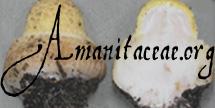
| name | Amanita subjunquillea |
| name status | nomen acceptum |
| author | S. Imai |
| english name | "East Asian Death Cap" |
| images |
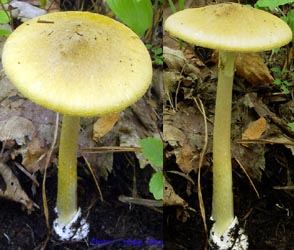  1. Amanita subjunquillea, Jilin Province, northeastern China. 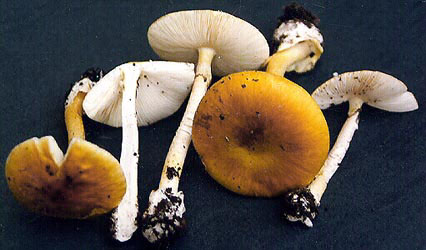 2. Amanita subjunquillea, Uttarakhand State, India. |
| cap | Fruiting bodies of A. subjunquillea are small to medium-sized, rarely large. Its cap is (20-) 30 – 60 (-100) mm wide and nearly hemispherical at first, then convex to plano-convex. The cap is brownish yellow to dirty citrin-yellow to mustard yellow, becoming darker towards the center. The cap's margin is smooth (only finely striate when old) and non-appendiculate. The volval remnants on the cap are rare; when present, they are white, patch-like, and membranous. The cap's flesh is white. |
| gills | The gills of this species are free, crowded, and white to cream-colored. The short gills narrow rather gradually. |
| stem | The stem is 40 - 120 (-150) × 3 - 10 (15) mm, nearly cylindric or slightly tapering upward, solid, and white to yellowish with yellowish fibrillose scales. The stem's flesh is white; the basal bulb is subglobose to subclavate to turnip-shaped, and 10 - 25 (-30) cm wide. The limbate volva is membranous and firm and has a free limb up to 20 mm high. Both the inner and outer surfaces of surfaces volval limb are white to dirty white. The stem's ring is placed at or near the top of the stem and is skirt-like, thin, membranous, and persistent; the ring's upper surface is white, and its lower surface is whitish. |
| odor/taste | The odor is indistinct. This species contains amatoxins and is deadly POISONOUS. |
| spores |
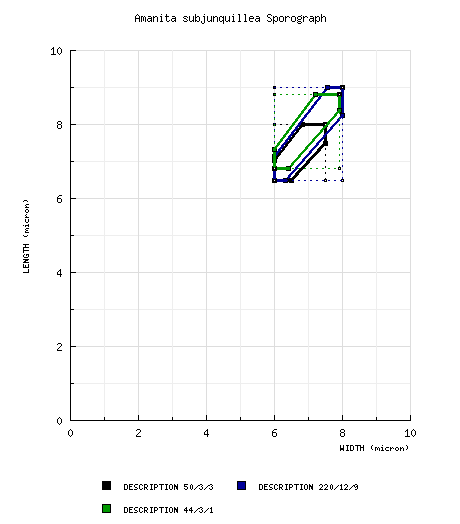
ZLY: Spores of east Asian collections measure 6.5 - 9.5 (-11.0) x (5.5-) 6.0 - 8.0 (-10.0) µm and are globose to subglobose (occasionally to broadly ellipsoid) and amyloid. Clamps are not present at bases of basidia. RET: Spores from a limited number of northern Indian collections measure (6.5-) 6.8 - 8.8 (-9.6) x (5.5-) 6.0 - 7.9 (-9.2) µm and are globose to subglobose to broadly ellipsoid and amyloid. Clamps are not observed at bases of basidia. |
| discussion |
The species is known from forests of eastern and southeastern Asia. Amanita subjunquillea is deadly POISONOUS. It is much more closely related to A. phalloides (Fr. : Fr.) Link, than to A. gemmata (=A. junquillea). For more concerning available data on phylogenetic relationships see (Zhang et al., 2010).—Zhu-L. Yang [See also A. fuliginea Hongo.—ed.] |
| brief editors | RET |

 Spore data sets and their composite