
| name | Amanita subglobosa |
| name status | nomen acceptum |
| author | Zhu L. Yang |
| english name | "Ringed-Bulb Amanita" |
| images |
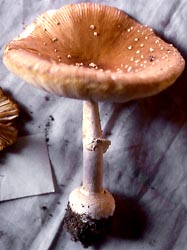 1. Amanita subglobosa 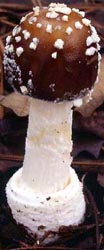 2. Amanita subglobosa 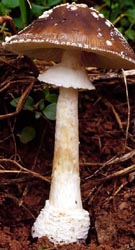 3. Amanita subglobosa |
| intro | Fruiting bodies of Amanita subglobosa are medium-sized to large, or occasionally small. |
| cap |
The cap is 40 - 100 (-150) mm wide, convex to applanate, sometimes concave, brownish to brown to cinnamon-buff, darker in the center, densely covered with white, dirty white to yellowish, conical to verrucose volval remnants 1 - 2 mm high and 1 - 2.5 mm wide; the cap's margin is striate (10% to 40% of radius) and non-appendiculate; the cap's context is white. |
| gills |
The gills are free to subfree and white to cream; the short gills are truncate. |
| stem |
The stipe is 50 - 150 (-240) × 5 - 20 (-30) mm, subcylindric, cream to white, and fibrillose; the stipe's basal bulb is 15 - 35 mm wide and subglobose, with its upper part covered with white, or sometimes yellowish to brownish, verrucose, granular to farinose volval remnants. There is often a collar encircling the base of the stipe and atop the bulb. The annulus is membranous, white, often on the upper part of stipe, although sometimes almost median, and persistent. |
| spores |
The spores measure (7.5-) 8.5 - 12.0 (-15.0) × (6.0-) 7.0 - 9.5 (-12.5) µm and are broadly ellipsoid to ellipsoid (or rarely subglobose or elongate) and inamyloid. Clamps are common on the bases of basidia. |
| discussion |
Originally described from southwestern China and widely distributed in that country, this species may occur in Japan also. Although this species' general appearance suggests Amanita pantherina (DC. : Fr.) Krombh., that species lacks clamps at the bases of basidia. Plentiful clamps are a character that A. subglobosa shares with the species phenetically similar to A. muscaria (L. : Fr.) Lam. For a very similar species described recently from Japan, see A. ibotengutake T. Oda, C. Tanaka & Tsuda.—Zhu L. Yang. |
| brief editors | RET |

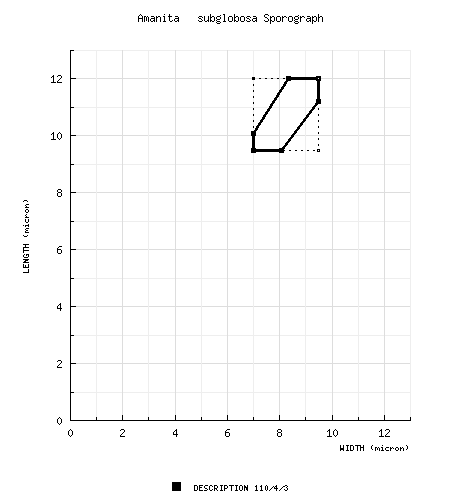
 Spore data sets and their composite