

| name | Amanita squarrosa |
| name status | nomen acceptum |
| author | Nagas. & Hongo |
| english name | "Fountain of Scales Lepidella" |
| cap |
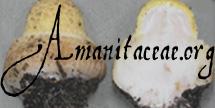
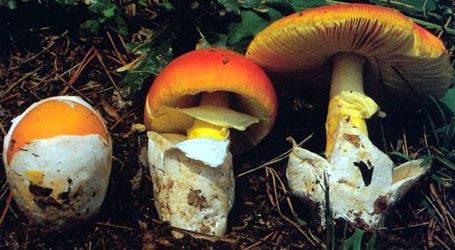
The cap of Amanita squarrosa is 30 - 45 mm wide, globose to roughly conical at first, later convex to plane, dry, with an appendiculate and nonsulcate margin. The cap is at first entirely covered with a whitish to yellowish or pinkish, thin, felted-membranous layer which is soon broken up into patches, scales, or subpyramidal warts. The cap is whitish to somewhat pinkish and more or less "fibrillose" between the fragments and somewhat has the impression of being silky. The flesh is up to 5 mm thick over the stem, rather soft, and white. |
| gills |
The gills are free, crowded, whitish, with a concolorous floccose edge, up to 5 mm broad; the short gills are attenuate. |
| stem |
The stem is 75 - 120 × 5 - 10 mm, tapering upward, white, stuffed, and bears a ring, with a clavate to spindle-shaped bulb. The bulb is up to 20 mm wide, more or less pointed at the base. Below the ring is decorated with densely placed ragged recurved scales and becoming also like a pinecone at the base of the stem and the top of the bulb. The scales often appear to be arranged in circles around the stem. The ring is located at the top of the stem and is fibrillose to floccose-powdery and quickly disappears. |
| spores |
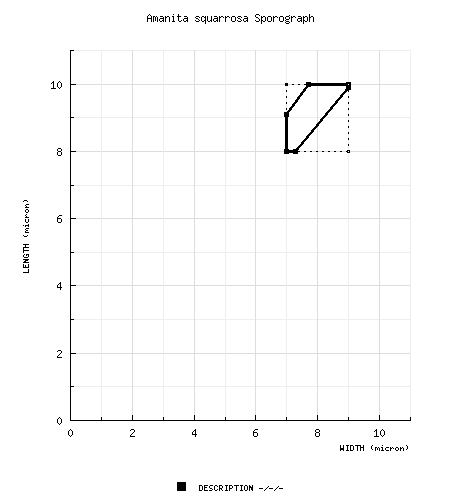
The spores measure 8 - 10 × 7 - 9 µm and are subglobose to broadly ellipsoid, occasionally ellipsoid and amyloid. Clamps are present at base of basidia. |
| discussion |
This species was originally described from Japan in Pine-Oak forests. In the original publication, the authors remark on the species' similarity to Amanita smithiana Bas, which would suggest placement in Bas' stirps Rhopalopus, but expressed concern about the fact that the known species in that group have considerably larger fruiting bodies, smooth stems, and longer proportionately more narrow spores. They do not mention another characteristic of stirps Rhopalopus, namely, that its species tend to have radicating or very deeply radicating bulbs, a characteristic lacking in A. squarrosa. Bas suggests that when material does not seem to fit in stirps Rhopalopus, that the reader of his thesis should see stirps Grossa. Stirps Grossa includes some taxa with subglobose to ellipsoid spores, has no known taxa that are very deeply radicating, and includes fruiting bodies with a considerable variety in size. However, the extremely scaly stem base of Amanita squarrosa is not to be found in this stirps either. For the moment, especially without examining dried material, we cannot confidently do more than place this species in Amanita subsection Solitaria.—R. E. Tulloss and L. Possiel |
| brief editors | RET |
| name | Amanita squarrosa | ||||||||||||||||||||
| author | Nagas. & Hongo. 1984. Trans. Mycol. Soc. Jap. 25: 371, fig. 3(a-f), 5. | ||||||||||||||||||||
| name status | nomen acceptum | ||||||||||||||||||||
| english name | "Fountain of Scales Lepidella" | ||||||||||||||||||||
| MycoBank nos. | 105038 | ||||||||||||||||||||
| GenBank nos. |
Due to delays in data processing at GenBank, some accession numbers may lead to unreleased (pending) pages.
These pages will eventually be made live, so try again later. Search:
Showing 0 to 0 of 0 entries | ||||||||||||||||||||
| holotypes | TMI | ||||||||||||||||||||
| intro |
The following text may make multiple use of each data field. The field may contain magenta text presenting data from a type study and/or revision of other original material cited in the protolog of the present taxon. Macroscopic descriptions in magenta are a combination of data from the protolog and additional observations made on the exiccata during revision of the cited original material. The same field may also contain black text, which is data from a revision of the present taxon (including non-type material and/or material not cited in the protolog). Paragraphs of black text will be labeled if further subdivision of this text is appropriate. Olive text indicates a specimen that has not been thoroughly examined (for example, for microscopic details) and marks other places in the text where data is missing or uncertain. The following material is derived from the protolog of the present taxon. | ||||||||||||||||||||
| pileus | from protolog: 30 - 45 mm wide, whitish to pinkish, globose to more or less conic at first later convex to planar, dry, glabrous or more or less fibrillose; context white, rather soft, up to 5 mm thick over stipe; margin nonsulcate, appendiculate; at first as felted-membranous covering, whititsh to yellowish to more or less pinkish, thin, soon breaking up into patches, scales or subpyramidal warts. | ||||||||||||||||||||
| lamellae | from protolog: free, crowded, whitish, up to 5 mm broad, with concolorous floccose edge; lamellulae attenuate. | ||||||||||||||||||||
| stipe | from protolog: 75 - 120 × 5 - 10 mm, white, narrowing upward, below partial veil densely ragged-squamose to squarrose, with scales pointing upward and slightly curving outward (per figure) and often arranged in circles around stipe, more or less strobiliform on lower stipe and top of bulb; bulb clavate to fusiform, up to 20 mm wide, more or less pointed at bottom; context white; partial veil apical, fibrillose to more or less floccose-pulverulent, ephemeral; universal veil not described. | ||||||||||||||||||||
| odor/taste | from protolog: Odor and taste "non-diagnostic." | ||||||||||||||||||||
| macrochemical tests |
none recorded. | ||||||||||||||||||||
| pileipellis | from protolog: as cutis; suprapellis more or less gelatinized, 25 - 45 μm thick; filamentous hyphae 2.5 - 7.5 (-12.5) μm wide; clamps present. | ||||||||||||||||||||
| pileus context | not described. | ||||||||||||||||||||
| lamella trama | not described. | ||||||||||||||||||||
| subhymenium | not described. | ||||||||||||||||||||
| basidia | from protolog: 55 - 70 × 12 - 15 (-17.5) μm, 4-sterigmate; clamps present. | ||||||||||||||||||||
| universal veil | from protolog: On pileus: filamentous hyphae 3 - 5 (-12.5) μm wide, rather frequent, branching; inflated cells abundant, ovoid to sublobose to globose (12.5 - 60 × 12.5 - 40 μm) and ellipsoid to subclavate (up to 125 × 80 μm), with globose cells usually dominant in upper part of warts, terminal singly or in chains (per figure). On stipe: not described. [Note: The chains of inflated cells are shown in fig. 3e to be coparallel, but the direction orientation of the chain is not mentioned. Considering the shape of the warts on the pileus of this species, it seems likely that the chains are arranged anticlinally with respect to the pileus surface.—ed.] | ||||||||||||||||||||
| stipe context | not described. | ||||||||||||||||||||
| partial veil | from protolog: inflated cells dissociating, clavate (up to 50 × 10 - 27.5 μm) and cylindric (up to 60 × 3 - 7.5 μm). | ||||||||||||||||||||
| lamella edge tissue | from protolog: filamentous hyphae present; inflated cells clavate or sphaeropedunculate or globose, up to 70 × 35 μm. | ||||||||||||||||||||
| basidiospores | from protolog: [-/-/-] 8 - 10 × 7 - 9 μm, (Q = 1.10 - 1.30), hyaline, smooth, thin-walled, amyloid, subglobose to broadly ellipsoid, adaxially flattened (per figure); apiculus sublateral, truncate-conic (both per figure); context as one large refractive guttule; color in deposit not recorded. | ||||||||||||||||||||
| ecology | from protolog: Subregarious. Terrestrial. In Pinus-Quercus forest. | ||||||||||||||||||||
| material examined | from protolog: JAPAN: HONSHU—Shiga-ken, Ôtsu-shi, Ishiyama-Senjyo, 8.x.1973 T. Ueda, T. Kimura, & E. Nagasawa s.n. (paratype, TMI 1307). Tottori-ken, Tottori-shi, Oro-yama, 4.x.1978 E. Nagasawa s.n. (holotype, TMI 7776), 2.x.1979 E. Nagasawa s.n. (paratype, TMI 7777). | ||||||||||||||||||||
| discussion |
The authors make the general comment that clamps are "rather frequent." Given the presence of clamps, the plenitude of both filamentous hyphae and inflated cells in the universal veil, the range of cell shapes in the universal veil, the lack of reported latex in the fruiting body, and the presumed vertical orientation of the chains of inflated cells in the volval warts on the pileus, it seems probable that the species can be assigned to Amanita [sect. Lepidella] subsect. Solitariae. Moreover, if the species could be fit in one of Bas' stirpes of that subsection, the choice would seem to be limited to one of the following four: If the bases of the warts are dominated by filamentous hyphae, then the choice in Bas' key is between stirps Ravenelii and strips Solitaria.Unfortunately the protolog does not supply sufficient data to key out this species to a stirps using (Bas 1969). | ||||||||||||||||||||
| citations | —R. E. Tulloss | ||||||||||||||||||||
| editors | RET | ||||||||||||||||||||
Information to support the viewer in reading the content of "technical" tabs can be found here.
 Spore data sets and their composite
Each spore data set is intended to comprise a set of measurements from a single specimen made by a single observer; and explanations prepared for this site talk about specimen-observer pairs associated with each data set. Combining more data into a single data set is non-optimal because it obscures observer differences (which may be valuable for instructional purposes, for example) and may obscure instances in which a single collection inadvertently contains a mixture of taxa.

Text and User-Generated Sporographs are published under the Creative Commons License.

In the case of a taxon page, image credits are on the 'image' tab.