

| name | Amanita sp-T06 |
| name status | cryptonomen temporarium |
| author | Tulloss & D. P. Lewis |
| images |
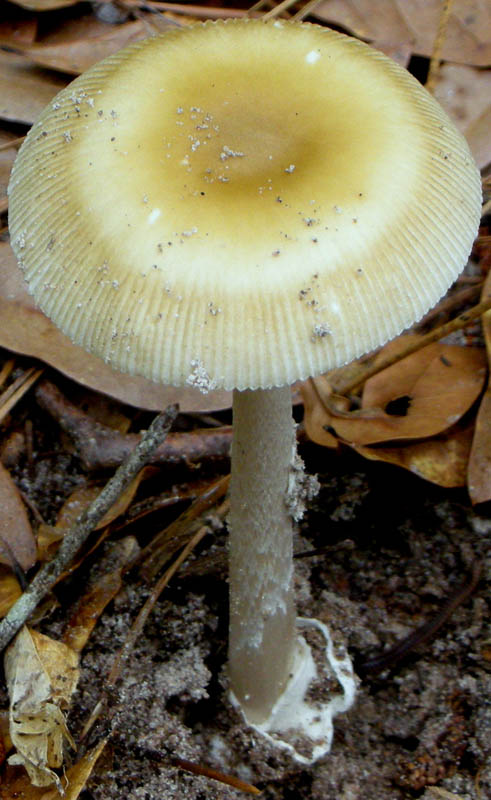 1. Amanita sp-T06, Ha Ha Tonka St. Pk., ? Co., Arkansas, U.S.A. (RET 629-7) 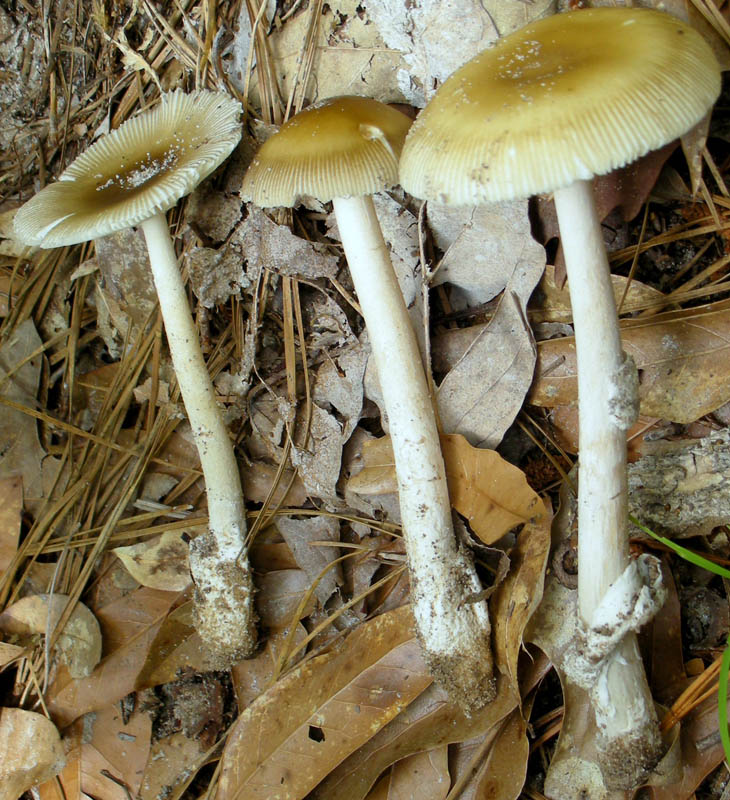 2. Amanita sp-T06, Ha Ha Tonka St. Pk., ? Co., Arkansas, U.S.A. (RET 629-7) |
| intro | This taxon has been repeatedly collected in the Big Thicket National Preserve of eastern Texas. The yellow zonate cap is a distinctive field character. Be sure to compare with A. justicei. The two taxa have been confused. |
| cap | The cap is 55 - 68 mm wide, palely zonate, with sordid to olivaceous bands of yellow and honey-tan or having olive (or olivaceous yellow or olivaceous tan) disc and a paler yellowish margin, becoming more sordid overnight in wax paper, plano convex, and umbonate. The cap's marginis striate (30 - 50% of pileus radius), and its context is off-white to white, and 2.5 - 6.5 mm thick above the stem. No remains of the volva are present on the cap. |
| gills | The gills are free, crowded, very pale yellowish white to sordid yellowish cream in mass, cream to very pale cream in side view, and 3.5 - 5 mm broad. The short gills are approximately squarely cut off, unevenly distributed, of diverse lengths (sometimes with few less than half the pileus radius in length), and plentiful. |
| stem | The stem is 120 - 152 × 6.5 - 8 mm, off-white to palely concolorous with pileus to pale buff, with surface fibrils (sometimes creating a "snake skin," "flame," or "zebroid" pattern) darkening from handling. There is no ring. The volva is sack-like, sheathing, whitish to yellow white, 25 - 42 × 13 - 13.5 mm, and with a small internal volval limb near the point of sack's attachment to the stem. Eventually, the sack becomes completely detached from the stem, and then the volval sack may be difficult to collect. |
| odor/taste | The odor and taste of this species have not been recorded. |
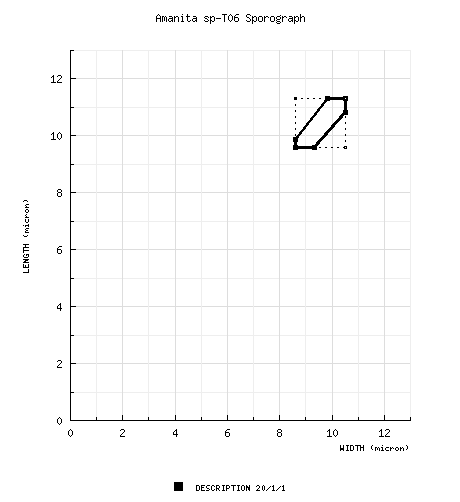
| spores | The spores measure (7.6-) 9.6 - 11.3 (-12.3) × (7.0-) 8.6 - 10.5 (-11.0) µm, are globose to sublglobose (infrequently broadly ellipsoid) and inamyloid. Clamps are not to be found at the bases of basidia. |
| discussion |
This species is distinguished from
A.
sinicoflava Tulloss by its often zonate
pileus, its non-graying volva, and (consequently)
different volval tissue. David P. Lewis has
called it "#217." This species has been found from the southern parts of the Gulf Coast states and the sandy pine-oak woods of eastern Texas.—R. E. Tulloss |
| brief editors | RET |

 Spore data sets and their composite