| name |
Amanita sp-NW04 |
| author |
Tulloss & J. E. Lindgr. |
| name status |
cryptonomen temporarium |
| english name |
double click in markup mode to edit. |
| GenBank nos. |
Due to delays in data processing at GenBank, some accession numbers may lead to unreleased (pending) pages.
These pages will eventually be made live, so try again later.
|
| intro |
Olive text indicates a specimen that has not been
thoroughly examined (for example, for microscopic details) and marks other places in the text
where data is missing or uncertain.
The following material is derived from original research of R. E. Tulloss and J. E. Lindgren. |
| pileus |
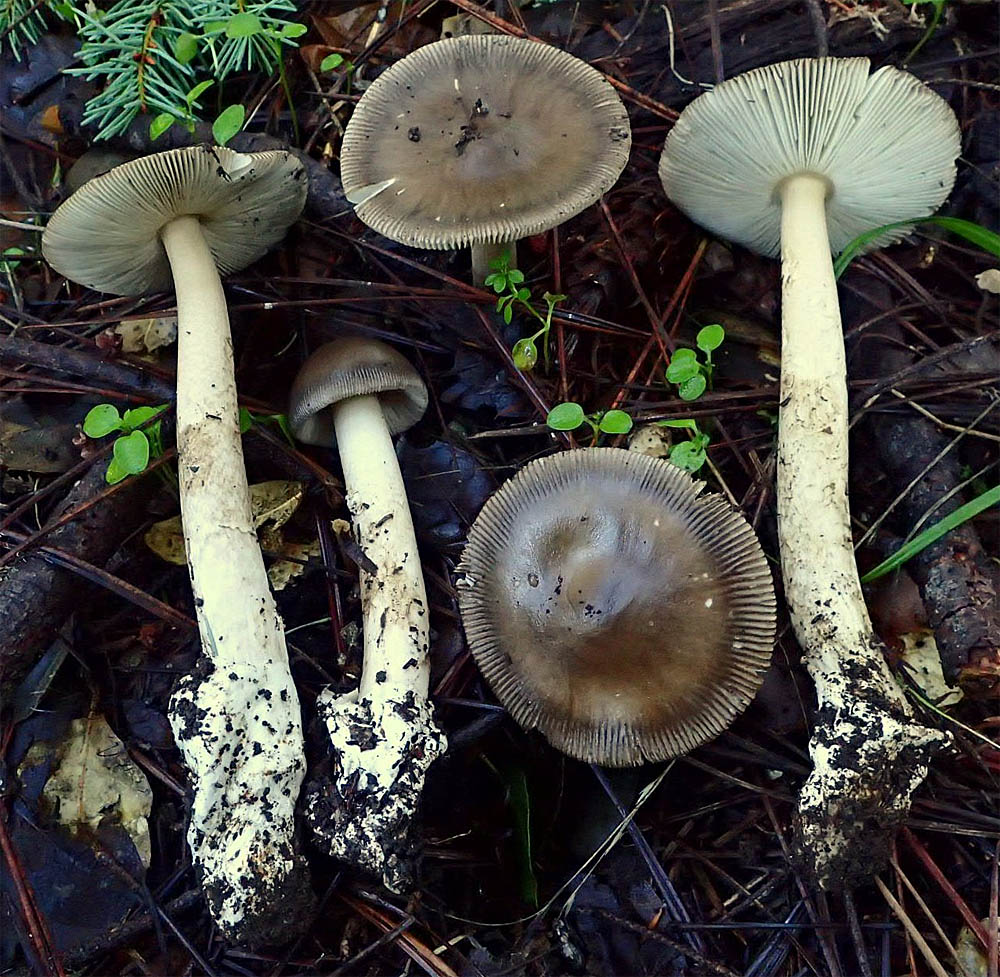
35 - 90 mm wide, pale brown to tannish brown to light golden brown to light orangish brown to light grayish brown over margin and darker over disc (for example brown to reddish brown to rich fulvous brown to fulvous to gray-brown to umbrinous brown), sometimes with dark line on inner edge of striae, ovoid to campanulate at first, then convex, with low umbo, tacky when wet, satiny when dry; context white, 5± mm thick at stipe, thinning evenly for about three-quarters of radius, then membranous to margin; margin striate to subtuberculate-striate to tuberculate-striate (0.35±R), often becoming rimose, decurved, nonappendiculate; universal veil absent or as submembranous patch or patches, white at first, becoming gray, sometimes with orange-brown or rusty stains on exterior surface, occasionally becoming areolate and then with pale tan to buff to brownish to ochraceous flakes with upturned edges or subpyramidal warts distributed over white or grayish patch. |
| lamellae |
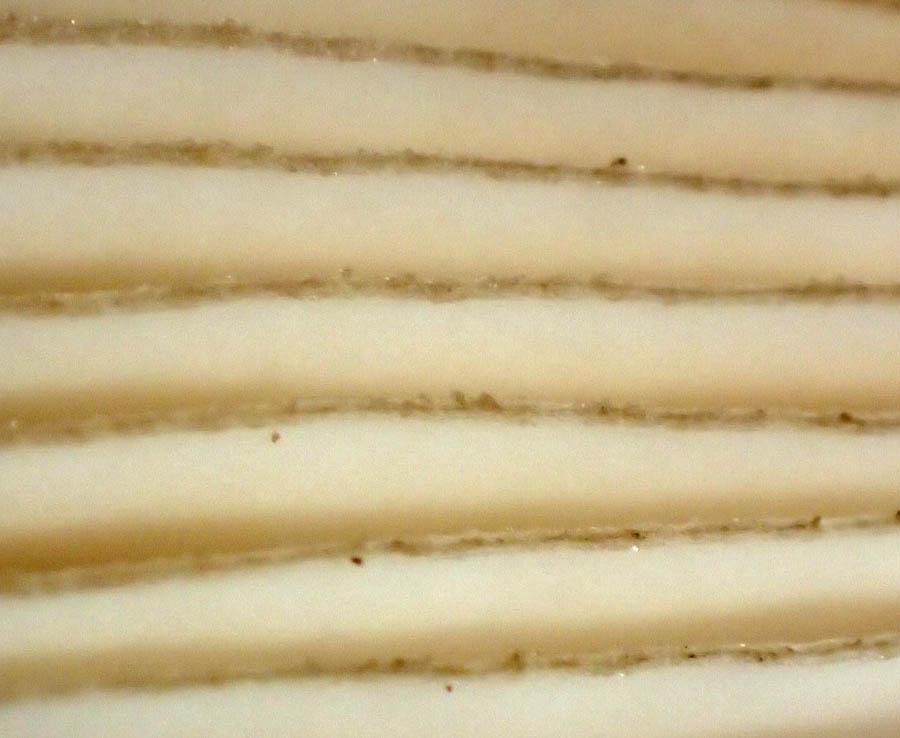
narrowly adnate with decurrent line on stipe, becoming free in age, subdistant, white to creamy white or nearly yellowish to pale grayish buff, in exsiccata off-white to pale grayish white to pale brownish gray to brownish gray, slightly browning when bruised, not marginate or slightly so (brown-edged under 10× lens), with edges minutely fimbriate (10× lens), 4± mm broad; lamellulae truncate to rounded-truncate to subattenuate, unevenly and sparsely distributed. |
| stipe |
??100 - 120 × 6 - 10 mm, with white or whitish ground, becoming grayish where handled, sometimes with pale gray to pale tan to buff pulverulence or flocculence near apex, below decorated with tannish brown to pale brown to brown to grayish brown to gray fibrils and/or floccose-fibrillose bands often in chevron-like pattern, narrowing upward; context stuffed, white (except for some gray tint near surface), unchanging when cut or bruised, rust colored in old larva tunnels; exannulate; universal veil as saccate volva, flaring at first, often collapsing on stipe, up to 50 - 60 mm from base of stipe to highest point of limb, occasionally with limbs broken up into large patches, occasionally with a strangulate zone as in A. constricta, dry, white inside and out at first or white on exterior and pale orangish-white on interior surface, with inner surface graying while exterior still white, lacking stains or with many orange-brown to brown to rusty stained spots on the exterior surface, with stains not fading on drying (retained in exsiccata), upper portions of limb often with sordid or pale grayish exterior surface in exsiccata, rather thick, may come cleanly away from stipe base, with floccose to cottony gray limbus internus somewhat suggestive of cothurnate volva of A. pantherina at base of flaring portion of limb and often exposed at upper rim of remaining cupulate volva in specimens having most of universal veil limb carried away on pileus. |
| odor/taste |
Odor mild or lacking. Taste not recorded. |
macrochemical
tests |
none recorded. |
| pileipellis |
up to 135 µm thick, comprising two layers; suprapellis 7 to 17 µm thick, extensively gelatinized, colorless; subpellis brownish yellow to brownish orange; filamentous, undifferentiated hyphae 1.8 - 8.5 µm wide, branching, densely interwoven, many with subradial orientation; vascular hyphae very scarce, 9.2 - 11.0 µm wide, with irregular outline. |
| pileus context |
filamentous, undifferentiated hyphae 5.8 - 15.0 µm wide, plentiful, dominant near pileipellis, without dominant orientation, criss-crossed interwoven, with some having subrefractive yellowish walls, often in fascicles except for those of larger diameter, with walls of those of larger diameter slightly thickened; acrophysalides plentiful, locally dominant away from pileipellis and lamellae, subglobose to subpyriform to ellipsoid to broadly clavate to broadly fusiform to narrowly clavate, up to 88 × 60 µm, with walls thin or slightly thickened (up to 0.5 µm thick); vascular hyphae not observed. |
| lamella trama |
bilateral, divergent, with central stratum often difficult or impossible to rehydrate in material examined, with angle of divergence shallow or sometimes obscure, with all elements thin-walled; wcs = 50 - 60 (-80) µm; with subhymenial base containing occasional relatively large inflated cells immediately adjacent to central stratum (up to 53 × 29 µm, at angles of up to 60° or nearly 90° to central stratum), but largely comprised of frequently branching hyphae with uninflated or partially inflated segments; filamentous, undifferentiated hyphae 2.0 - 5.0 µm wide, branching, with intercalary subfusiform segments up to 16.5 µm wide; diverging, terminal, inflated cells not observed; vascular hyphae 2.8 - 6.0 µm wide, branching, sinuous, occasional to (infrequently) locally abundant. |
| subhymenium |
wst-near = 15 - 35 (-40) µm; wst-far = 35 - 75 µm; with many inflated cells (ramose, ellipsoid, ovoid, with largest nearest to central stratum) and partially inflated cells (clavate, branched) and occasional uninflated short hyphal segments, with 3 to 5 cells between the bases of basidia/-oles and nearest edge of central stratum, with basidia arising from cells of all types (least frequently from uninflated hyphal segments), with 1/2 to 2 cells between the base of a short basidiole and the base of the longest nearby basidium/-ole. |
| basidia |
(43-) 55 - 82 × 11.8 - 18.0 µm, thin-walled, dominantly 4-, but not uncommonly 2-, and occasionally 1-, sterigmate, with sterigmata up to 11.8 × 2.8 µm; clamps and proliferated clamps scattered to rare (less than a ten found in extensive search of on section from Lindgren 91-30). |
| universal veil |
On pileus: scant filamentous undifferentiated hyphae moderately frequently branching and collapsed and gelatinized inflated cells (not visible to naked eye). On stipe base, exterior surface layer: as thin layer of filamentous, undifferentiated hyphae in fascicles, gelatinized, sublongitudinally arranged. On stipe base interior and inner surfaces: filamentous, undifferentiated hyphae 2.0 - 11.0 µm wide, branching, plentiful, often in fascicles, loosely interwoven around inflated cells, with some having slightly thickened walls; inflated cells globose or subglobose (up to 55 × 54 µm, with wall up to 0.8 µm thick) to ovoid or ellipsoid (up to 45 × 35 µm, with wall up to 1.0 µm thick) to peanut shaped or irregularly subfusiform (up to 64 × 31 µm, with wall up to 1.0 µm thick at least at apex), with wall rarely thinner than 0.5 µm thick, faintly sordid to pale brown in mature material, plentiful to locally dominant (in clusters); vascular hyphae not observed. |
| stipe context |
longitudinally acrophysalidic; filamentous, undifferentiated hyphae 1.2 - 11.0 µm wide, branching, plentiful; acrophysalides plentiful, up to 200 × 42 µm, thin-walled or with wall up to 1.0 µm thick; vascular hyphae 7.0 - 10.5 µm wide, scarce, sinuous, with irregular outline. |
| partial veil |
absent. |
| lamella edge tissue |
sterile. |
| basidiospores |
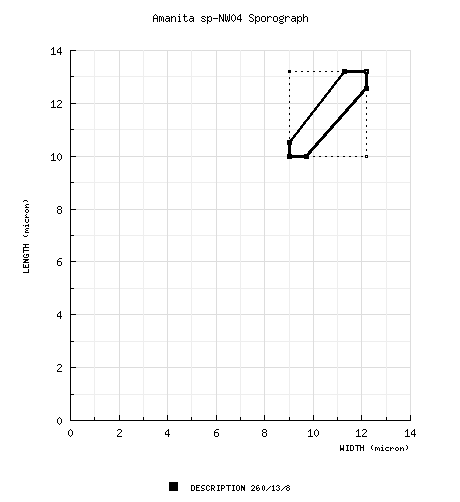
[260/13/8] (7.0-) 10.0 - 13.2 (-19.2) × (6.0-) 9.0 -
12.2 (-17.8) µm, (L = 10.8 - 12.3 (-12.8) µm;
L’ = 11.5 µm; W = 9.9 - 11.2 (-12.0) µm;
W’ = 10.7 µm; Q = (1.0-) 1.03 - 1.17 (-1.25);
Q = 1.07 - 1.11 (-1.12); Q’ = 1.09),
hyaline, colorless, smooth, thin-walled, inamyloid,
globose to subglobse to broadly ellipsoid,
occasionally lachrimiform (?on basidiocarps apparently
just beginning sporulation), often at least somewhat
adaxially flattened, sometimes expanded at one end;
apiculus sublateral to lateral, sometimes
rather stubby, truncate-conic to cylindric;
contents mono- to multiguttulate to granular;
white in deposit. |
| ecology |
Solitary to subgregarious to gregarious to
scattered. Canada: At 850 - 1200±
m elev. Under Abies amabilis, Chamaecyparis nootkatensis, Pseudotsuga menziesii,
Thuja plicata, and Tsuga mertensiana;
or in moss-covered, black soil under A.
amabilis, C. nootkatensis, and T.
mertensiana; or with the immediately preceding
plants and Thuja plicata, Menziesia
ferruginea, and Vaccinium alaskense; or
under A. amabilis, C. nootkatensis,
Th. plicata, and T. mertensiana with
occasional Ps. menziesii. Oregon and
Washington: At 1190± - 1850 m
elevation. Under Abies procera (Noble
Fir); or in conifer duff under old growth Tsuga
and Ps. menziesii; or in very dry conifer
duff with volcanic dust in conifer dominated
forest under Ps. menziesii, Tsuga
heterophylla, Alnus rubra, Acer
circinatum with understory including
Polystichum munitum (sword fern),
Oxalis, and Vaccinium parvifolium
(red huckleberry). California: At
65± m elev. Associated with
10-year-old Pinus muricata. |
| material examined |
CANADA:
BRITISH COLUMBIA—Squamish-Lillooet
Regional
District - Meager Mtn., upper Meager Crk. above
Devastation Crk., 2.ix.1989 Paul Kroeger PK1406 (in
herb. P. Kroeger). Greater Vancouver Regional
District - North Vancouver, Mt. Seymour,
2.viii.1992
Paul Kroeger PK1600 (in herb. P. Kroeger),
PK1601 (in
herb. P. Kroeger), 23.viii.1992 Paul Kroeger
PK1605
(in herb. P. Kroeger), PK1606 (in herb. P.
Kroeger).
U.S.A.:
CALIFORNIA—Marin Co. - MMWD, Lake Lagunita,
7.vi.2019 Ronald L. Pastorino 6-6-19F [mushroomobserver
#353436]
(RET 868-8, nrITS-LSU seq'd.);
Point
Reyes Nat. Seashore, large intermediate island
located near Glenbrook Tr. off of Muddy Hollow
parking lot [38.0519° N/ 122.8741667° W,
65 m], 27.xii.2005 Kabir G. Peay KGB69
(UCB 1860351).
WASHINGTON—Skagit Co.
- Mt. Baker Nat. For., above Baker Lk., near Rainbow
Falls, 22.ix.1991 Buck McAdoo 193#17 (RET
050-1). Skamania Co. - GPNF, Rd 5701
ca. Siouxon Crk., 2.x.1991 J. E. Lindgren 91-30
(RET 084-3, nrITS seq'd.).
Thurston Co. - Olympia, 48th Way NW [47.104° E/
123.035° W, 41 m], 2.xi.2018 Ellen Rice & Sally
Bennett s.n. [mushroomobserver
#342246]
(RET 847-5, nrITS-LSU seq'd.). |
| discussion |
The descriptions accompanying some of the material we
reviewed suggests to us that the specie has often been
mis-identified in the field as A.
pachycolea.
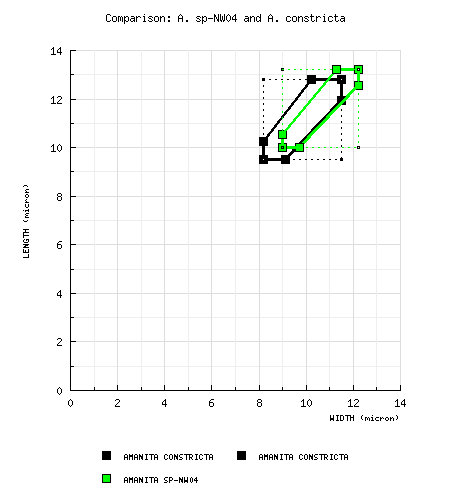
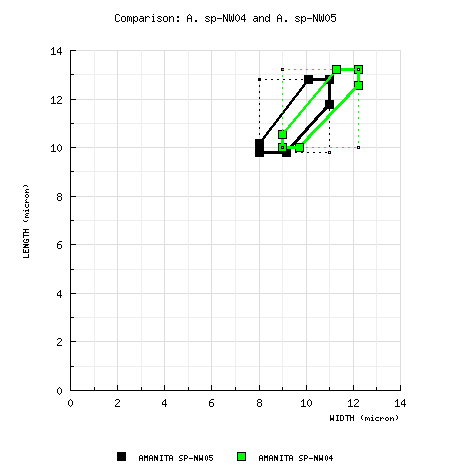
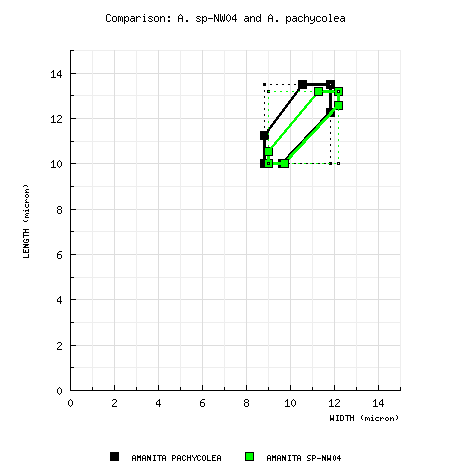
The following diagrams compare the spores of the
present taxon with those of
A.
constricta,
A.
sp-NW05, and A.
pachycolea:
Lindgren 91-35 (RET 084-2) collected at Cascade
Head, Tillamook Co., Oregon, is apparently an
immature specimen of this species (based on colors,
habit, volva staining, discoloring of lamellae,
and anatomical examination of the most mature part
of the lamellae). It is interesting to note
that even the lamellae of a “button” of this
species may become brownish gray on drying.
Moreover, we note that
-
rusty stains both on the universal veil and in
larva tunnels
-
gray interior surface of the universal
veil
were present prior to sporulation in this
collection.
Peay KGP69 is known to us only from its nrITS
sequence (GenBank DQ822792).
This species has been called “Amanita sp.
NW4” by RET in correspondence and in regional
checklists, etc. |
| citations |
—R. E. Tulloss and J. E. Lindgren |
| editors |
RET |
|




 Spore data sets and their composite