

| name | Amanita sp-NFL01 |
| name status | cryptonomen temporarium |
| author | Tulloss |
| intro | This temporarily numbered entity is based on material in DAOM that was collected in 1954 at Crater Lake, Labrador (92 - 96 km southwest of Saglek). |
| cap | The cap of entity was described as silvery gray and 15 - 30 mm wide.&mbsp; The cap margin may become yellowish with age. |
| gills | The gills are rounded at the cap margin and whitish to light tan to pinkish tan. |
| stem | The stem is 5 - 10 mm thick, exannulate, white above, and gray below. At the stem base, the volva breaks up into small patches or large warts. |
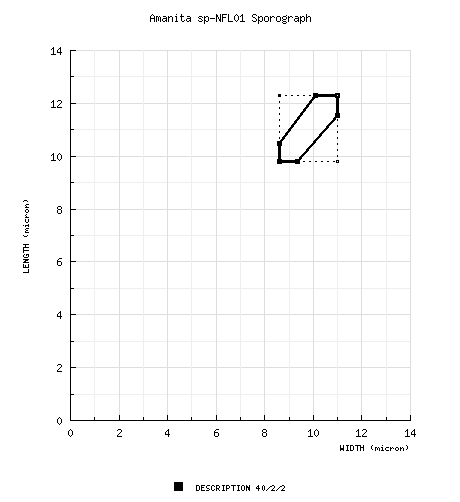
| spores | The spores measure (9.3-) 9.8 - 12.3 (-13.2) × (8.5-) 8.6 - 11.0 (-12.5) µm and are subglobose to broadly ellipsoid and inamyloid. Clamp information t.b.d. |
| discussion |
The collection on which this temporary code item occured in dense moss on "coarse ground moraine," at about 610 m elevation in Labrador. Compare to the better documented Amanita sp-NFL10.—R. E. Tulloss |
| brief editors | RET |
Information to support the viewer in reading the content of "technical" tabs can be found here.
| name | Amanita sp-NFL01 |
| bottom links | [ Keys & Checklists ] |
| name | Amanita sp-NFL01 |
| bottom links | [ Keys & Checklists ] |
 Spore data sets and their composite
Each spore data set is intended to comprise a set of measurements from a single specimen made by a single observer; and explanations prepared for this site talk about specimen-observer pairs associated with each data set. Combining more data into a single data set is non-optimal because it obscures observer differences (which may be valuable for instructional purposes, for example) and may obscure instances in which a single collection inadvertently contains a mixture of taxa.

Text and User-Generated Sporographs are published under the Creative Commons License.

In the case of a taxon page, image credits are on the 'image' tab.