

| name | Amanita sp-M16 |
| name status | cryptonomen temporarium |
| author | Tulloss |
| images |
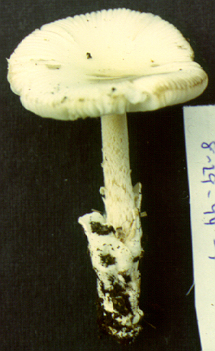 1. Amanita sp-M16, Mpio. Panotla - Tlaxcala edo., México |
| intro | The following material is based on original research of R.E. Tulloss. |
| cap | The dull white plano-convex cap is 38 mm wide; it develops some brown spotting in age. The cap has a depressed center and a slightly waxy feel. The cap's flesh is white with a water soaked line above the gills, and is 2 mm thick over the stem. The cap's flesh thins evenly for more than 3/4 of the cap's radius. then is membranous to the edge. The edge is striate, and no volval remnants are present. |
| gills | The pale cream gills are free, crowded, and 5 - 5.5 mm broad. A faint descending line is present on the top of the stem. The short gills are not very frequent, roundly cut off or end gradually, unevenly distributed, and of diverse lengths. The short gills rarely are transversely connected. |
| stem | The white stem is 49 x 5-6 mm, it can become pale brown from age and handling. The stem narrows upward and flares very slightly at the top; it is decorated with short fibers and sometimes with inward curving scales due to the cracking of the stems surface. The stem's flesh is white and becomes brownish in regions near the surface. The stem is densely packed with interwoven, almost vertical white fibers. The soft white volva is sack-like, membranous, 29 x 8.5 mm and less than 1 mm thick. |
| odor/taste | Odor and taste were not recorded. |
| spores | The spores measure 9.5 - 11.0 (-13.0) × (8.3-) 8.8 - 10.0 (-10.3) µm and are inamyloid and subglobose to broadly ellipsoid. Clamps are probably rare or absent at bases of basidia. |
| discussion |
This species was found at an elevation of 2600 m in woods dominated by various species of Oak (Quercus) and also Alligator Juniper (Juniperus deppeana), and an understory that included Clustered Frostweed (Helianthemum glomeratum). The user should compare A. rasitabula, a species from northeastern North America that has some similarities with the present taxon in color, habit, and spore size and shape.—R. E. Tulloss and N. Goldman |
| brief editors | RET |

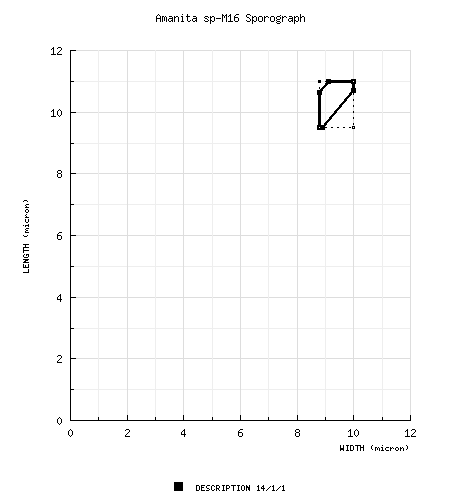
 Spore data sets and their composite