| name |
Amanita rasitabula |
| author |
Tulloss nom. prov. |
| name status |
nomen provisorum |
| english name |
"Blank Slate Ringless Amanita" |
| GenBank nos. |
Due to delays in data processing at GenBank, some accession numbers may lead to unreleased (pending) pages.
These pages will eventually be made live, so try again later.
|
| intro |
This small to moderate-sized entity is the mushroom frequently misidentified as Amanita vaginata var. alba in eastern North America and (at least parts of) Mexico.
Olive text indicates a specimen that has not been
thoroughly examined (for example, for microscopic details) and marks other places in the text
where data is missing or uncertain.
The following material not directly from the protolog of the present taxon and not cited as the work of Dr. Z. L. Yang or another researcher is based upon original research by R. E. Tulloss. |
| pileus |
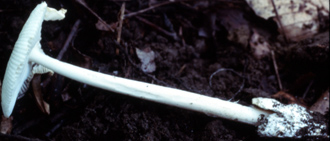
28 - 44 mm wide, pure white to off-white, unchanging when cut or bruised, dull and tacky to shiny and dry, irregularly convex with slight depression over disc, with age shallowly convex with faint umbo; context white, unchanging when cut or bruised, 1.5 - 3 mm thick over stipe, narrowing evenly for 40 - 50% of radius, then membranous to margin; margin striate (0.2R - 0.5R), nonappendiculate; universal veil absent or present as ??. |
| lamellae |
free to narrowly adnate, close to crowded, lacking decurrent line on stipe apex, cream-white in mass, white to very pale cream in side view, unchanging when cut or bruised, broadest (3± mm) at mid-length, with edge minutely flocculose and white; lamellulae truncate, unevenly distributed, of diverse lengths, plentiful. |
| stipe |
72 - 80+ × 4 - 5 mm, white, becoming faintly grayish from handling, subcylindric or narrowing upward, flaring (sometimes only barely) at apex, finely punctate-squamulose in upper 20± mm, minutely fibrillose and longitudinally striatulate below; context white, not changing when cut or bruised, hollow with occasional cross-walls comprising white fibrillose material, with similar material lining central cylinder (1 - 1.5 mm wide); exannulate, also lacking flocculose sheath at stipe apex; universal veil as saccate volva 22± × 7± mm, whitish, not changing color when damaged or after exposure, smooth, membranous to submembranous, sometimes tearing, attached at or above bottom of stipe; limbus internus unusually tall, thin, with fibrillose rather than fleshy structure. |
| odor/taste |
Odor lacking. Taste not recorded. |
macrochemical
tests |
none recorded. |
| basidiospores |
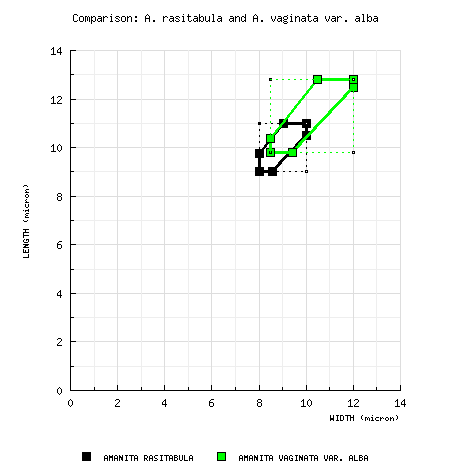
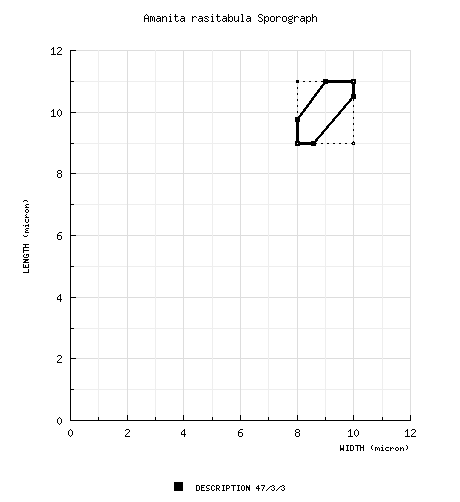
[47/3/3] (8.8-) 9.0 - 11.0 (-13.0) × (7.5-) 8.0 - 10.0 (-10.3) µm, (L = 9.6 - 10.4 µm; L’ = 9.9 µm; W = 8.6 - 9.2 µm; W’ = 8.9 µm; Q = (1.0-) 1.05 - 1.22 (-1.27); Q = 1.10 - 1.12; Q’ = 1.11), hyaline, colorless, smooth, thin-walled, inamyloid, subglobose to broadly ellipsoid, infrequently globose, sometimes expanded at one end, usually at least somewhat adaxially flattened; apiculus sublateral, cylindric to truncate-conic; contents mono- to multiguttulate to granular, dominantly monoguttulate; white in deposit. |
| ecology |
Usually solitary, infrequently in pairs. Isl. of Newfoundland: ?. Tlaxcala: At 2600± m elev. In ?? forest. New Jersey: In Northern Hardwood forest dominated by Quercus or in sandy loam of lawn 4 or 5 days since most recent rain (following a record drought) with Quercus palustris Muenchh. and Pinus sylvestris L. Pennsylvania: At ca. 235 m elev. In dark, moist loam. Vermont: At ca. 460 m elev. |
| material examined |
MÉXICO: TLAXCALA—Mpio. Panotla - 1 km E of S. Francisco Temezontla [19°20’41” N/ 98°16’31” W, 2640 m], 29.viii.1994 A. Montoya Esquivel s.n. [Tulloss 8-29-94-F] (RET 134-7; TLXM).
U.S.A.: CONNECTICUT—Middlesex Co. - Devil’s Hopyard St. Pk.[41°28'32" N/ 72°20'25" W, 72 m], 25.ix.1999 Karen Davis s.n. [Tulloss 9-25-99-K] (RET 301-8), 2.viii.2008 Pat Burchell s.n. [Tulloss 8-2-08-A] (RET 446-4).
NEW JERSEY—Hunterdon Co. - Lebanon, Oakmoss Mycol. Preserve [40°38'50.07" N/ 74°47'50.92" W], 3.viii.2007 R. B. Balsley s.n. (RET 411-6; in herb. Balsley). Mercer Co. - Hopewell Twp., off Carter Rd., woods behind AT&T/Lucent research labs [40°21’39” N/ 74°43’29” W, 63 m], 14.viii.1981 R. E. Tulloss 8-14-81-B (RET 322-10). Monmouth Co. - Roosevelt, lawn of public school, 22.ix.1999 R. E. Tulloss 9-22-99-B (RET 295-8). Warren Co. - ca. Blairstown, Yard Crk. Scout Res., 10.vii.1981 M. H. & R. E. Tulloss 7-10-81-A (RET ??).
NEW YORK—Oneida Co. - unkn. loc., 18.ix.2010 Eric Smith s.n. [www.mushroomobserver.org #53151] (RET 483-1).
PENNSYLVANIA—Pike Co. - Dingman's Ferry, Pocono Environmental Education Ctr. [41°10'17" N/ 74°54'52" W, 235 m], 21.vi.1981 M. A. King & R. E. Tulloss 6-21-81-A (RET 168-7), 24.vi.1989 NJMA foray participant s.n. [Tulloss 6-24-89-C] (RET ??).
VERMONT—Bennington Co. - ca. Bennington, 29.viii.1981 Davis s.n. [Tulloss 8-29-81-G] (RET ??). Windsor Co. - Plymouth, Camp Timberlake, 263 Farm & Wilderness Rd., off St. Rte. 100 [43°34'15" N/ 72°45'21" W, 458 m], 15.viii.1981 M. A. King , M. H. & D. C. Tulloss s.n. [Tulloss 8-15-81-A] (RET 322-9).
|
| discussion |
(t.b.d.)
For purposes of comparison, spore data from European material of A. vaginata var. alba are presented here:
[100/4/4] (8.6-) 9.8 - 12.8 (-17.0) × (7.0-) 8.5 - 12.0 (-13.5) µm, (L = 10.8 - 11.9 µm; L’ = 11.4 µm; W = 9.5 - 11.0 µm; W’ = 10.3 µm; Q = (1.02-) 1.04 - 1.22 (-1.82); Q = 1.08 - 1.14; Q’ = 1.11).
A sporograpgh comparison of the spores of the two species is provided in the following figure:
|
| citations |
—R. E. Tulloss |
| editors |
RET |
|




 Spore data sets and their composite