| name |
Amanita sp-Kerala01 |
| author |
K. B. Vrinda & Tulloss |
| name status |
cryptonomen temporarium |
| GenBank nos. |
Due to delays in data processing at GenBank, some accession numbers may lead to unreleased (pending) pages.
These pages will eventually be made live, so try again later.
|
| intro |
Olive text indicates a specimen that has not been
thoroughly examined (for example, for microscopic details) and marks other places in the text
where data is missing or uncertain.
The following material is based on Vrinda et al.
(2005a) and
on original research by the authors of this page. |
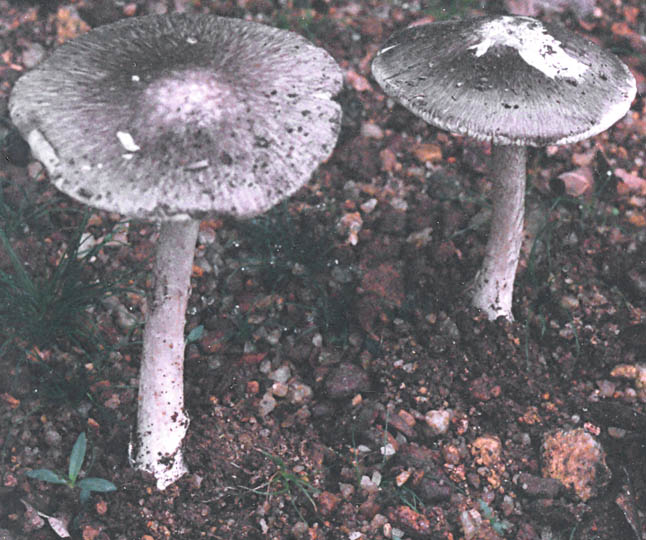
| pileus |
Vrinda et al. (2005a):
35 - 65 mm wide, gray (4B-C1) to
grayish beige (4C2) or greyish brown to yellowish
brown (5E3-4), appearing streaked as though with
innate radial fibers (although closer examination
shows more irregularity in color distribution),
sometimes almost white after rain, in dry weather
with pileipellis often splitting here and there and
exposing white context, convex to planar to depressed
in age, with slight umbo, viscid to subviscid when
young, becoming dry and shiny when old;
context white, up to 4 mm thick above stipe,
not bruising or staining on exposure;
margin nonappendiculate, nonstriate,
regular and decurved in younger specimens,
irregular and undulating in older specimens,
becoming rimose, sometimes flaring upward in older
specimens; universal veil often absent,
occasionally as single large white patch and soon
disappearing. |
| lamellae |
Vrinda et al. (2005a): free, crowded, white during all stages of development or becoming very pale yellow with age, unchanging when bruised, up to 5 mm broad, ventricose; lamellulae subattenuate or attenuate or attenuate with an extended narrow "tooth" projecting along underside of cap context, moderately common??, of at least four distinct lengths.
[Self-reminder to the authors: Need to recharacterize form and quantity of lmaellulae in fresh material.] |
| stipe |
Vrinda et al. (2005a): 50 - 90 × 4 - 7 mm, white, with hair brown (5E4) surface fibrils below partial veil, narrowing upward slightly; bulb ovoid; context white, fibrous, unchanging; partial veil white, membranous, flaring and skirt-like, superior, persistent, striate on upper surface, smooth below, eventually collapsing on stipe; universal veil as membranous limbate volva, white, usually 3-lobed, up to 30 mm from bulb base to highest point on limb.
[Self-reminder to the authors: It is desirable to separate the bulb length from the stem length and provide separate measurement for each of the parts.] |
| odor/taste |
Vrinda et al. (2005a): Odor not distinctive. Taste not recorded. |
macrochemical
tests |
Vrinda et al. (2005a): H2SO4 on fresh lamellae: purplish tint developing within seconds. KOH - negative on context and surfaces of basidiome. HCL - negative on context and surfaces of basidiome. HNO3 - negative on context and surfaces of basidiome.
[Self-reminder to the authors: What were the concentrations of the acids used?] |
| basidiospores |
Vrinda et al.
(2005a):
[180/9/6] (5.5-) 8.8 - 10.5 (-11.2) ×
(5-) 6.5 - 7.5 (-8.8) μm, (L' = 8.9 μm;
W' = 6.5 μm; Q' = 1.37),
hyaline, thin-walled, smooth, weakly amyloid to
amyloid; white in deposit. [Note: A sporograph
cannot be generated for this data.—ed.]
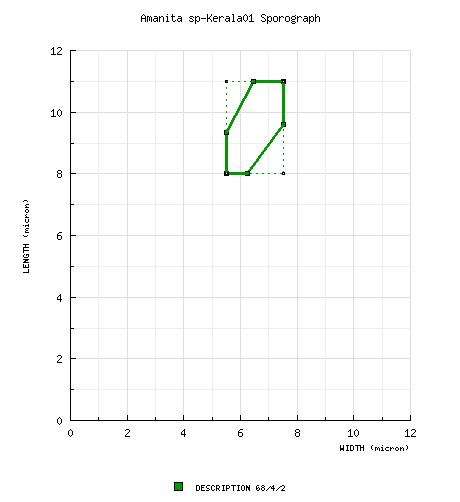
RET/CRC: [68/4/2] (7.4-) 8.0 - 11.0 (-11.5) × (5.0-)
5.5 - 7.5 (-8.8) μm, (L = 8.8 - 9.7 μm;
L' = 9.3 μm; W = 5.9 - 6.4 μm;
W' = 6.3 μm; Q = (1.18-) 1.28 - 1.70 (-1.73);
Q = 1.47 - 1.51; Q' = 1.48),
hyaline, colorless, thin-walled, smooth, weakly
amyloid to amyloid, broadly ellipsoid to ellipsoid,
infrequently elongate, sometimes swollen at one end,
infrequently constricted, Usually adaxially
flattened; apiculus sublateral, cylindric;
contents granular to guttulate (with or
without additional small granules); white in
deposit. |
| ecology |
Vrinda et al. (2005a): In troops. At ?? m elev. In leaf litter in plantation of Acacia (alien, imported from Australia). |
| material examined |
Vrinda et al. (2005a): INDIA:
KERALA—Perayam - Thiruvananthapuram,
19.iv.2004 K. B. Vrinda S7086 (TBGT),
20.iv.2004 K. B. Vrinda S7087 (TBGT),
21.iv.2004 K. B. Vrinda S7093 (TBGT),
22.iv.2004 K. B. Vrinda S7097 (TBGT),
28.iv.2004 K. B. Vrinda s.n. (TBGT),
29.iv.2004 K. B. Vrinda s7107 (TBGT).
RET: INDIA:
KERALA—Perayam - Thiruvananthapuram,
21.ix.2004 K. B. Vrinda S7093 (TBGT; RET 391-7),
2006 K. B. Vrinda S9651 (TBGT; RET 391-9). |
| discussion |
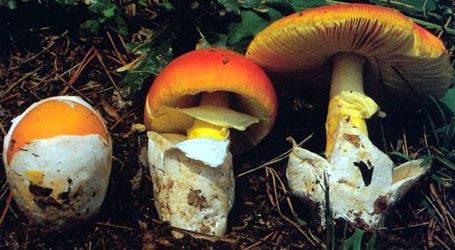
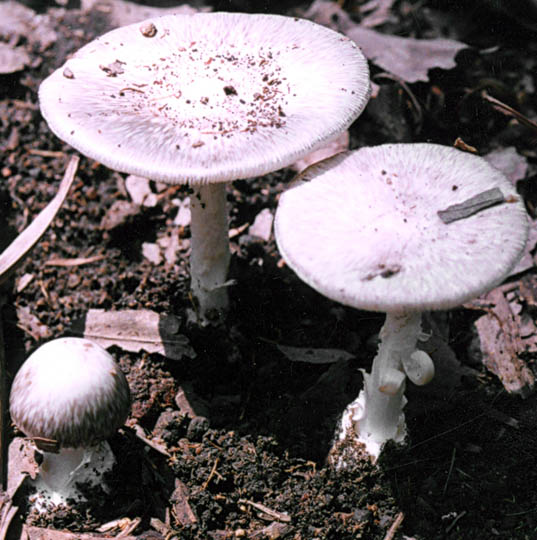
Morphologically, this species is distinct from all
known taxa in sect. Phalloideae.
The pattern of pigmentation on the cap is strongly
reminiscent of amatoxin-containing species with
apparently virgate pilei (e.g., A. phalloides, A.
marmorata, and A. subjunquillea).
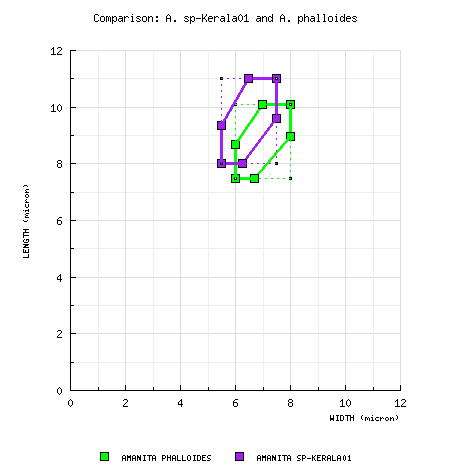
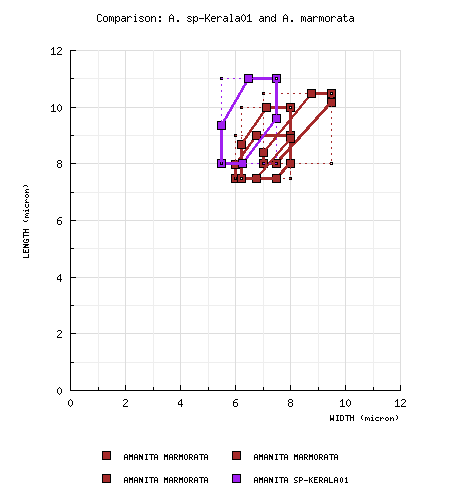
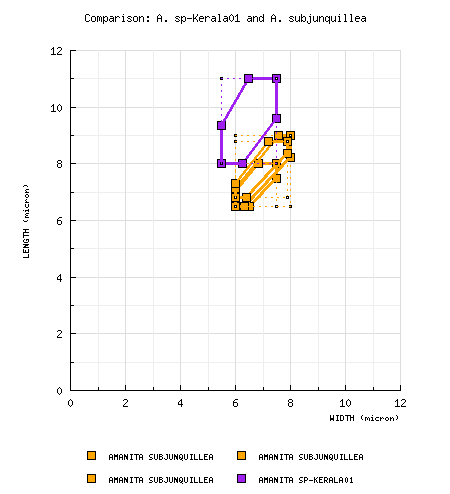
In the following figures sporographs for the
A. phalloides, A. marmorata, and
A. subjunquillea are
compared with the sporograph of the present
species:
MegaBLAST runs of partial and complete nrITS
sequences from Vrinda S7093 and 9651 produced
sequences from three collections of A.
marmorata (two from introduced genets in South
Africa and one from an introduced genet in
Hawaii, U.S.A.) as closest matches, with E value of
0.0 and match percentage of 99%. |
| citations |
—K. B. Vrinda, R. E. Tulloss, and C. Rodríguez Caycedo |
| editors |
RET |
|




 Spore data sets and their composite