

| name | Amanita sp-F16 |
| name status | cryptonomen temporarium |
| author | Tulloss |
| intro |
The specimen of W. A. Murrill to which the current code is applied was originally identified by its collector as the taxon now called A. murrilliana, which proved to be an error discovered during RET's study of original material of that latter taxon. This specimen is the only one known to RET that may possibly belong to the apparently rare and poorly known species Amanita cokeriana Singer. However, rather than claim this specimen is a true representative of A. cokeriana, it is treated here until more information becomes available. |
| cap | Based on the fact that Murrill placed the collection treated here in the taxon now named A. murrilliana and also based on the shading of the cap colors in the dried material, the cap was probably pallid at the margin and darker in the center—probably shades of cream, tan, and/or brown. The flesh of the cap was not described. The cap's margin was striate and nonappendiculate. No remnants of the volva were present on the cap. |
| gills | There is no available information about the gills of this mushroom. |
| stem | Very little information is available about the stem of this species. It was probably pallid and narrowing upward, and a ring was usually present, although sometimes fragmentary. The sack-like volva was probably white or whitish on the outer surface and was elongate; it was connected to the stem on the sides as well as at the stem's base. There was a small internal limb of the volva placed at the point of the volva's attachment to the stem. |
| odor/taste | There is no inforamation available on the odor or taste of this mushroom. |
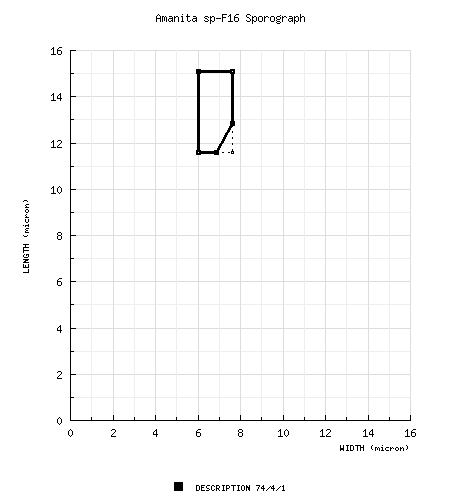
| spores | The spores measure (11.2-) 11.6 - 15.1 (-19.0) × (5.5-) 6.0 - 7.6 (-8.5) µm and are elongate to cyllindric (rarely bacilliform) and inamyloid. Clamps are common at bases of basidia. |
| discussion | The single collection represented by this taxon page is the only one that I have seen that might represent the apparently rare and poorly known A. cokeriana (see discussion of A. recutita sensu Coker.—R. E. Tulloss |
| brief editors | RET |
Information to support the viewer in reading the content of "technical" tabs can be found here.
 Spore data sets and their composite
Each spore data set is intended to comprise a set of measurements from a single specimen made by a single observer; and explanations prepared for this site talk about specimen-observer pairs associated with each data set. Combining more data into a single data set is non-optimal because it obscures observer differences (which may be valuable for instructional purposes, for example) and may obscure instances in which a single collection inadvertently contains a mixture of taxa.

Text and User-Generated Sporographs are published under the Creative Commons License.

In the case of a taxon page, image credits are on the 'image' tab.